
Fire Fighting Robot Using Arduino – Full Explanation
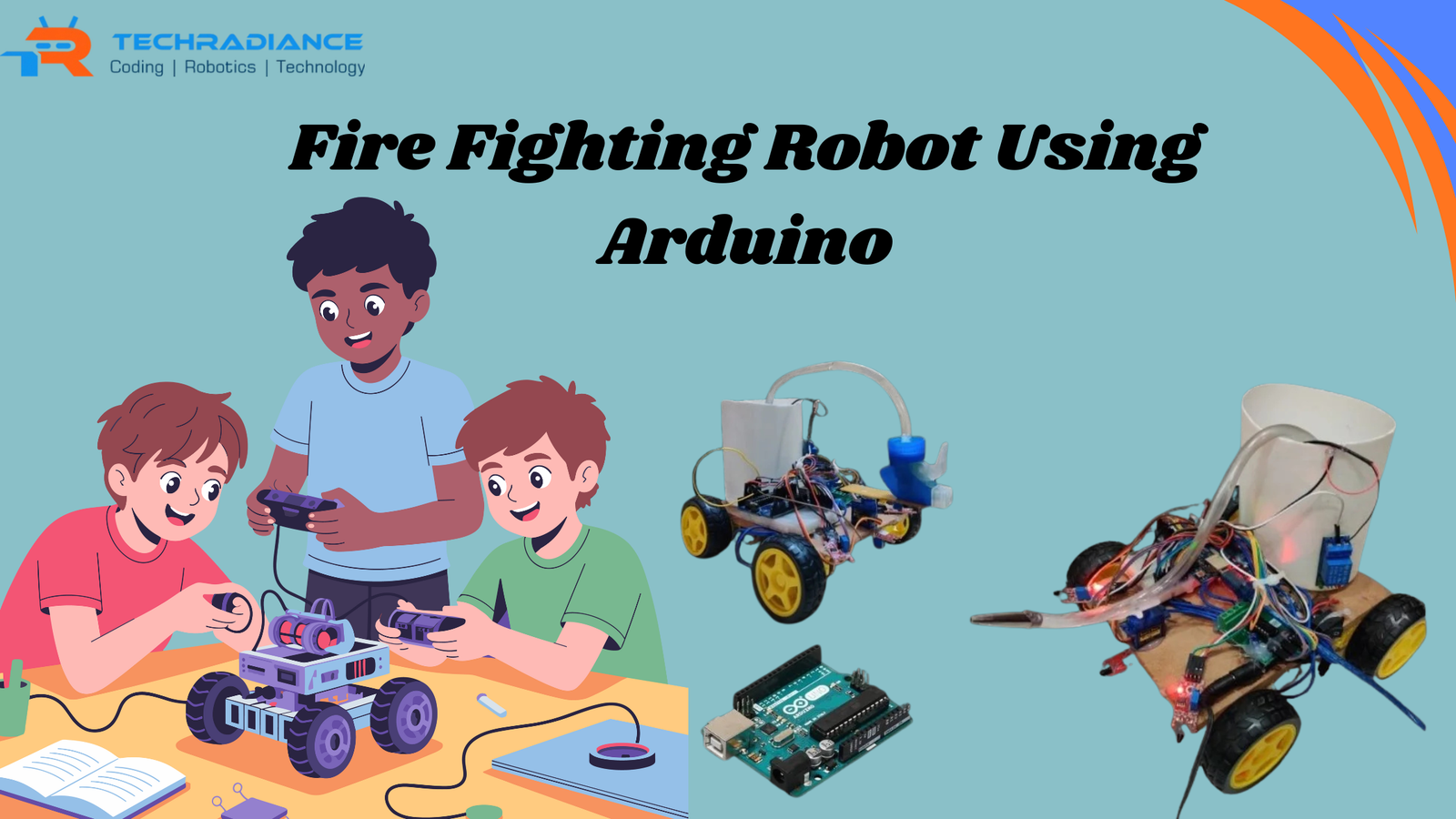
A Fire Fighting Robot Using Arduino is a device that detects the fire and extinguishes it completely. It is used with sensors that detect flames or heat and motors to move, as well as a tiny extinguisher that can put out the flame. The robot is useful in areas where humans aren’t in danger. Utilising a few components, such as Arduino sensors, wheels, and a pump, anyone can make this fire extinguisher robot either at home or for a school project. In this full guide by Techradiance, you will discover the basics of it and how it operates, the most important parts that make it work, the advantages, and the reason it’s one of the most effective robotics projects that students can do.
Author: Rahul, a Robotics Expert
Introduction
Fire incidents can occur anytime and at any time. Sometimes, the flame is so intense that human beings can’t even touch it. To address this issue, engineers and students create the Fire fighting Robot Using Arduino. The robot is able to be autonomous to detect fire and put it out safely.
This blog, Techradiance, can explain the issue in a straightforward and easy way. No matter if you’re a beginner or a student, or an enthusiast of robotics, you’ll be able to grasp everything quickly.
What is a Fire Fighting Robot Using Arduino?
A Fire fighting robot using Arduino is a tiny robot that detects fire and then puts it out without touching it. It operates automatically since Arduino functions as its robot’s “brain”.
The robot makes use of:
- Flame sensors to detect fire
- Motors to move
- A CO₂ or water pump to put out fires
- Control systems to make decisions
The concept is also known as a Fire Fighter Robot using Arduino as well as a fire extinguisher robot, since the robot’s primary task is to safeguard individuals from the dangers of fire.
Why Do We Need a Fire Fighting Robot?
Fire can be risky. Humans can be injured while trying to contain the flame.
Robots, however, are not so dangerous.
- Never get tired
- Do not be afraid
- Could be able to access areas of danger
- Be quick and safe
That’s why colleges, schools and businesses create Fire fighting robot projects to enhance security and create smart solutions to tackle real-world problems.
How Does a Fire Fighting Robot Work?
Understanding the process is easy.
Below is the way that an Arduino Fire Fighting Robot is operated step-by-step:
1. The sensors detect fire.
Sensors for flames or IR sensors constantly look around the space.
When they detect the presence of flame or IR, they transmit an alert to the Arduino. Arduino.
2. Arduino decides
Arduino interprets the sensor’s signal and concludes:
“There is an ignition. Move towards it!”
3. Motors propel the robot forward
The robot drives straight towards the flame using its wheels.
4. The pump or fan put the fire out
Based upon the type of model
- Water pumps spray water or
- A fan blows air with force to extinguish the flame.
5. The fire ceases automatically
If the flame is out, sensors stop transmitting messages.
The robot returns to calm and is waiting for the next one to start.
This entire process makes it an automatic fire extinguisher because it can do everything by itself.
Key Components Used in the Fire Fighting Robot
Let’s take a look at the most important components in simple terms.
1. Arduino Board
It represents the robotic cerebral cortex.
It decides what to do and when.
2. Sensors for Flame Sensors
They function as the eyes of the robot.
They help the robot detect fire.
3. Motor Driver
The wheel control is controlled by this part and controls the robot’s movement forward, left, right or forward or backward.
4. DC Motors + Wheels
They help the robot move around.
5. Pump or Fan or Pump
This process actually put out the flame.
The water pump sprays them with water
The fan blasts out the flame
6. Battery
It powers the robot.
7. Pipes / Mini Tank
Storage and delivery of water.
Features of the Fire Fighting Robot
These essential elements help make the building of a Fire Fighting Robot Project simple, yet powerful.
- Automatic fire detection
- A robot that self-moves
- Instantly extinguish fire
- is safe for high-risk locations
- Cost-effective and for beginners
- Customizable design
This is the reason it’s the most popular Fire Fighting Robot initiative in colleges, schools, and technical workshops such as Techradiance.
Benefits of a Fire Fighting Robot
1. Saves Lives
The most important benefit is security. The robot puts out fires in hazardous areas without putting people at risk.
2. Very useful for industrial Safety
Chemical plants, factories, and other facilities use these robots to ensure fire safety.
3. Great Learning Project for Students
Students learn about robotics, electronics, and coding with Arduino.
4. It works automatically
There is no need for anyone else to manage it.
5. Cost-Effective
Much less expensive than large fire alarms.
6. Fast Fire Response
The robot will respond in minutes when it senses fire.
These advantages help make this fire extinguisher robotic very practical and informative.
How to Build a Fire Fighting Robot Using Arduino?
Here’s a very simple guide that anyone can follow:
Step 1: Gather all components
Arduino motors, sensors, and pumps, battery, and chassis.
Step 2. Assemble the chassis
Attach the motors and wheels to the base plate.
Step 3: Join the sensor
Install flame sensors in the front.
Step 4: Make sure you connect the motor driver
Connect the motors to the motor driver, and the motor driver connects to the Arduino.
Step 5: Add the fan or pump
Connect it to the motor, then connect it to the Arduino via a relay.
Step 6: Upload your Step
Write simple code using the Arduino IDE to detect fire and control the pump.
Step 7: Check the robot
Put a candle in a safe location.
Turn on the robot and watch it sense and then extinguish the flame!
This is the simplest method to build your very personal Arduino Fire Fighting Robot .
Applications of a Fire Extinguisher Robot
- College science projects and schools
- Industrial fire safety
- Warehouses and storage spaces
- Laboratories and hospitals
- Automatic home safety zones
- Competitions in robotics
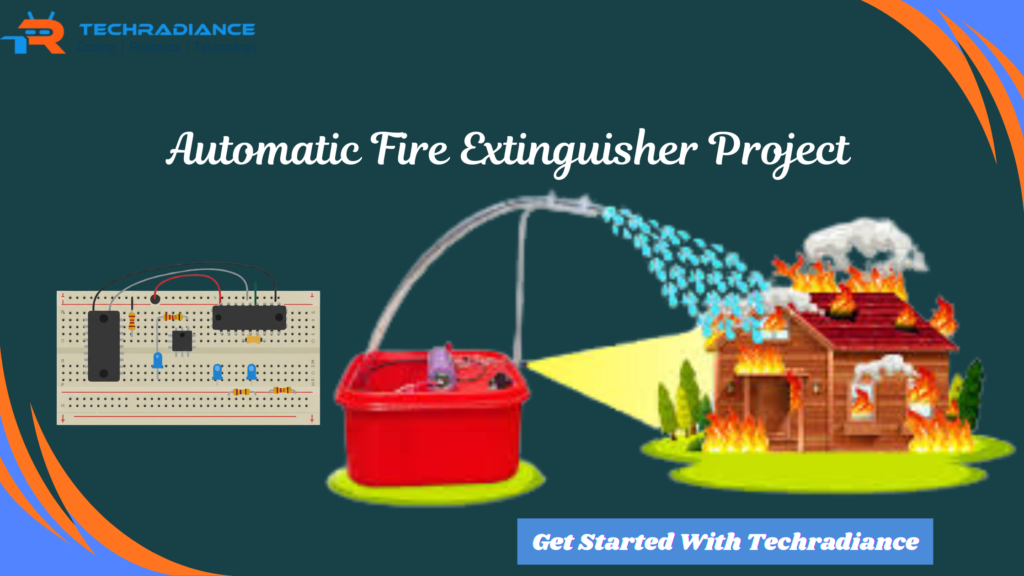
A lot of students also exhibit projects such as the Automatic Fire Extinguisher Project in exhibits.
Challenges in a Fire Fighting Robot Project
- Sensors could detect the presence of fire in sunlight
- The water pump might not be able to reach the flames
- Robot movements could be slow
- The battery’s power could be depleted quickly.
This can be enhanced with stronger motors, better sensors, and power sources that are stable.
Future Scope of Fire Fighting Robots
Robotics is expected to become more sophisticated. Future robots could have:
- Thermal cameras
- AI-based fire detection
- Drones flying to fight fire
- Voice alerts
- GPS navigation
This makes the fire fighting robot project an exciting new technology to look forward to in the near future.
⭐ Testimonials – What Students Say About Techradiance
1. Riya Sharma – Class 10 Student
“Learning to create a firefighting robot with Arduino during Techradiance was an amazing experience! The instructor explained everything in an extremely simple language. Even though I was just beginning, I was able to understand every step, and even build the robot of my choice.”
2. Arjun Mehta – Engineering Student
“I took part in the robotics workshops by Techradiance and constructed my very first fire extinguisher machine. The instructors were extremely accommodating and helped me overcome my doubts. This course helped boost my confidence and helped me improve my skills in the practical.”
3. Sneha Verma – School Robotics Club Member
“Techradiance made robotics a breeze for me. The firefighting robot build was enjoyable, safe, and extremely interesting. I didn’t think I could construct an entire robot on my own; however, their help made it feasible.”
4. Rahul Singh is the parent of a student
“My son went to a Techradiance workshop and absolutely loved it! He designed and built a firefighter robot with Arduino. The instructors were pleasant, accommodating, and focused on practical learning. Highly recommended for any student. “
Final Thoughts:
A Fire Fighting Robot Using Arduino is among the most secure and reliable robotics-related projects for students. It teaches students how the technology of today can be used to save lives. Utilising simple components like motors, flame sensors, and pumps, one could make a robot that can detect and then extinguish fire on its own.
Companies such as Techradiance allow young minds to explore robotics in a fun and engaging manner. No matter what you call it, a firefighter robot using Arduino or a fire extinguisher robot, or an automated fire extinguisher, the goal is the same: to protect individuals from the dangers of fire.
This project is useful, educational, and full of knowledge
Frequently Asked Questions
1. What is the purpose of the fire fighting robot?
The goal of a fire combat robot is to identify fire in a way that it can extinguish completely without putting people in danger.
2. How to make an automatic fire robot?
To build an automated fire robot, you’ll need Arduino motors, flame sensors, an electric motor driver, a battery, and a fan or pump. After you have assembled the components and uploaded the code, it will allow the robot to detect fire and extinguish it on its own.
3. How does a fire fighting robot work?
Fire-fighting robot operates by using sensors for flames to detect the presence of fire. When the sensors detect a burning flame, Arduino can move the machine towards the flame and switch on the fan or pump to put out the flame.
4. What components are used in a fire extinguisher robot?
The primary components are Arduino as well as the motor driver, flame sensors, the DC motor, wheels, batteries, and a water pump or fan to extinguish the flame.
5. What is an automatic fire extinguisher project?
An automatic fire extinguisher is a setup that detects fire by itself and then extinguishes it, with no human intervention, by making use of sensors, pumps or fans.