
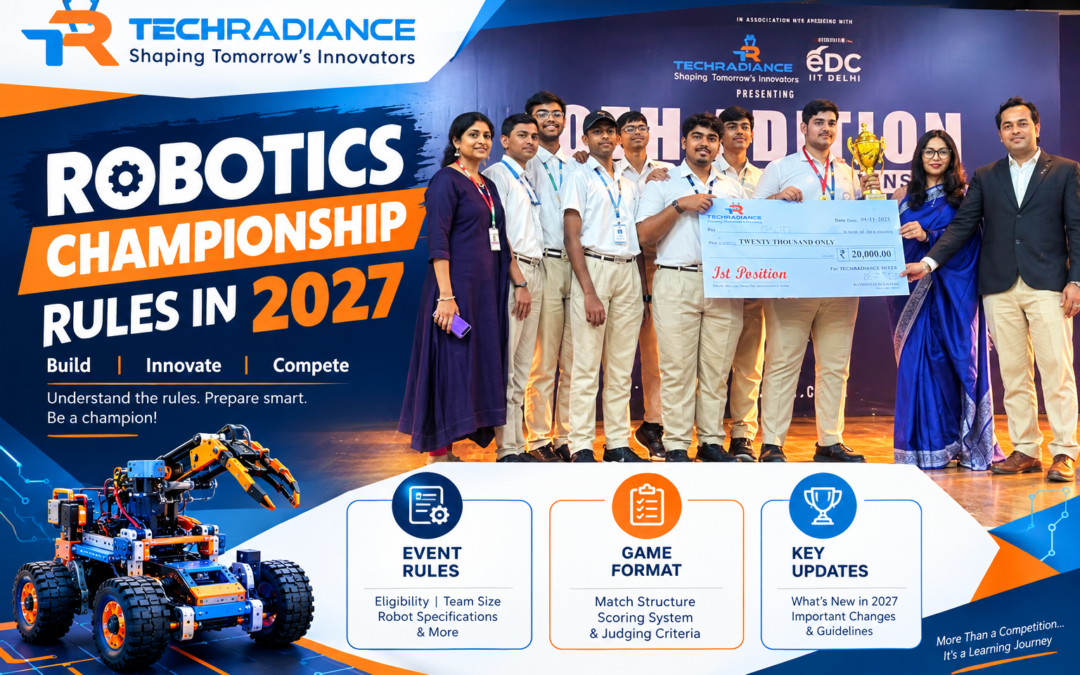
In a Robotics Championship, students compete by using robots to complete various tasks. To keep up with the event’s regulations, students might have to construct, program, operate, or enhance a robot.
Because they ensure that the competition is safe and fair for all teams, the rules are crucial. Each Robotics Championship may have various rules; thus, before competing, students should always study the official rulebook.
Knowing the rules ahead of time will help kids prepare for a school robotics competition and make it easier and more fun.
Author: Himanshu ( Content Writer)
What Are the Basic Rules of a Robotics Championship?
The fundamental rules often outline who is eligible to compete, how teams are formed, what kind of robot can be used, what components are permitted, how the challenge is played, how points are awarded, and what behaviors can result in a penalty or disqualification.
Consider the rules as the competition’s instruction manual.
Before the competition, pupils ought to be aware of:
- Size of the team
- Requirements for age or class
- Robot weight and size
- Permitted parts
- Rules for batteries and power
- Time of competition
- System of scoring
- Safety guidelines
- Penalties
- Procedure for robot inspection
The rules of each competition may vary. Therefore, students shouldn’t assume that a rule from one Robotics Championship would apply to another.
Who Can Participate in a Robotics Championship?
The competition determines the regulations for participation.
While some Robotics Championships are intended for professional teams or college students, others are intended for schoolchildren. Students are also divided into age groups in other competitions.
Students may be divided into groups like these for school-level competitions:
- Students in elementary or primary school
- Junior pupils
- Senior pupils
- Various age or school groupings
For precise eligibility conditions, students should refer to the official competition information.
Selecting the appropriate category prior to registration is crucial.
How Many Students Can Be on a Robotics Competition Team?
The competition and category determine the size of the team.
Small teams of two or three students are permitted in some tournaments. Larger teams might be permitted in other tournaments.
Various tasks should be assigned to various members of each team. For instance:
- Programming can be done by one student.
- The robot design can be completed by one student.
- The robot may be tested by one student.
- Research and presentation assistance can be provided by another student.
Effective teamwork is crucial. A robot might be useful, but in order to properly complete a task, a team must also communicate and plan.
Participants should carefully review the regulations for the specific competition they are participating, since TechRadiance competition guidelines, for instance, may stipulate a team size and other event-specific conditions.
What Are the Rules for Building a Competition Robot?
One of the most crucial aspects of a Robotics Championship is this.
Typically, students must construct or prepare a robot in accordance with the competition’s technical specifications.
The guidelines could clarify:
- Which controllers are suitable for use?
- Which motors are permitted?
- Which sensors are suitable for use?
- Is wireless communication permitted?
- Is it permitted to use pre-made robots?
- Can kids construct their own robot components?
- Does the robot have to operate independently?
- Is it possible to manually control the robot?
Some competitions, for instance, call for an autonomous robot. This means that without a student supervising every move, the robot must make choices and finish the work.
Remote-controlled robots might be permitted in other competitions.
Therefore, before constructing your robot, carefully review the category regulations.
What Are the Robot Size and Weight Limits?
The size and weight of a robot are restricted in many Robotics Championships.
For instance, a competition can specify that a robot must be heavier, taller, wider, or longer than a certain amount.
Why is this important?
Consider a tiny arena for competition. It would not be fair to other teams if one team brought a huge robot.
For this reason, organizers could verify:
Weight + Height + Width + Length
before the start of the competition.
Before attending the event, students should measure their robot.
Check the robot’s size before the tournament day.
What Parts and Components Are Allowed in a Robotics Competition?
Different components are permitted in different competitions.
A robot could employ components like:
- Arduino Motors
- Drivers
- Infrared sensors
- Ultrasonic sensors
- Wheels and Batteries
- Servo motors
- LEDs
- Buzzers
- Additional mechanical and electrical components
But not every competition permits every element.
Wireless connectivity, specific sensors, power levels, pre-built robots, and other components may be restricted in some events.
For Eg: Students should understand the regulations for their specific competition rather than adhering to a general robotics guideline, as demonstrated by TechRadiance’s Line Follower competition, which defines specific robot dimensions and permitted components.
Are Students Allowed to Modify Their Robot During the Competition?
The event will determine this.
Certain tournaments allow students to prepare or take tests. Before their official try, students could be able to inspect their robot and make minor adjustments.
Robot modifications may be subject to stringent regulations in other competitions.
Students ought to inquire:
After the examination, may I switch out my robot?
Is it possible for me to switch programs?
Is it possible to fix my robot in between rounds?
Can I swap out a broken part?
It is possible to avoid issues during the tournament by being aware of these guidelines.
Testing the robot numerous times before to the event is a good idea. When permitted by the competition rules, students should also bring the required tools, cables, chargers, and spare parts.
How Does a Robotics Championship Competition Work?
The procedure for a Robotics Championship is typically straightforward.
Step 1: Sign up
The team signs up for the appropriate competition category.
Step 2: Getting the Team Ready
Students prepare their robot after learning about the task.
Step 3: Inspection of Robots
The robot’s dimensions, weight, parts, and safety can all be examined by organizers.
Step 4: Get Ready or Practice
Certain competitions offer time for preparation or practice.
Step 5: Round of Competition
The task is carried out by the robot.
Step 6: Evaluation
The team’s score is determined by judges or referees using the regulations.
Step 7: The Following Round
Teams that achieve the necessary score or outcome may advance to the next round, depending on the tournament.
Step 8: Outcome
The official scoring system is used to determine the final ranking.
Every Robotics Championship may have a unique format.
How Are Robots Judged and Scored in a Robotics Championship?
Robots can be evaluated in a variety of ways.
Points could be awarded in a competition for:
- Finishing chores
- Getting to checkpoints
- Speed and Accuracy
- Deliveries that work
- Inventiveness
- Presentation of robot design and programming
- Observing the guidelines
In certain competitions, speed is the primary concern. Some concentrate on accurately completing missions. Innovation contests may also consider how beneficial the student’s concept is.
Because of this, before the competition starts, students should be aware of how points are awarded.
Students can choose what to practice by being aware of the scoring system.
What Penalties Can Students Get in a Robotics Competition?
When a team violates a competition rule, they are punished with a penalty.
Penalties could consist of:
- Points lost
- Increasing time
- Losing a try
- Restarting an activity
- Pausing a run
- Disqualification
In many competitions, ForExample , students are prohibited from touching their robot while it is performing a job. There could be a penalty or disqualification for touching the robot when it is prohibited.
Students should never attempt to disobey the rules in order to find shortcuts.
Making the robot function is not the main objective. The objective is to finish the task in a safe and equitable manner.
What Safety Rules Must Students Follow in a Robotics Championship?
Safety must always come first.
Batteries, wiring, motors, tools, and moving robot parts should all be handled carefully by students.
Typical safety guidelines could be:
- Avoid using hazardous materials.
- Make sure all cables are connected correctly.
- Prior to the tournament, check the batteries.
- Avoid causing harm to the competition arena.
- Keep your hands away from moving parts.
- Observe the judges’ and organizers’ instructions.
- Avoid using the robot outside of the designated region.
A component that is prohibited by the competition rules should never be used.
Before the competition, organizers might examine the robots to ensure their safety.
What Happens If a Robot Fails During the Competition?
Sometimes robots don’t work.
It is possible for a sensor to malfunction. It’s possible for a wire to break loose. A motor could not be able to move. There might be a problem with the program.
Don’t freak out.
What follows will be explained per the specific competition’s regulations.
A team might be permitted to fix the robot, restart from a particular spot, or proceed with the remaining attempt, depending on the circumstances. There may only be one official attempt in some competitions.
Testing is crucial because of this.
A clever robotics team asks more than just:
“Is our robot functional?”
It also queries:
“If something goes wrong, what will we do?”
How Can Students Prepare for a Robotics Championship?
Students can do the following easy steps:
- Go over the competition regulations in their entirety.
- Recognize the difficulty.
- Construct the robot in accordance with the guidelines.
- Test the robot several times.
- Rehearse the competition task.
- Verify the robot’s weight and dimensions.
- Check the wiring and batteries.
- Develop your programming and debugging skills.
- Acquire knowledge about the scoring system.
- Collaborate as a group.
Students might grow more at ease throughout the competition the more they practice.
Why Should Students Participate in a Robotics Championship?
There is more to a Robotics Championship than just winning.
Pupils get the opportunity to learn by doing.
They are able to learn:
- Electronics, robotics
- Coding
- Problem-solving
- Collaboration and Creativity
- Thinking logically
- Communication and time management
A robot may occasionally make mistakes during practice. That’s alright.
Students can identify the issue, modify the design, retest it, and gain new knowledge.
That is among the most useful aspects of robots.
Techradiance Jr. World Cup 2026
Through robotics and Innovation Challenges, young children can learn, develop, test, and compete in the Techradiance Jr. World Cup 2026.
Students get the opportunity to learn by doing.
They are able to learn:
Electronics, robotics, Coding
School Zonal Round → IIT Nationals → International Final (Dubai/Malaysia)
Students can learn cooperation, creativity, coding, and problem-solving while participating in robotics competitions in phases.
Students should carefully study the criteria for the category they have chosen before participating in any challenge. Each event may have different robot specs, team criteria, scoring systems, and competitive procedures.
What Should Students Check Before a Robotics Championship?
Before the competition day, make use of this easy checklist:
Students get the opportunity to learn by doing.
They are able to learn:
Electronics, robotics, Coding
☐ Can I fit into this category?
☐ Is the size of my team correct?
☐ Does my robot fit the required size?
☐ Does my robot weigh enough?
☐ Can I use all of my components?
☐ Is my battery secure?
☐ Does my robot adhere to the competition challenge?
☐ Do I comprehend the method of scoring?
☐ Am I aware of the penalties?
☐ Have I put my robot through a lot of testing?
☐ Do I own the necessary tools and equipment?
You are more ready to compete if you can respond “Yes” to each of these questions.
Student Experience: What Do Students Learn?
“I discovered that robotics is more than just creating robots. I had to collaborate with my teammates and test it numerous times. It improved my understanding of coding.
— [Akshat], [Vikas Bharti School, Delhi], Class [5]
“I was anxious at first since our robot wasn’t operating correctly. We discovered the issue after repeatedly testing it. I learned to keep trying from the competition.
— [Vihan], [Purna Prajana Public School, Mumbai], Class [8]
Before publication, actual comments from TechRadiance participants should take the place of these testimonies. The article can be more reliable and helpful for parents and schools if it is based on actual student experiences.
Final Thoughts:
Students can transform their ideas into functional robots through an enjoyable Robotics Championship.
Building a quick robot is not the most crucial thing. Students should be aware of the guidelines, practice the task, collaborate with one another, and learn from their errors.
Recall:
Build → Code → Test → Enhance → Contest → Acquire
Robotics is fascinating because of this.
Before constructing the robot, children training for the Techradiance Jr. World Cup 2026 can create the robot with more confidence and steer clear of easy blunders on competition day.
Frequently Asked Questions (FAQ’S)
There isn’t just one “World Champion in Robotics.” International robotics contests include RoboCup, World Robot Olympiad (WRO), and FIRST Global, each with its own categories and winners.
One of the most well-known early humanoid social robots in India is Mitra. It was created by Invento Robotics and gained notoriety for utilizing facial recognition and artificial intelligence to communicate with humans.
In 2026, India will host a number of robotics competitions. These include the ISRO Robotics Challenge (IRoC-U) 2026, Techradiance Jr World Cup 2026-27, the World Robot Olympiad India 2026, and various national robotics contests.
The Techradiance Jr. World Cup 2026–2027 will take place at IIT Delhi in the Month of April 2027. Teams create robots and compete against one another for tasks including Soccer Robot, LFR, and Coding Hackathon, etc
RoboCup claims to be the biggest and most famous robotics and AI competition in the world. The event took place in Incheon, South Korea, from June to July, 2027