
Best Robotics Course for Kids Ages 6-10 in 2026
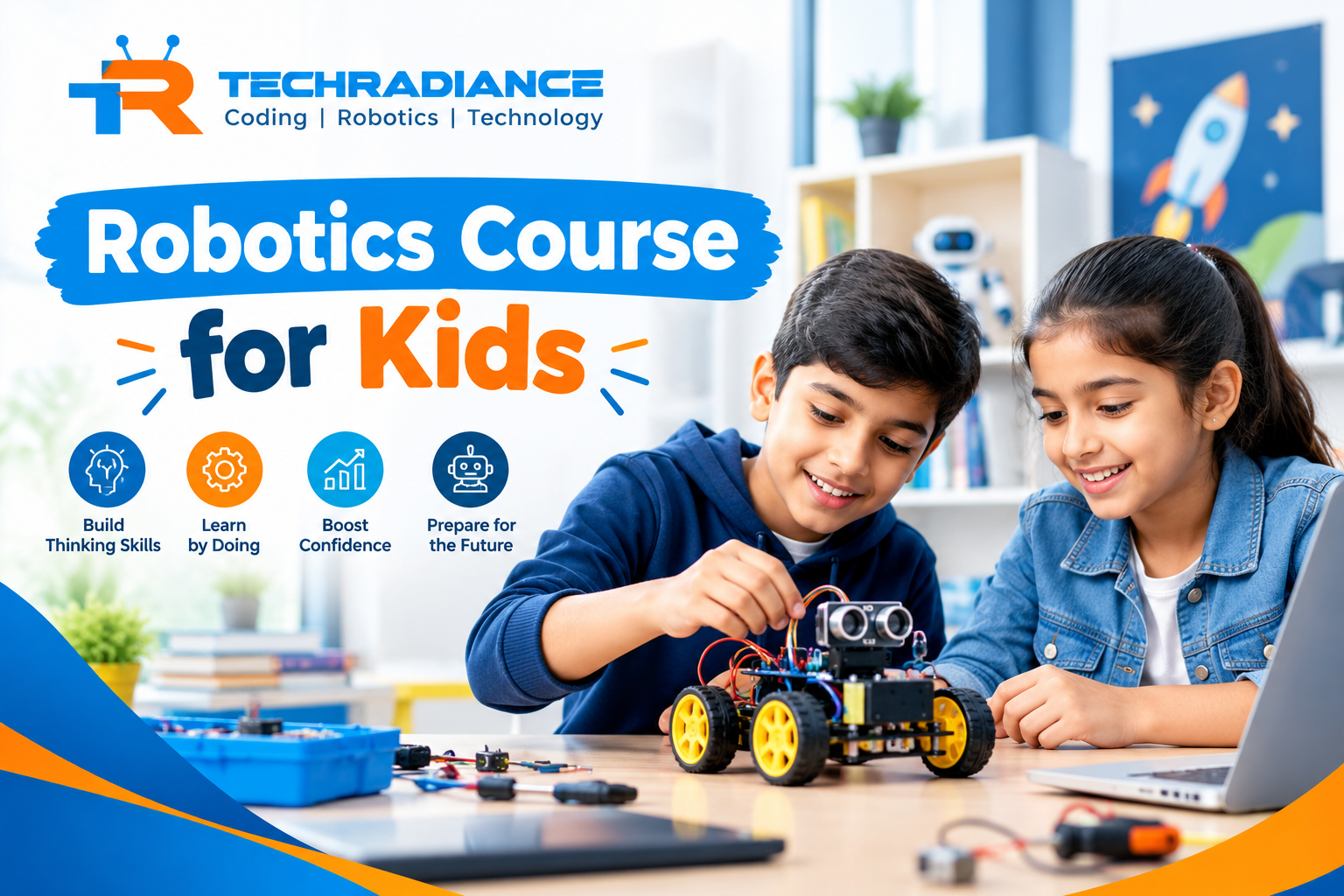
Are you looking for the best Robotics Course for kids? Through practical projects, a quality robotics program teaches kids electronics, coding, engineering, and problem-solving skills. At Techradiance, kids can improve their creativity, logical thinking, and future technological skills while exploring robotics through the construction and programming of real projects.
Author: Himanshu ( Content Writer )
What Is a Robotics Course for Kids?
A Robotics Course for Kids is an educational program that teaches kids how to make basic robotic projects and how robots operate.
Youngsters can learn about several robot components, including:
Motors
LEDs, buzzers, sensors, wheels, controllers, and batteries
Basic electronic parts
Programming and coding
Lessons should be straightforward and activity-based for younger kids.
For example, a teacher can demonstrate to kids how a robot uses a sensor to detect an object rather than just describing what a sensor is. The youngster can then attempt to use the sensor to construct or program a little project.
Because kids can see the outcome of their creations, learning becomes more engaging.
Why Should Kids Learn Robotics at Ages 6-10?
Learning is most exciting between the ages of 6 and 10. Children inevitably ask, “How does this work?” and “Can I make one myself?”
These questions can be transformed into useful learning exercises through robotics.
A quality Robotics Course can assist kids in acquiring several critical abilities:
1. Problem-Solving Skills
Robots don’t always function correctly the first time.
A child may construct a robot that fails to recognize objects or moves in the incorrect direction. The child can examine the issue and try again rather than giving up.
This illustrates a crucial lesson: we may learn from our failures.
2. Reasoning
Children learn to think step-by-step using robotics.
For instance:
Stop the motor if the sensor detects an object.
This straightforward concept aids kids in comprehending how decisions and instructions function in technology.
3. Originality
Youngsters can design their own robotic concepts.
They may construct a robot that avoids obstacles, a smart car, an automated lighting system, or another straightforward project.
Every robotics problem has more than one solution.
4. Overview of Coding
Coding and robotics frequently collaborate.
When they’re ready, kids can progress from basic block-based coding to text-based programming.
Coding becomes less intimidating and more fun as a result.
5. Self-assurance
A child may feel a sense of accomplishment when they construct something that functions.
Children may be inspired to attempt more challenging undertakings by that tiny accomplishment.
What Should a Robotics Course for Kids Ages 6-10 Include?
Not all courses are appropriate for young children.
An excellent program should be appropriate for the child’s age and skill level.
Parents should keep an eye out for these crucial items.
Practical Projects
Youngsters should be given the chance to construct and try new things.
It is insufficient to just watch videos about robots. Concepts can be better understood through practical exercises.
Age-Related Instruction
A ten-year-old does not require the same amount of robotics education as a six-year-old.
Concepts should be explained in the course through straightforward illustrations, exercises, demonstrations, and examples.
Basic Coding
Youngsters should progressively learn how to operate a robot via commands.
Compared to complex code, visual or block-based programming may be simpler for novices.
Motors and Sensors
In many novice robotics projects, sensors and motors are essential components.
- Youngsters can pick up basic ideas like:
- Something can be detected by a sensor.
- Movement can be produced by a motor.
- Instructions can be processed by a controller.
- The robot can be instructed via a program.
Project-Based Learning
Lessons can be made more engaging with projects.
Children can use multiple concepts to construct something instead of learning each topic individually.
Online Robotics Classes for Kids: Are They Useful?
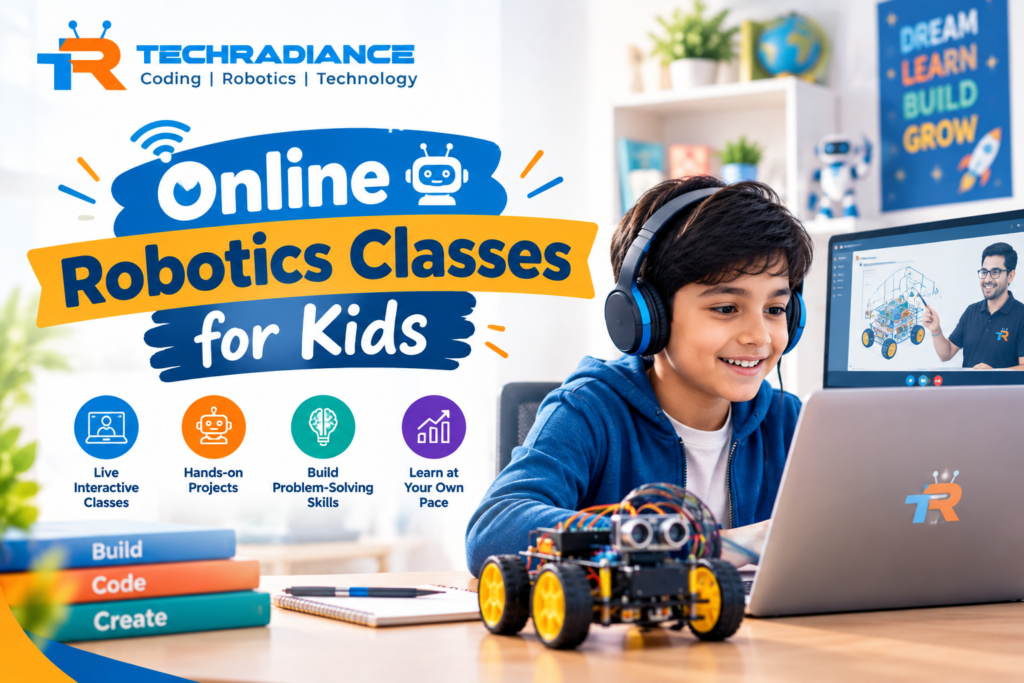
When created appropriately, Online Robotics Classes for Kids can be beneficial for children.
Because kids may learn from home without having to travel to a classroom, online learning can be convenient for families.
Parents should, however, confirm that the online program consists of:
- Instruction that is guided or live
- Activities that are practical
- Interaction between teachers
- Initiatives
- Easy explanations
- Support for resolving doubts
- Appropriate educational resources
Practical learning is particularly crucial for robotics.
An online course can assist a child who has a robotics kit at home as they construct and test projects.
Therefore, since learning is not restricted to watching videos, an Online Robotics Course can function well.
Online Robotics Course vs Offline Robotics Classes
There are benefits to both offline and online learning.
| Feature | Online Robotics Course | Offline Robotics Classes |
| Location | Learn from home | Attend a physical centre |
| Convenience | High | Depends on travel |
| Teacher interaction | Online | Face-to-face |
| Practical work | Can be done with a home kit | Usually done in class |
| Schedule | Often more flexible | Usually fixed |
| Team activities | Depends on the program | Often easier in person |
The child’s learning style, available time, location, and course structure all influence the best option.
Whether the course is online or offline is not the most crucial factor. Practical learning and instructional quality are more important.
What Is Robotics Education in India Like in 2026?
Robotics education in India is increasingly linked to real-world technological competencies.
Children are being introduced to robots, coding, artificial intelligence, electronics, and other STEM subjects in schools, educational institutions, and training firms.
Robotics can give young students an early introduction to technology without needing them to understand complex engineering concepts.
When children are 6 to 10 years old, the emphasis should often be on:
- Investigating technology
- Comprehending fundamental robotics
- Constructing basic projects
- Acquiring knowledge of fundamental code
- Growing in logical reasoning
- Promoting originality
- Resolving basic issues
Developing a young child into a professional engineer is not the aim.
Building curiosity and a solid basis for future learning is the aim.
Can Kids Learn AI and Robotics Together?
Yes, when the teachings are age-appropriate, kids can learn about robots and basic artificial intelligence ideas.
Advanced machine-learning theory or complex mathematics should not be the first topics covered in an artificial intelligence robotics course for young students.
Instead, kids can pick up basic concepts like:
AI: What is it?
Artificial intelligence (AI) is a technology that enables machines and computers to carry out tasks that often require human-like decision-making.
Children can learn, for instance, how a smart system can identify basic patterns, detect objects, or react to sensor data.
It’s crucial to provide examples that kids can relate to while explaining AI.
How Does a Robotics Course for Kids Work?
A basic learning procedure can be used in a beginner course:
Step 1: Acquire the Fundamental Concept
The instructor describes robots and their practical applications.
Step 2: Examine Robot Components
Youngsters learn about basic parts like wheels, controls, sensors, and motors.
Step 3: Acquire Basic Coding Skills
Youngsters discover how commands teach a robot what to accomplish.
Step 4: Construct a Project
The youngster builds a basic robot or electronic project using the concepts they have learned.
Step 5: Evaluate the Project
The young person verifies that the project functions as planned.
Step 6: Identify and Address Issues
When something doesn’t work, the child learns to figure out what’s wrong.
Step 7: Make the Project Better
Kids can test it again after making changes to the design, components, or directions.
One of the most beneficial aspects of robotics education is the cycle of construct → test → learn → improve.
Benefits of a Robotics Course for Kids
Many learning advantages can be obtained from a well-designed robotics program.
Improved Problem Solving
Youngsters learn to divide a task into manageable chunks.
Improved Reasoning
Children learn from robotics that commands must be followed in the proper sequence.
Increased Originality
Youngsters are able to create their own projects and try out various concepts.
Early Proficiency in Coding
Children have a useful purpose for studying programming thanks to robotics.
STEM Education
Science, technology, engineering, and mathematics are all integrated with robotics.
Real-World Education
Building and testing projects is an effective way for kids to learn.
Teamwork
Children can learn how to split duties, share ideas, and work together to solve problems through group projects.
Self-assurance in Technology
Youngsters get more at ease utilizing technology as a tool for creation rather than merely for utilization.
Why Choose Techradiance for Robotics Learning?
The goal of Techradiance is to make technology education useful, intelligible, and interesting for students.
For young children, learning robotics should be more about making and exploring than it is about learning complex ideas by heart.
Through basic tasks, a learning program can expose kids to robotics and progressively increase their comprehension of code, electronics, sensors, automation, and artificial intelligence.
Techradiance also works in the broader field of robotics and technology education, using project-based learning to assist students in acquiring useful skills.
Instead of picking a course only because it contains the word “robotics” in its name, parents should consider the actual course structure, age suitability, teaching style, project work, instructor support, and learning results.
What Can Kids Build After Learning Robotics?
The child’s age and level of learning determine the projects.
Students just starting out can work on easy tasks like:
- Robot in motion
- Robot that avoids obstacles
- Intelligent light
- Sensor-based initiative
- Model of automatic door
- Robot that follows lines
- Intelligent car
- A basic alarm system
Children can work on more complex projects as they grow more at ease.
The key is to gradually increase the level of difficulty.
What Should Parents Check Before Choosing a Robotics Course?
Parents can inquire about the following before enrolling a child:
1. Is the course appropriate for kids between the ages of six and ten?
2. Does it involve practical projects?
3. Is there a kid-friendly approach to teaching coding?
4. Does the instructor provide clear explanations of concepts?
5. Are robotics kits necessary or included?
6. Is it possible for kids to ask questions in class?
7. Does the course take place offline, online, or both?
8. How many projects will the kid finish?
9. Does the course promote problem-solving and creativity?
10. When a project fails, is there assistance available?
Parents can use these questions to determine whether their child’s needs are met by the course.
Student Testimonials
“I enjoyed building the robot because, once I was done, I could see it move. It gave the impression that coding was a game.
— Vikas, DAV Public School, New Delhi
“I gained a better understanding of how sensors and motors operate thanks to the robotics exercises. Testing my project was enjoyable.
— Drishti, Purna Prajana Public School, Vasant Kunj
“After taking robotics lessons, my child’s enthusiasm for creating things increased. The teachings were easy to understand because of the practical exercises.
— Prashant, Parent
Note: Before posting, testimonials should be replaced with verifiable Techradiance student or parent testimonials.
Final Thoughts
A successful Robotics Course for Kids should be easy, useful, and enjoyable.
The goal is not to teach complex engineering to kids between the ages of six and ten. It is intended to help kids learn how technology functions, hone their problem-solving abilities, experiment with coding, and grow into self-assured creators.
Parents should search for age-appropriate instruction, practical activities, hands-on projects, and teacher assistance whether they choose an online robotics course or a classroom setting.
A child’s first robot might become more than just an enjoyable hobby with the correct direction. It might spark a lifelong interest in technology, robotics, coding, and artificial intelligence.
Techradiance seeks to make this educational process useful and interesting so that kids can learn technology through construction, testing, experimentation, and creation.
Frequently Asked Questions
Children as young as 7 years old can begin learning the fundamentals of robotics. Robotics should be taught at this age through easy exercises, construction projects, and entertaining experiments.
Robotics can be taught by beginning with basic robot components, simple code, and modest practical tasks. Children’s robotics classes can also offer hands-on activities and teacher-led instruction.
The length of the course, learning level, robotics kit, projects, and class structure all affect how much a robotics course costs. Before enrolling their child, parents should check what is provided.
Start with a Robotics Course for Kids that is appropriate for your child’s age and interests. Children can become interested in robotics through practical projects, easy coding, and entertaining activities.
No, robotics doesn’t have to be challenging. Robotics is taught step-by-step in a solid starting course through age-appropriate projects, practical exercises, and straightforward terminology.