
Best Arduino Uno Beginner Kit for Students in 2026
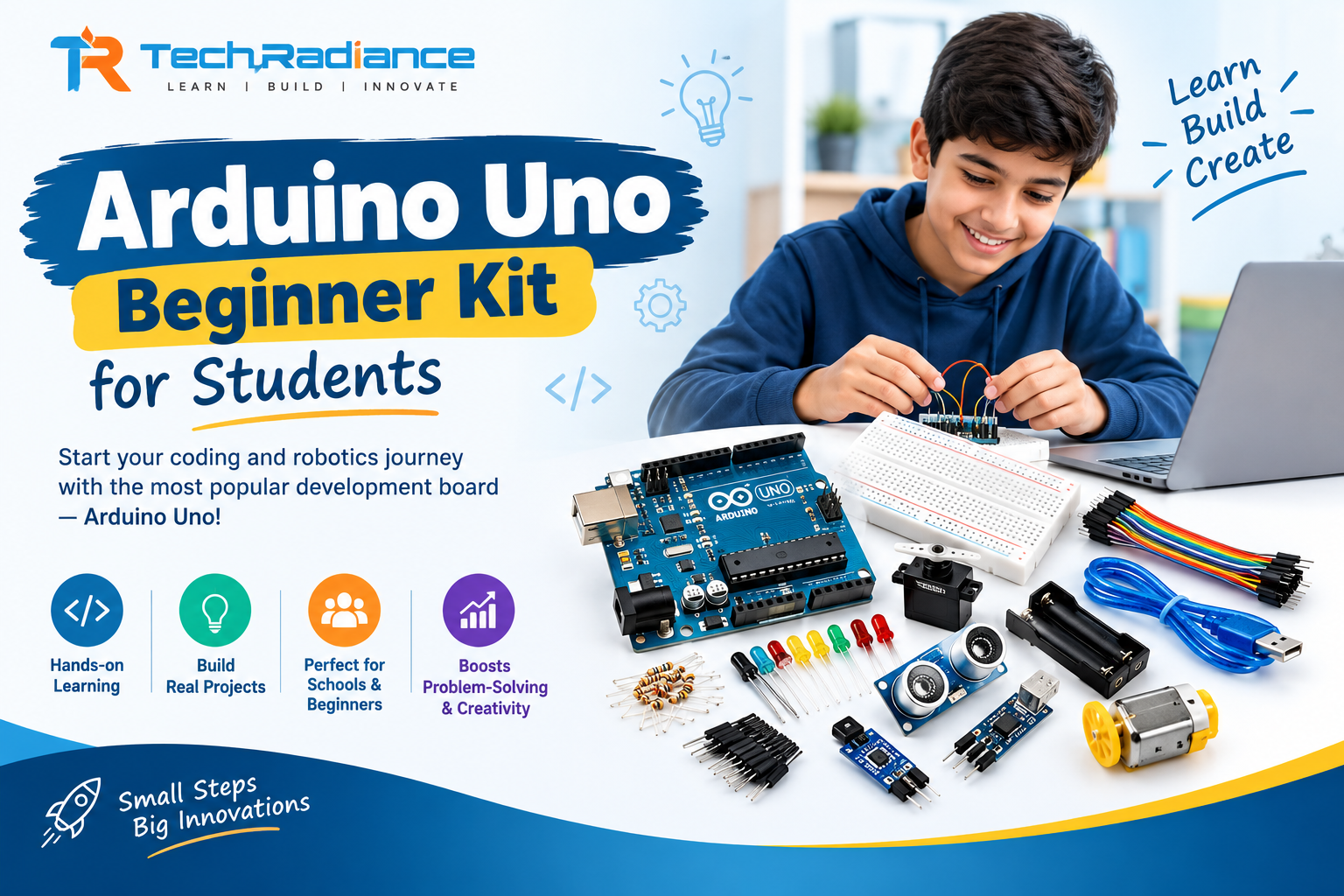
When children are able to construct something with their hands, learning electronics may be thrilling. Students can join wires, write basic code, turn on LEDs, use sensors, and make small working projects in addition to reading about circuits.
One of the simplest methods for beginners to begin learning fundamental electronics, coding, robotics, and STEM is with an Arduino Uno Beginner kit. It provides students with all the components they need to conduct experiments and comprehend the interplay between hardware and software.
In 2026, students who wish to investigate robotics, automation, and technology will find Arduino-based learning to be more beneficial. However, with so many kits on the market, a frequently asked question is: How do you pick the best Arduino kit for a student?
This guide an Arduino Uno kit is, why students should use one, what parts they require, and what novices should consider when selecting a kit.
Author: Himanshu ( Content Writer)
What Is an Arduino Uno Beginner Kit?
An Arduino Uno Beginner kit is a set of electronic parts intended to teach novices fundamental electronics and Arduino programming through hands-on projects.
An Arduino Uno Board is typically the primary component of the kit. LEDs, sensors, motors, buzzers, screens, and other parts can be connected to it by students. After that, they can create basic programs to manage these parts.
For instance, a student may design a project in which:
Pressing a button activates an LED.
When an object approaches, a buzzer sounds.
When it gets dark, a light automatically switches on.
When a specific situation is identified, a motor begins to run.
Because students can see their code in action, learning becomes more engaging.
Why Should Students Learn with an Arduino Uno Kit?
When they can learn by doing, many pupils find technology easier to understand. This practical experience is offered via an Arduino Uno starter kit.
Students can connect an LED or sensor to a board and test it themselves rather than merely learning about it from a textbook.
Students can study with an Arduino Uno kit:
- Simple electronics
- Programming for beginners
- Solving problems
- Thinking logically
- Concepts of robotics
- Motors and sensors
- STEM ideas
- Building a project
- Innovative thinking
The nicest thing is that pupils don’t have to begin with challenging assignments. They can start with something as basic as blinking an LED and work their way up to more complex projects.
What Are the Key Components in an Arduino Uno Kit?
Depending on the kit, the components may vary. Nonetheless, a practical starting kit should have enough components so that students can construct many kinds of projects.
1. The Arduino Uno Board
The primary controller is the Arduino Uno. Consider it the project’s brain.
Students can control linked components by uploading programs to the board.
2. A breadboard
Students can connect electronic components without permanently soldering them together by using a breadboard.
Because users can simply alter their circuit while experimenting, it is particularly helpful for novices.
3. Wires for jumpers
The Arduino board is connected to sensors, LEDs, resistors, and other parts using jumper wires.
4. LEDs
Simple lights like LEDs are great for a student’s first Arduino project.
An LED may blink at various speeds with a program written by a novice.
5. Resistors
A circuit’s electrical current flow can be regulated with the aid of resistors. Using various resistor values, students can also learn fundamental concepts in electronics.
6. Sensors
An Arduino project can comprehend what is going on around it thanks to sensors.
For instance, an ultrasonic sensor can assist in measuring distance, and a light sensor can detect brightness.
7. Buzzer
Sound can be produced by a buzzer. It can be used by students to make small musical projects, warning systems, or alarms.
8. Motors
Students learn about movement and robotics through motors. Small moving robots and other mechanical projects can be made using them.
9. A USB cable
The Arduino board is typically connected to a computer via a USB cable so that students can upload their applications.
How Does an Arduino Uno Kit Work?
The fundamental procedure is straightforward.
Write code, upload it, Arduino processes it, and components react.
Consider a student who wants to create an automated nite light.
The student first attaches a light sensor to the Arduino. The sensor measures the amount of light in its immediate environment.
The student then creates a basic program.
The Arduino receives the sensor data and activates an LED if the environment gets dark.
This straightforward project simultaneously teaches the student about electronics, programming, sensors, and decision-making.
What Can Students Build with an Arduino Kit?
The variety of projects that students may make with an Arduino Kit is one of the reasons they like it.
Beginners can begin with easy tasks like:
- LED Blinking Project
- Traffic Light Project
- Digital Dice
- Automatic Night Lamp
- Electronic Doorbell
- Temperature Monitor
- Distance Detector
- Mini Alarm System
- Smart Dustbin
- Line-following Robot
- Obstacle-Avoiding Robot
Students can create more engaging robotics and automation projects by combining various sensors and components as their confidence grows.
What Are the Benefits of Using an Arduino Uno Starter Kit?
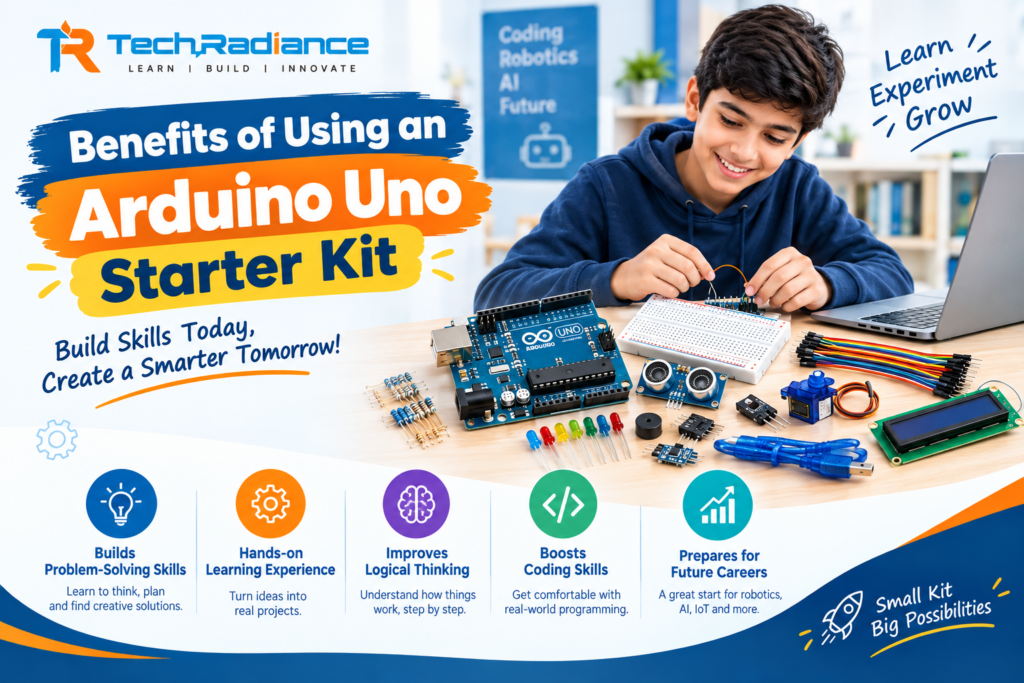
Practical Education
Instead of just reading about circuits, students learn by making them.
Simple to Understand
Arduino is appropriate for students who are just beginning their technological journey because it employs programming techniques that are easy for beginners to understand.
Promotes Innovation
Students are not required to construct a single project. They are free to try new things and come up with original ideas.
Enhances the Ability to Solve Problems
A circuit may not always function on the first attempt. Students must identify the links, comprehend the issue, and come up with a solution.
Explains Coding
Students can better grasp fundamental programming concepts like variables, conditions, loops, and functions by working on Arduino projects.
Encourages STEM Education
Science, technology, engineering, and mathematics combine in practical ways with Arduino.
How to Choose the Right Arduino Uno Beginner Kit?
Not every kit suits beginners. Teachers, parents, and kids should consider a few key factors before purchasing one.
Examine the Parts
Verify that the kit has the fundamental parts required for starting projects. There might not be enough components for practical learning with a kit that only includes an Arduino board.
Seek out Project Assistance
When given project instructions or educational materials, beginners learn more quickly.
Students should find it easy to grasp what to connect, how to write the code, and why the project works with a good kit.
Take into Account the Student’s Age
A school student’s equipment should be simple to use and safe. Instead of complex electronics, younger pupils might benefit from guided activities.
What Is the Arduino Uno Kit Price?
The Arduino Uno kit Price might change based on the board, quantity and quality of components, project materials, and whether or not the kit comes with extra learning assistance.
Students and parents should consider what is included in the kit and what they can actually build with it rather than selecting a kit only based on price.
Because students can work on multiple tasks without having to buy extra parts right away, a somewhat more comprehensive kit might offer more learning opportunities.
Why Choose Techradiance for Arduino-Based Learning?
Making for kids is the main goal at Techradiance.
Students can go from merely learning about technology to actually using it to make things with the aid of Arduino-Based Activities.
Students can investigate ideas like coding, circuits, sensors, motors, and automation through practical STEM and robotics exercises.
Learning, building, testing, making mistakes, and trying again are the straightforward objectives.
This method can help students gain confidence while working on their own projects and make technology less daunting for novices.
What Do Students Say About Hands-On Robotics Learning?
Because the results of their work right away, students frequently like robotics and Arduino activities.
After completing practical exercises, students could provide the following kinds of feedback:
- I enjoyed building the circuit because I could see the LED being controlled by my code.”
- It was more enjoyable to build the project than to merely read about electronics. I gained knowledge about how sensors operate.
- My project didn’t work at first, but I checked the wires and fixed it. I now have a better understanding of the circuit.
This type of hands-on learning can also increase engagement in classroom technological activities for educators and schools.
Final Thoughts
To investigate coding, electronics, robotics, and STEM, an Arduino Uno Beginner kit might be an easy and thrilling place to start.
Having the kit alone is not the most crucial factor. It’s what pupils do with it.
Students start to grasp how technology functions in the real world when they connect a circuit, write their first program, watch an LED light on, or drive a little robot.
Learn one topic at a time, start with a basic project, and gradually develop more difficult projects.
An Arduino Uno kit can transform a student’s curiosity into a practical technological project with the correct instruction and practical experience.
Frequently Question Asked ( FAQ’S)
Yes, Arduino starter kits are available. An Arduino board, breadboard, jumper wires, LEDs, resistors, sensors, and other parts required to construct basic electronics and coding projects are typically included in an Arduino beginner kit.
Simple electronic parts, sensors, unambiguous project instructions, and learning assistance make up the ideal Arduino kit for beginners. Students can learn through practical projects more easily with a full Arduino Uno starter kit.
C and C++ programming languages are used with Arduino. In the Arduino IDE, novices typically develop Arduino programs in a simplified C/C++ language. The majority of Arduino Uno boards are not primarily programmed in Python.
Yes, for those who wish to learn coding, electronics, robotics, and STEM through hands-on projects, an Arduino kit can be worthwhile. It enables students to conduct experiments, create functional projects, and comprehend the interplay between hardware and software.