Are you searching for the top renewable energy project for your school’s science fair? You’re in the right spot. This blog, Techradiance, can provide you with easy, fun, and simple renewable energy project ideas that you can create at your institution. These ideas are great for kids, as well as for fifth graders who can comprehend and test them.
Let’s find out everything we can about renewable energy projects, step by step.
A renewable energy project is a model, or even a tiny device, that demonstrates how we can generate energy from natural resources such as wind, sunlight, and water. These sources of energy will never end. This is why they are referred to as “renewable”.
For instance:
The sun provides us with solar energy of the sun.
The wind is the source of our wind energy.
Water that flows gives us hydro energy.
Students create models made from these sources. It is referred to as a renewable energy science project. These projects allow us to understand how nature could be used to power our schools, homes, and cities without causing harm to the environment.
Why Should Students Choose Renewable Energy Projects?
Many students are asking, “Why should I pick a renewable energy source over any other subject?” Here’s the reason:
It is a solution to an actual problem that the world is in need of: renewable energy that is clean, and your project offers a way to solve it.
It is simple to explain; judges and teachers are able to understand quickly due to its connection to everyday life.
It educates you about the world and teaches you how to help save the planet while you study the science.
It’s in huge demand. Every year, the renewable projects of students receive top awards in science fairs due to being distinctive and beneficial.
It develops real abilities. You learn about motors, circuits, sensors, and clean technology.
At Techradiance, we tell students to pick a relevant subject. ‘Renewable energy is not only an idea, but it’s the future.
How to Choose the Right Renewable Energy Project Idea
Before you decide on your project, you should ask these questions:
Do I know the way this energy source functions?
Do I have the necessary materials quickly?
Do I have the ability to explain this project to my judges in a few phrases?
Does my project provide a clearly beneficial effect on society?
After you have answered these questions, you’re ready to select from our list of renewable energy project ideas below.
Best Renewable Energy Project Ideas for Science Exhibition
Here are some simple and fun ideas for projects that you can test:
1. Solar-Powered Fan
Make a small fan that operates using the solar panel instead of electricity. This illustrates how sunlight can provide power to machines used in everyday life.
2. Solar Water Heater Model
Demonstrate how sunlight can heat water without the use of electricity or gas. This is an excellent idea to save energy in your home.
3. Wind Turbine Model
Create a small windmill with plastic or cardboard blades that are connected to a motor. If the wind blows, it turns the blades and creates electricity.
4. Mini Hydro Power Model
Demonstrate how water flowing through the air turns a wheel attached to a generator, generating electricity. This is an easy but effective demonstration.
5. Solar Oven
Make a small box with cardboard and foil. It uses light to cook or cook food. This is among the most loved activities among young students.
6. Bicycle Generator
Demonstrate how a bicycle can produce electricity with a small engine. This is a way to connect renewable energy to everyday activities.
7. Solar-Powered Charger
Design a small charging station with a solar panel to charge mobile phones or a small battery.
These projects are easy to construct, inexpensive, and ideal for those who are just beginning. They’re also perfect whether you’re in the 5th grade or Class 12.
Benefits of Building a Renewable Energy Project
Let’s look at the advantages of working on this kind of project:
You can learn about science through practical applications and not only theories from books.
You learn the process of making energy and how it can be conserved.
You can build confidence by presenting before teachers and judges.
You can contribute to a more sustainable tomorrow by learning about eco-friendly options.
You make a statement in competitions because renewable energy subjects are always a hit and stunning.
At Techradiance, the robotics and STEM labs let students explore these ideas in a hands-on manner using real-world kits as well as expert guidance and proper guidance.
Renewable Energy Projects in India: Why It Matters
India is striving to make use of more renewable energy. Wind farms and solar parks, as well as hydropower plants, are being constructed throughout the nation. This is the reason why renewable energy projects in India are becoming increasingly well-known in schools.
When students construct these kinds of projects, they are not just doing their homework. They are also learning about the goals of India’s government – such as the use of solar and wind power to lessen pollution and also rely less on fossil fuels.
Techradiance is a partner in this cause by helping schools establish STEM as well as robotics laboratories so that students can learn about the concepts of renewable energy with active learning.
What Schools Say About Techradiance
“Our students constructed a solar-powered model to display their work in a science exhibit with the help of their STEM laboratory, Techradiance, that we have set up at our school. They understood the concept of renewable energy a lot better after building the model themselves.” — Shanaya, Silicon Public School
“Techradiance’s instructors helped our students step-by-step as they were working on the renewable projects they had in mind. The assistance made a huge difference in the way that students were during the exhibit.” — Ritika, Red Roses Public School
Final Thoughts
Picking the renewable energy project in your science fair is a wise choice. It’s easy to construct and fun to build, and will help you understand the way that the world is moving toward clean energy. If you choose a solar oven, a wind turbine, or even a miniature hydro model, you’re learning the skills you need for the future.
If your school would like to create a proper STEM and robotics laboratory in which students can develop real renewable energy projects, and much beyond, Techradiance is here to aid you.
Q1: What is the easiest renewable energy project for a science exhibition?
A solar-powered air conditioner or solar oven is among the simplest tasks to complete. It requires only a few materials and is simple to explain.
Q2: Can a 5th-class student make a renewable energy project?
Yes! Ideas like a solar oven or bicycle generator are easy and safe for children to build with adult assistance.
Q3: Why are renewable energy projects important?
They teach us to make use of natural resources like sunlight, wind, and water to create pure
Q4: Which renewable energy source is best for a school project?
The solar energy option is the largest and most well-known option due to the fact that sunlight is readily available all around, and solar panels are simple to set up in small-sized models.
Q5: How does Techradiance help students with these projects?
Techradiance supplies robots and STEM labs in schools, and kits and trainers so that students can create real, functional renewable energy models with appropriate instructions.
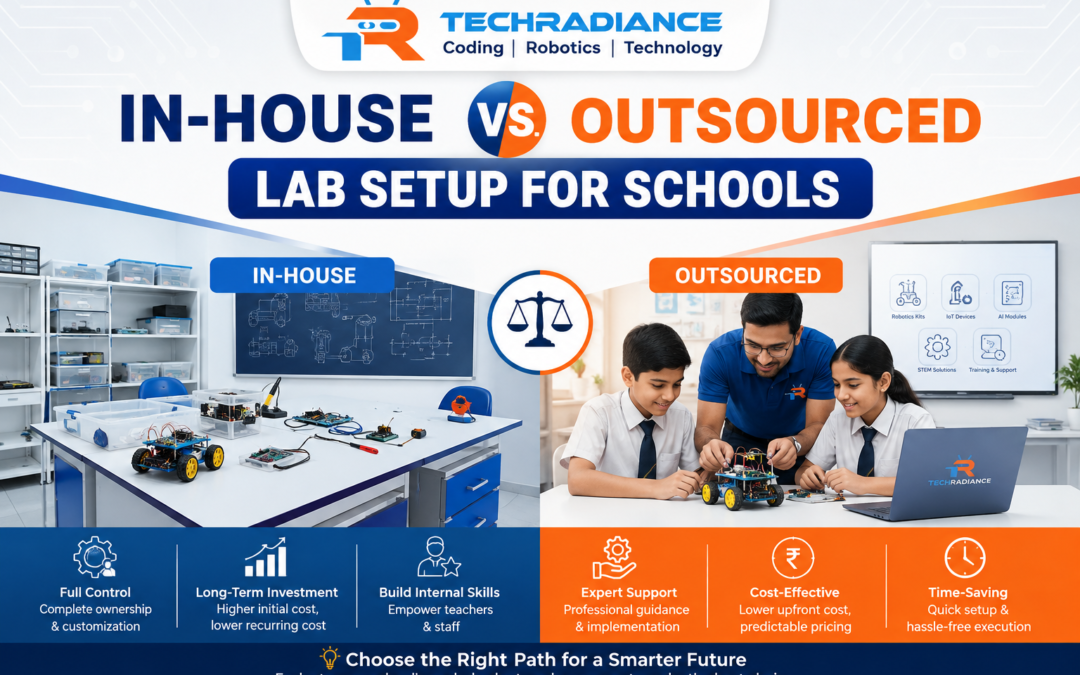
Setting up an innovative lab in schools—whether a robotics lab, a STEM lab, or even an AI lab—is a huge decision. Once a school has decided to construct one, the next question is asked: should we build the lab on our own, or Outsource School Lab Setup to a company that already has the know-how to set it up?
Both choices can be successful. However, they differ in cost, time, and quality, and the amount of stress your staff and teachers undergo. We’ll explain the two options in plain terms so that you can make the best decision for your school.
Let’s begin with the basics. If an institution outsources lab setup,this means that the school contracts with an outside firm to design, plan installation, and frequently provide training for teachers to use the lab, instead of coordinating everything on its own.
This differs from having it done in-house, in which the school’s staff buys equipment, prepares the classroom, creates the curriculum, and then trains teachers independently in a step-by-step manner.
Imagine it as building a home. You might be able to learn about plumbing wiring, carpentry, and plumbing yourself. It is also possible to hire professionals who know how to perform the task efficiently and quickly. Both can get you a house. However, the path is quite different.
Why Are Schools Even Thinking About This Now?
Many schools across India are establishing robotics, AI, STEM, and other labs that focus on skill development due to NEP 2020 and CBSE’s push to provide hands-on, real-world learning. However, the majority of schools do not have a team of in-house robotics experts as well as curriculum designers or lab engineers, sitting around. Therefore, the issue of the in-house lab vs. outsourced lab setup is a pressing issue for school principals, school leaders, or management team members.
In-House Lab Setup: What It Actually Looks Like
In-house labs mean that your school
Purchases equipment directly from several suppliers
The room layout is designed independently
Creates or copies curriculum
Internally trains teachers
Manages repairs, replacements, and upgrades each year
The benefit: You have full control. You decide everything.
The tough element: It takes a considerable amount of time, study, and trial and error, and the majority of schools do not have a full-time employee whose task is “robotics lab specialist”. This can lead to delays, incorrect purchase of equipment, or a room that looks nice but isn’t used by the teachers.
If a school goes with hiring a lab setup company for schools, the business usually manages everything:
Design and layout of the lab
Equipment sourcing (already tested and ready for school)
The curriculum is mapped to the guidelines of CBSE/NEP.
Teacher Training
Maintenance and support on an ongoing basis
This is a turnkey lab setup for schools in India, which means that the school won’t have to handle the smallest of things. The company will provide a fully functional lab.
School Lab Setup Vendor vs In-House Team: Quick Comparison
Factor
In-House Team
Outsourced Vendor
Time to set up
Slower (trial and error)
Faster (already skilled)
Equipment quality
Depends on the knowledge of staff.
School-specific equipment that has been tested
Curriculum
It must be constructed from scratch.
Made-to-order, updated frequently
Teacher Training
The school must organise it separately.
Usually, they are included.
Support continues.
The school handles repairs alone.
The vendor provides maintenance/AMC.
Staff members are given a frontline effort.
High
Low
Should Schools Outsource Lab Setup?
This is a straightforward, truthful response: if your school has no in-house robotics/STEM professionals, outsourcing is often the better and more efficient option. It saves your teachers from having to learn a new skill in addition to their duties as teachers and reduces the possibility of wasting money on inappropriate equipment.
But if your institution has a strong technical staff and has the time to construct things step-by-step, it is possible for an in-house setup to be a good idea too. It is just a bit more time-consuming to achieve the same standard.
Pros and Cons of Outsourcing School Labs
Pros:
Quicker set-up (weeks instead of months)
Equipment selected by those who’ve used this equipment many times before
The curriculum is already aligned with the CBSE/NEP
Teachers receive proper training, not the whims of a few.
Continuous support for when something fails
Cons:
A little less “custom” influence over each small choice
Trusting an outside party is essential.
This is a cost for service that goes beyond equipment costs
For the majority of schools, the advantages far outweigh the consin particular since the “cons” for outsourcing are much less than the risk of putting an internal setup wrong.
Cost of In-House Lab Setup vs Vendor
This is often the first question management at schools is asked. Here’s the real picture:
An in-house lab setup might appear more cost-effective on paper since you’re only paying for the equipment. But the hidden costs are a lot more expensive — faulty purchases, time spent by staff looking for information, delayed timelines, and lack of curriculum support.
A vendor-led set-up is clearer in its upfront price, but it typically includes the equipment, curriculum training, support, and maintenance all in one bundle. If you look at the total price (not only the equipment costs), the outsourced setups usually are more cost-effective over the long term.
How to Choose a Lab Setup Partner for Schools
If your school chooses to work with one of the vendors and you’re looking for a way to select the best one:
Review their past experiences: Have they had experience working in similar schools to ones like yours (CBSE, ICSE, similar age groups)?
Find out about the curriculum: Do they have it already made and up-to-date, or do they just provide equipment?
Discuss teacher training: Will your teachers be taught to manage the lab with confidence?
Request after-sales assistance: What happens if the equipment fails after six months?
Get references and talk with other schools they’ve worked with.
The robotics labs are more complex than a typical classroom setting — they include sensors, coding kits and controllers, as well as safety considerations. Making these do-it-yourself setups without prior knowledge can result in an impressive lab at first but is less utilised after a couple of months because the teachers don’t feel confident in working with the equipment.
The robotics lab setup company eliminates this risk by managing the technical setup as well as the teacher training in tandem to ensure that the lab remains functional and productive every year, and it’s not only for official opening photographs.
Benefits of Outsourcing STEM Lab Setup
It saves the school’s management team time and stress
Lowers the risk of purchasing the incorrect or obsolete equipment
It comes with a course that is more than machines
Makes teachers feel confident with the right education
Often, long-term support is provided to ensure that the lab doesn’t stand idle after a few years
School STEM Lab Outsourcing in India — A Growing Trend
All over India, more schools, from CBSE up to ICSE as well as state boards, are opting to outsource their robotics, STEM, and AI labs, instead of creating the labs from scratch. This is due to schools wanting to concentrate on teaching and not managing equipment and technical project logistics.
How Techradiance Helps Schools with Lab Setup
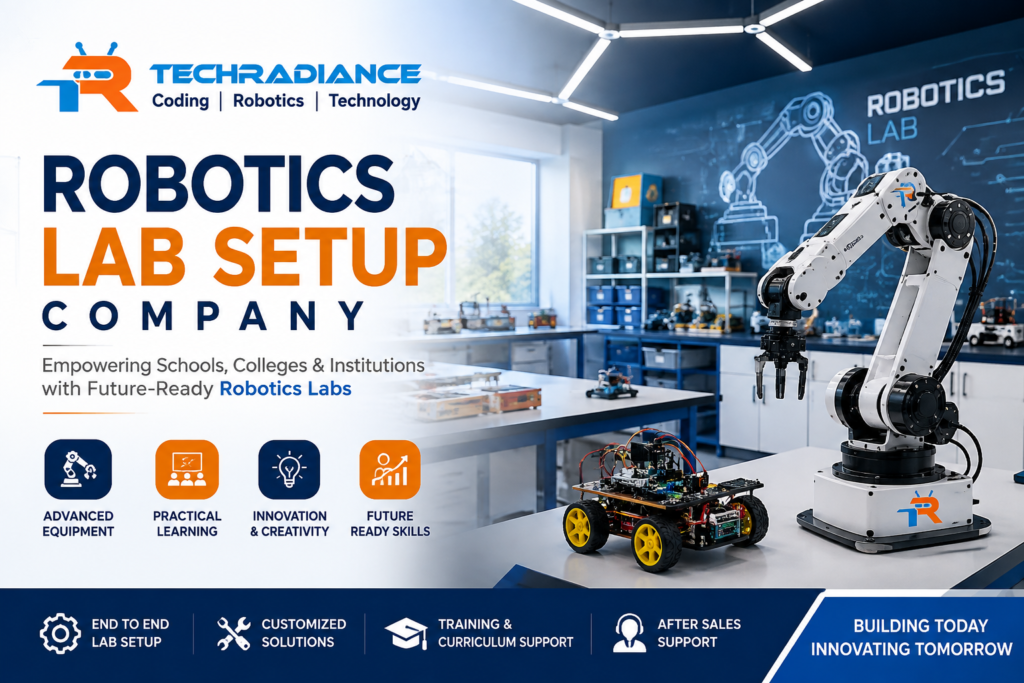
Techradiance partners with school districts across India to establish robotics, AI, STEM, AR-VR, EV, and skill-development labs that provide a complete turnkey solution. This means that schools receive equipment and a syllabus aligned to CBSE/NEP with trained teachers, as well as ongoing support through one source.
We’ve worked with, including Delhi Public School and Billabong High International School, as well as Edify World School, to make this transition effortless.
What Schools Say About Us
“Techradiance helped make the whole process simple, from planning to installing to assisting our teachers. Our students are truly more involved now.” — Shanaya, Silicon Public School
“The assistance didn’t end even after we set up. Techradiance’s staff has been responsive anytime we’ve needed assistance in the classroom or with equipment.” — Ritika, Red Roses Public School
“We were looking for a partner who knew both the technical as well as academic aspects of STEM education. That’s exactly what we received.” — Himanshu, DPS Public School.
Final Thoughts
Both outsourced and in-house lab setups are able to work in most institutions; outsourcing school lab setup is faster and more reliable, as well as less stress-inducing for the teachers and the management. It’s not only about purchasing equipment; it’s about making sure that the lab is being used each year properly.
When your organisation is looking into robotics, AI, or STEM lab setup and is looking for an expert partner to handle everything from curriculum to equipment to teacher education, Techradiance can help.
This is when you contract an outside firm to build, construct, and train personnel for the lab at your school instead of doing everything with your own staff.
Should schools outsource lab setup?
In most situations, particularly when schools don’t possess internal technical experts. It reduces time, eliminates errors, and comes with training as well as support.
Is outsourcing more expensive than doing it in-house?
In most situations, particularly when schools don’t possess internal technical experts. It reduces time, eliminates errors, and comes with training as well as support.
What should schools check before hiring a lab setup company?
Experience in schools and curriculum quality, teacher education, and after-sales service.
Is a turnkey lab setup better than DIY?
In most schools, yes, because it incorporates the equipment, curriculum, as well as instruction, which means that the lab is used properly, not simply installed.
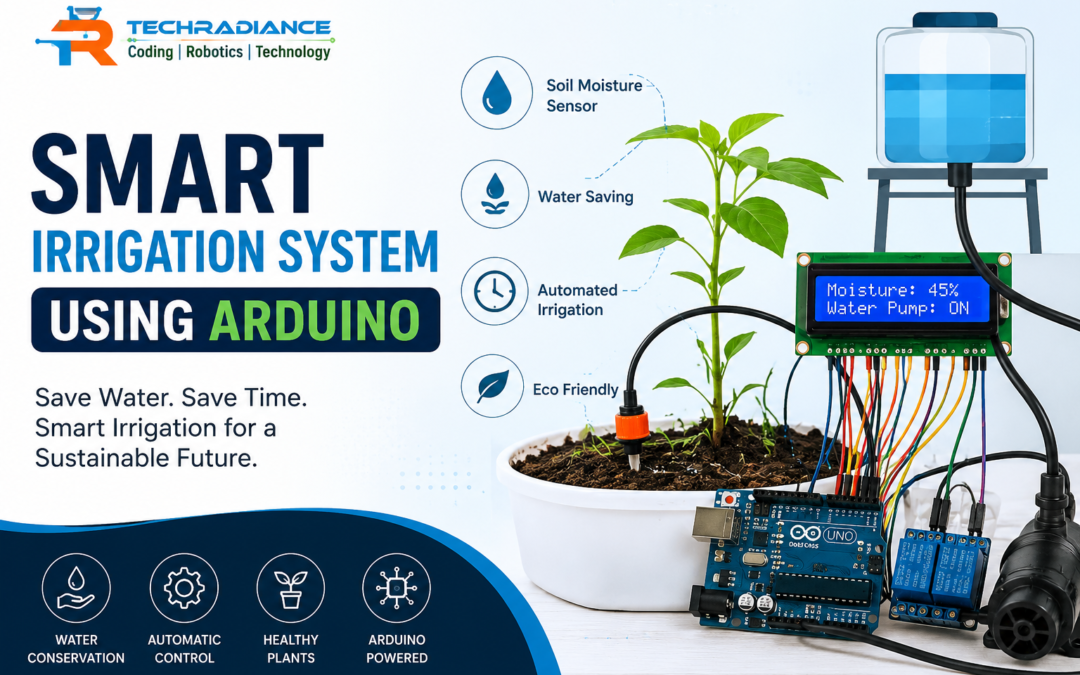
Imagine a plant that receives water on its own when the soil is dry. It is not necessary to inspect the plant again. This is feasible using a Smart Irrigation System Using Arduino.
A smart irrigation system makes use of an Arduino-like computer and soil moisture sensors, as well as a water pump along with a few other basic components. The sensor determines the amount of water present in the soil. If it is dehydrated, the Arduino tells the pump to pump water. When the soil has sufficient moisture, the pump stops.
This project is an easy and engaging way for kids to get familiar with Arduino sensors, electronics programming, and plants, along with water conservation.
In this easy-to-follow guide, we will be able to understand the concept of what a smart irrigation system is, why it is useful, how it works, its benefits, required components, and how students can build an automatic plant watering system using Arduino
A Smart Irrigation System Using Arduino is an automated system that waters plants according to the moisture content of the soil.
The system utilises a soil moisture gauge to determine whether the soil is damp or dry. The sensor transmits this info to the Arduino board. Arduino is then able to make an easy choice.
When the ground is not moist, the water pump is turned on.
If the soil is sufficiently moist, the water pump is turned off.
This is different from regular watering, in which one has to be aware of when to water the plants.
For students, it is an excellent illustration to show the ways that sensor technology and programming could solve problems in real life.
Why Is Smart Irrigation Important?
They require water in order to grow; however, providing them with too much or insufficient water can result in issues.
If we do not water our plants, they could become too dry. In contrast, a plant that is given excessive amounts of water could waste water and harm the plant.
An intelligent irrigation system aids in solving this problem by providing water only to the soil when it is needed.
It could be helpful in:
Home gardens
School gardens
Small farms
Greenhouses
Terrace gardens
Plant nurseries
Science exhibits
Robotics and STEM labs
For students, the project provides a valuable concept: technology can be employed to conserve natural resources.
How Does an Automatic Plant Watering System Using Arduino Work?
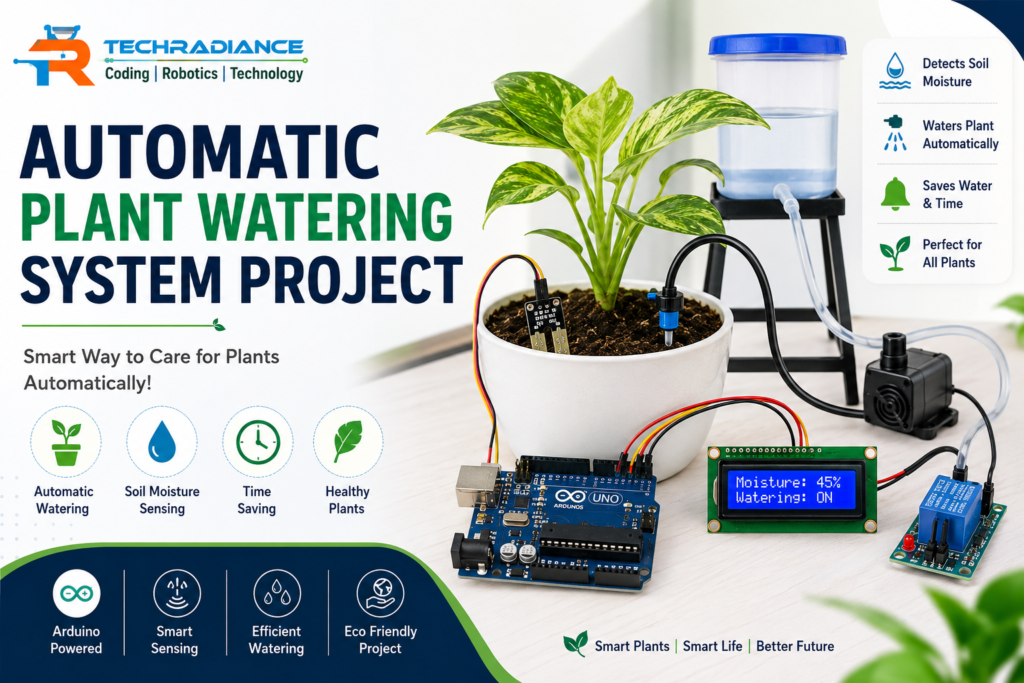
The operation of an Automatic Plant Watering System Using Arduino is simple to comprehend.
The soil moisture sensor is located inside the soil. It determines the amount of moisture within the plant’s roots.
When the soil gets wet, the sensors relay data to Arduino. Arduino analyses the information and triggers a relay. The relay functions as an electronic switch that activates the power source, which is the water pump.
The pump collects water from a tank and transmits it to the plant using small pipes.
If the soil is saturated, the sensor will detect the shift. Arduino will then turn the pump off.
Simple Working Process
Soil becomes dry. The sensor detects dryness. Arduino detects the signal, and the pump is turned ON. The plant is flooded – soil is wet. Arduino switches off the pump.
This easy process shows what the inputs, decisions, and output functions are in a computer system.
What Components Are Needed for an Automatic Irrigation System Project?
Students do not require sophisticated equipment to create the basic Automated Irrigation System Project.
The principal elements are:
1. Arduino Board
Arduino is the central part that runs the entire project. It receives data from the sensor and also controls the power source, which is the water pump.
2. Soil Moisture Sensor
This sensor is used to determine if the soil is wet or dry. It transmits the moisture data to an Arduino.
3. Water Pump
The pump transports water from a container into the plant.
4. Relay Module
Relays function as an electrical switch. It aids the Arduino in controlling the flow of water.
5. Water Container
A small container could be used to hold water in a container.
6. Connecting Wires
Jumper wires are used to connect various components.
7. Tubing or Small Pipe
The pipe transports water to and from the.
8. Power Supply
The Arduino and the other components require a power source.
Students may also include an LED or display, buzzer, or any other sensor to enhance the quality of the project.
How to Make an Automatic Plant Watering System Project?
A simple Automated Plant Watering System project can be developed in a couple of easy steps.
Step 1: Prepare the Soil and Plant
Choose a small plant and put it in an earthen pot. Be sure that the soil is easily accessible to the moisture sensors.
Step 2: Place the Moisture Sensor
Place the soil moisture sensor into the soil around the plant’s root. It must be placed in a proper position so that it can detect variations in water.
Step 3: Connect the Arduino
Connect the sensor to the Arduino as per the circuit for the project. The sensor transmits data back to the Arduino.
Step 4: Connect the Relay and Pump
The relay is connected to an Arduino, and it utilises it to regulate the water pump.
Very Important! It is recommended that students work in conjunction with an adult or a teacher in connecting power and electrical components.
Step 5: Add the Water Pipe
Install an end of the pipe close to the plant, and attach the opposite end of the pipe to the pump.
Step 6: Upload the Arduino Program
Arduino requires a tiny program that tells it what it should do.
For instance:
If the soil is dry, turn off the pump.
If the soil is damp, turn off the pump.
Step 7: Test the System
Check the project’s performance by checking the readings of the sensors. If the soil is dry, the pumps must begin. Once enough water has reached the ground, the pump needs to stop.
This is the basic concept of an Automatic Plant Watering System.
What Are the Benefits of a Smart Irrigation System Project?
The Smart Irrigation System Project has many benefits for gardeners, students, and schools.
Saves Water
The system will provide water when the soil requires it, instead of watering plants excessively.
Saves Time
There is no need to manually inspect every plant constantly.
Helps Plants Get Regular Water
Plants may receive water if the soil is dry, and this can aid in healthy development.
Easy to Understand
Arduino-based projects are ideal for those who are new to programming because they can understand the work step-by-step.
Builds STEM Skills
Students will learn about engineering, science, technology, and math through a real-world project.
Improves Coding Skills
Students write basic directions for Arduino and discover how software controls hardware.
Encourages Problem-Solving
Students have to figure out solutions if the sensor, circuit, or pump isn’t working as it should.
What Do Students Learn From This Project?
An Automated irrigation system project isn’t just about watering plants. It could teach students a variety of important skills.
Students can be taught:
How sensors function
How does Arduino reads information? Arduino interprets data
Basic programming
Simple electronic circuits
How pumps function
Concepts of input and output
Problem-solving
Conservation of water
Basic automation
Technology that is applied in real-world situations
It is perfect as a tool for STEM education as well as robots in classes, science fairs and school labs.
What Is the Difference Between Normal Irrigation and Smart Irrigation?
Normal irrigation generally depends on a single person to decide when they should water plants.
Smart irrigation utilises sensors’ data to determine the best option.
Normal Irrigation
Smart Irrigation
Usually, manual control is required.
Does it work automatically?
The person decides when to water.
The sensor provides soil information.
It is possible that watering has been forgotten.
The system can react to soil that is dry.
More manual work
Much less manual work
Limited automation
Utilises sensors and Arduino
The basic idea is that smart irrigation uses technology to make irrigation more efficient and automated.
How Can Schools Use This Project?
Schools can utilise an Automatic Plant Watering System Using Arduino as an activity in STEM that is practical.
Teachers could have students build the garden of their dreams that they can connect to an Arduino system. Students will then be able to examine what happens to the soil when it is wet and when water is added.
The project may be complemented by lessons on:
Plants
Conservation of water
Electronics
Coding
Robotics
Automation
Environmental protection
Techradiance, these hands-on projects will help students comprehend concepts by creating and testing real-world models instead of simply studying them.
How Can You Improve the Project?
Once they have mastered the fundamental task, they can then expand the options.
For instance, they may include:
LCD display
Water-level sensor
Sensor for temperature
Sensor for rain
Multiple soil moisture sensors
Mobile monitoring
Solar power
Automatic scheduling
A more sophisticated system could monitor different plants and regulate the amount of watering each plant independently.
This demonstrates to students how a basic classroom project could be transformed into a bigger IoT and smart agriculture project.
Student Testimonials
The testimonials below serve as examples of educational content. They should be replaced by verified student/customer feedback prior to publication.
Testimonial 1
Aarav, Class 6 Student
“Building this Arduino irrigation program helped me to understand sensors. I enjoyed watching the pump come on when the soil got dry.”
Testimonial 2
Ananya, Class 7 Student
“I thought that coding was a challenge; however, this project made it much easier to grasp. I discovered that Arduino can be used to control real objects.”
Testimonial 3
Rohan, Class 8 Student
“My favourite part was testing the humidity sensor. It was thrilling to see how the system could tell that the plant needed water.”
Testimonial 4
Meera, Class 7 Student
“This project showed me how technology can be used to conserve water. I was happy to build something that could be useful in real gardens.”
Through the combination of an Arduino board, a soil moisture sensor relay, and a water pump, students can build an Automatic Plant Watering System that reacts to the conditions of the soil.
Additionally, it teaches students about electronic programming, sensors, automation, water conservation, and STEM in fun and practical ways.
If it’s used as an automatic irrigation system project as the school science model, or even as a robotics lab exercise, students are given the chance to learn by doing.
Schools looking to introduce students to Arduino and robotics programming, STEM and AI project ideas, and Techradiance will help you create interactive educational experiences to make the technology more accessible to understand and more enjoyable for children and students
Frequently Asked Questions:
1. How to create a Smart Irrigation System?
To build an intelligent irrigation system, connect a soil moisture sensor, a controller relay, and a water pump. The sensor can detect dry soil and inform the controller that it should turn on the pump. If the soil is moist, the pump shuts off.
2. Can I make a Smart Irrigation System without Arduino?
Yes. You can make a smart irrigation system without Arduino by using other controllers such as ESP32, ESP8266, or a simple moisture-sensor-based circuit. In IoT applications, ESP32 is a popular option.
3. What IoT sensor is used in a Smart Irrigation System?
The sensor for soil water is the most important sensor that is used in a sophisticated irrigation system. It monitors the amount of moisture in the soil. It aids the system in determining which plants require water.
4. How Much Does a Smart Irrigation System Cost?
A basic smart irrigation system may cost between Rs. 500 and Rs. 22,000 based on the Arduino IoT board and sensors, pumps, and other parts. Advanced systems that have many sensors, as well as mobile surveillance, may be more expensive.
5. Can school students make an automatic plant watering system project?
Yes, school children can design an automatic plant watering system under the guidance of an adult or teacher. It’s a fantastic STEM project to learn about sensors, Arduino, and coding, as well as electronics, along with water conservation.
Schools are rapidly changing. Students today require more than blackboards and textbooks. They must also learn the workings of technology and how to use it to tackle real-world issues.
This is the reason why modern School Labs have become a vital component of learning. The best school labs provide students a space where they can play around, create things, fail, and then learn from their mistakes.
From robotics and artificial intelligence to 3D printing and intelligent technologies for learning, technological advancements have the potential to help make learning more useful and engaging.
But what technology do schools need to have in 2026? How can schools select the best technology?
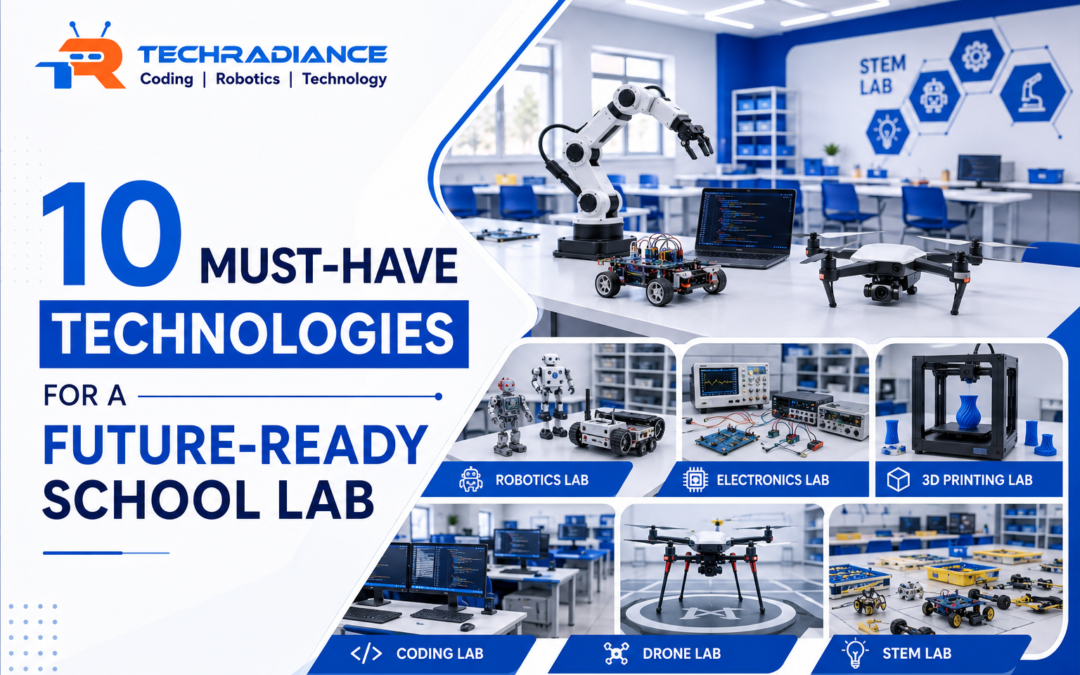
In this article, we’ll look at the10 must-have technologies for a future-ready school laband describe what they are, the reason they’re useful, and how students can benefit from these technologies.
School labs are specially designed learning environments where students learn through practical exercises. Instead of just studying a subject, students get to experience the way it operates in real-world situations.
For instance, a student can study electricity in an instructional book. In a lab, that student could build an easy circuit and watch the light turn on.
Modern labs could comprise robotics kits, computer systems, sensors, 3D printers, drones, AI tools, electronic components, as well as other learning technologies.
The objective is to learn, experiment, create, and solve problems.
Why Do Schools Need Modern Technology Labs?
Technology is now an integral part of nearly every aspect of daily life. Students are using smartphones, computers, tablets, and digital tools all day. Schools can make use of these tools to enhance learning.
Modern labs can help students:
Learn difficult concepts more quickly
Develop problem-solving abilities
Discover through hands-on activities
Increase their creativity
Teams work better when they are in a group.
Create confidence
Learn the way technology functions
Get ready for a future career
Modern labs do not require the use of expensive equipment. The most important factor is selecting the technology that students can use and understand.
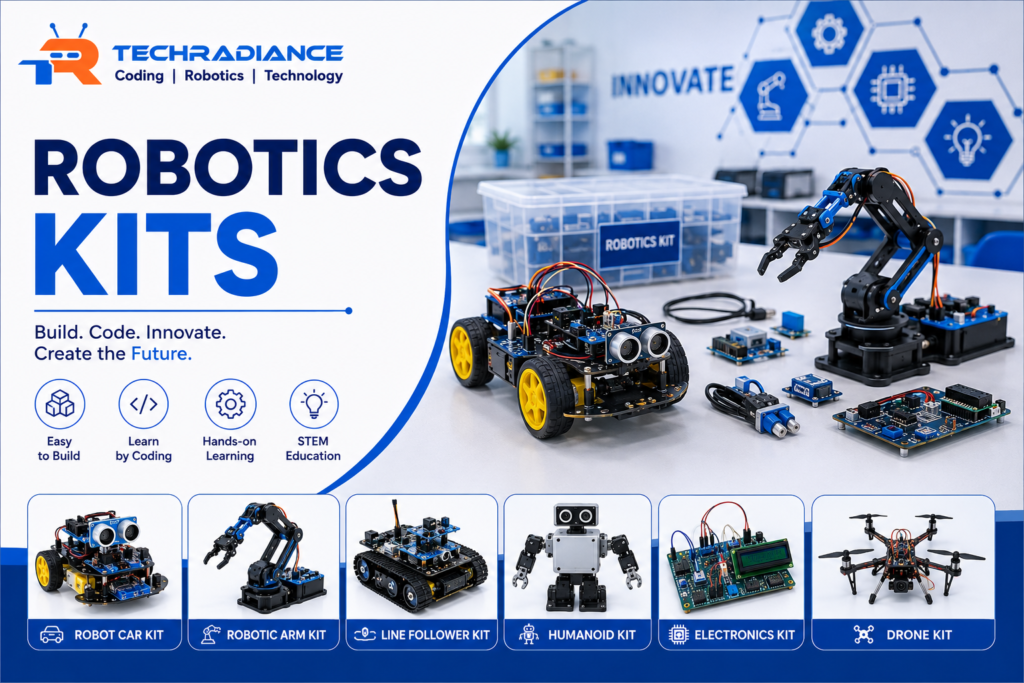
1. Robotics Kits for Hands-On Learning
Robotics is among the most fascinating technologies that students can study in a lab at school.
Robotics in Educationlets students construct and programme basic robots. They will learn about how sensors, motors, batteries, controllers, and software interact.
For example, students could make a line-following robotic device that follows the black lines across the floor. Students can also construct simple robots that avoid obstacles or vehicles.
Why is robotics useful for students?
Robotics helps students think step-by-step. If a robot doesn’t function, the students must discover the cause and then solve the issue.
This fosters creative thinking, logical thinking, and teamwork abilities.
A robotics laboratory can teach students about engineering and programming in a way that is fun.
2. Artificial Intelligence Tools
Artificial Intelligence, or AI, is becoming a crucial component of modern education.
AI in Education will help students understand how computers learn from information and make decisions.
Students are able to learn the basics like machine learning, speech recognition, computer vision, and AI-based apps by engaging in age-appropriate activities.
Students can, for instance, make a simple task that recognises objects by using cameras or study the ways in which an AI system can answer questions.
How does AI help students?
AI activities help students pose questions, like:
“How can the computer detect something?”
“How does a machine understand?”
“Can a computer make a decision?”
These questions can transform technology into an exciting learning experience.
Students should also be taught by schools to utilise AI in a responsible manner and be aware of the fact that AI tools should be used to aid learning, not replace it.
3. 3D Printers for Creative Projects
The 3D printer can be used by students to transform a digital concept into a tangible object.
Imagine a student creating tiny bridges, a gear model house, and robot parts using the computer. A 3D printer will create the design layer-by-layer.
This makes learning more concrete.
What kinds of projects can students create using the help of a 3D printer?
Students can design:
Small engineering models
Robot parts
Science models
Architectural designs
Educational prototypes
Simple mechanical objects
3D printing allows for the integration of design, maths, science, engineering, creativity, and science through one process.
4. IoT and Sensor Technology
The Internet of Things, commonly known as IoT, is a way to connect physical gadgets with the web or to other electronic systems.
Sensors can be used to gauge things like light, temperature, and movement, as well as moisture and distance.
Students can make use of these sensors to make simple projects.
For example, they could create an automated system for watering plants. A moisture sensor could determine whether the soil has dried. If the soil requires irrigation, then the sensor could start the small pump.
What’s the significance of IoT?
IoT aids students in understanding the way our everyday smart devices function.
It also allows them to be introduced to electronic devices, programming automation, and data collection.
These are essential capabilities for future jobs in technology.
5. Smart Classroom Technology
Smart classroomssmart classroom makes use of technology that is digital to help make learning and teaching more engaging.
Displays with interactive screens, projectors, electronic learning tools, apps, and multimedia content can assist teachers in straightforwardly explaining complex topics.
Instead of reading only about the solar system’s history, pupils could view an animated video and discover planets digitally.
What can a smart classroom do to help students learn?
It can be helpful to teachers:
Animations and videos to show
Display interactive lessons
Make complex concepts clear visually
Conduct digital activities
Share learning materials quickly
If smart classroom technology is paired with hands-on lab experiences, students are able to first comprehend concepts digitally before they apply them in real-world situations.
6. Drones and Drone Technology
Drones aren’t just used for shooting. They are also being used as tools for education.
In a lab at school, students will be able to learn the basics of drone technology, which includes flight, sensor controls, motors, and programming.
A drone-based educational activity could teach students about areas like photography, engineering, geography mapping, automation, and more.
What could students learn from drones?
Students can comprehend:
How do drones stay in the air
Motors can help you fly.
How sensors aid in movement
How drone controllers interact with drones
How drones can be utilised to survey and map
If properly monitored and accompanied by security rules, drones could be a fascinating element of modern STEM learning.
7. Coding and Programming Tools
Coding is another essential tech-related skill that students should master.
Students don’t have to start with complex programming languages. Beginning with younger learners is easier. Software for visual programming that uses blocks rather than long code lines.
As they get better at it, they are able to progress to a text-based approach.
Why should students study coding?
Coding is a way of teaching students to:
Break down a huge problem into manageable steps
Be logical
Find mistakes
Create digital projects
Control robots and other devices
Coding can be even more beneficial when students can use the code to manage a robot or game, sensor or any other physical activity.
8. AR and VR Learning Technology
Augmented Reality (AR) along with Virtual Reality (VR) can enhance the learning experience.
With AR, students can experience digital data overlaid on reality. With VR, they are able to experience a computer-generated environment.
For instance, students can go on a virtual tour around space, look at their body’s anatomy, or go to historic sites without having to leave the classroom.
What are the advantages of AR or VR?
These technologies can make complicated or obscure subjects more understandable.
They can also help support Innovative Teaching Methods by providing students with the opportunity to study ideas instead of just studying them.
The most important thing is to utilise AR and VR only when they really improve understanding rather than merely because they are visually appealing.
9. STEM Lab Equipment
A successful lab requires the proper School lab equipment. Technology is beneficial only when students are equipped with the tools required to safely experiment.
Based on the school’s objectives, the equipment used could consist of:
Robotics kits
Sensors
Electronic components
Computers
Microcontrollers
Tools for measuring
3D printers
Coding tools
Kits for science experiments
Safety equipment
What are the most important things schools should think about before purchasing equipment?
Schools should enquire:
Does the equipment meet the needs of the age of the students?
Are students able to use it safely?
Does it help the curriculum?
Do teachers know how to make use of it?
Can students create multiple projects using it?
Do you have technical or training assistance available?
A good STEM education does not mean possessing the latest and top equipment. It’s about providing students with the appropriate tools to research and develop.
10. Digital and Educational Technology
The final technology isn’t just one device. It’s the broad application of Educational Technology to connect learning and experimentation with digital resources, as well as evaluation.
Digital tools can assist teachers in delivering instructions, gathering data from projects, sharing materials, and monitoring the progress of students.
This is the point at which Technology in Education is able to be effective. Technology should be used in conjunction with teachers and not replace them.
For instance, a student can watch a video tutorial, then build an engineering project using robotics, gather information using sensors, and then display the results on computers.
This is a total learning experience.
How Does Technology Support STEM Education in Schools?
STEM education in schools emphasises science, technology, engineering, and maths.
Modern labs allow for the integration of all four of these areas together.
Take a look at a simple and clever irrigation plan.
Students can:
Learn about science through knowing the needs of plants.
Make use of maths to determine the use of water.
Make use of technology via sensors.
Engineers can be used to construct the system.
Utilise coding to automate the process.
This is the reason why practical labs are so beneficial. Students do not learn each subject in isolation. Students are learning about how the different disciplines work together to solve real problems.
What Are the Benefits of Technology-Based School Labs?
Technology-based labs can bring several long-term advantages.
1. Learning Becomes More Interesting
Students will see their ideas transform into actual projects. This can make learning more engaging.
2. Students Learn by Doing
Instead of merely memorising information, students can try out and discover how things function.
3. Problem-Solving Skills Improve
If a task doesn’t work, students should determine the cause and then try it again.
4. Creativity Grows
Students can create their own projects and come up with many ways to solve the problems.
5. Teamwork Improves
Many projects in technology require students to collaborate. Students can write code while the other builds the model.
6. Students Become Ready for the Future
The skills of technology will help students comprehend the current career options that involve engineering AI robot design, software science, and other areas.
How Can Schools Build a Future-Ready Lab?
Schools do not need to set up every technology at the same time.
It is better to begin with the school’s mission and goals as well as student demands.
The first step is to determine what the students need to be taught. Select the best School Lab Equipment and techniques.
Schools should also think about teacher education as well as security of students, maintaining space, and future enhancements.
A great lab must be able to adapt. Students must be able to utilize the same equipment to complete different projects while they go from beginning to advanced tasks.
An expert technology partner can assist schools in planning and setting up their lab efficiently.
Why Choose Techradiance for School Technology Solutions?
Techradianceaids schools in creating practical, technologically based learning environments.
Its method can help schools who want to explore areas like robots, AI, STEM programming, and other new technologies.
The aim should not just be to install machines in an educational setting. A successful lab must assist studentsin understanding how to build, create, experiment, and develop.
If they are planned properly, schools can transform ordinary classrooms into an environment where students learn abilities for the future.
Final Thoughts:
It is the School Lab of 2026, which will be much more than a place packed with machines. It’s a place where students can ask questions, play around, create projects, tackle problems, and make their ideas real-world applications.
Robotics, AI, IoT, 3D printing, drones, coding, drones AR/VR Smart classroom tools and many other tools can help make learning more efficient and enjoyable.
But technology alone cannot guarantee higher education. The combination of excellent instructors, appropriate equipment, practical exercises, and creative teaching methods makes the difference.
If you are a school planning your next steps, the best method is to begin by asking a single question:
What Schools Say About Technology-Based Learning
The value of modern labs in schools can be observed when students begin using technology to develop, test, and work on real-world issues. Here are some examples of student testimonials that demonstrate the benefits schools get from technological learning:
“The robotics-related activities have helped to make our students more engaged in their studies. They love building projects and feel more confident in solving challenges .” — G.D GoenkaSchool Principal
“Our students can understand technology better when they learn through doing. The projects that they work on have made STEM learning more interesting for them.” — STEM Coordinator
“Introducing AI and robotics activities has given our students the opportunities to study techniques that they could use in their careers.” — Summer FieldSchool Director
“The lab exercises encourage students to work together as a team. They make mistakes, but persevere until they discover an answer .” — Vikas Bhart School,Science Teacher
“A properly planned technology lab can convert theoretical knowledge into practical experiences. Students are thrilled to take part in hands-on activities .” — Academic Coordinator
Author: Himanshu ( Content Writer)
Frequently Asked Questions
How many labs are in a school?
The number of labs available depends on the size of the school facilities, curriculum, and other factors. The most common labs for schools comprise computers, science andmaths, as well as robotics, STEM, and language laboratories. Schools may have multiple laboratories based on the students’ requirements.
What is the budget of a STEM lab?
The cost of a STEM lab is contingent on its size, the equipment, and the number of students. A simple STEM lab might need a lower investment, but a high-end lab equipped with robotics, AI, IoT, and 3D printing tools could be more expensive.
How to set up a school laboratory?
In order to set up the school lab, first establish the learning objectives, choose a suitable location and equipment that is appropriate for the age group, design safety measures, educate teachers, and develop an activity that students can do. A qualified lab setup partner will assist schools with designing the equipment, setting it up, and implementing it.
What is the future of robotics in education?
It is likely that the future for robotics in the classroom is exciting. Robotics could help students learn engineering, coding, and logical thinking, as well as creativity and teamwork, and problem-solving abilities, while making them ready for jobs in the field of technology.
Why are robotics and AI important in schools?
Robotics and AI assist students in understanding the latest technology by utilizing it in their learning. They teach problem-solving, creativity, and coding skills as well as logical thinking and other abilities that are valuable for future studies as well as jobs.
Which technology is best for school students?
There is no one best technology for each student. Robotics, coding, AI, IoT, 3D printing, and AR/VR can be beneficial if chosen in accordance with students’ age, the curriculum objectives, learning goals, as well as the level of their education.
How much does a school lab cost?
The cost of running a school laboratory is contingent on the type of lab, its size, the equipment technology, infrastructure, and the training needed. A basic lab is less expensive than a more advanced lab that includes robotics, AI, IoT, or 3D printing, which needs a bigger budget.
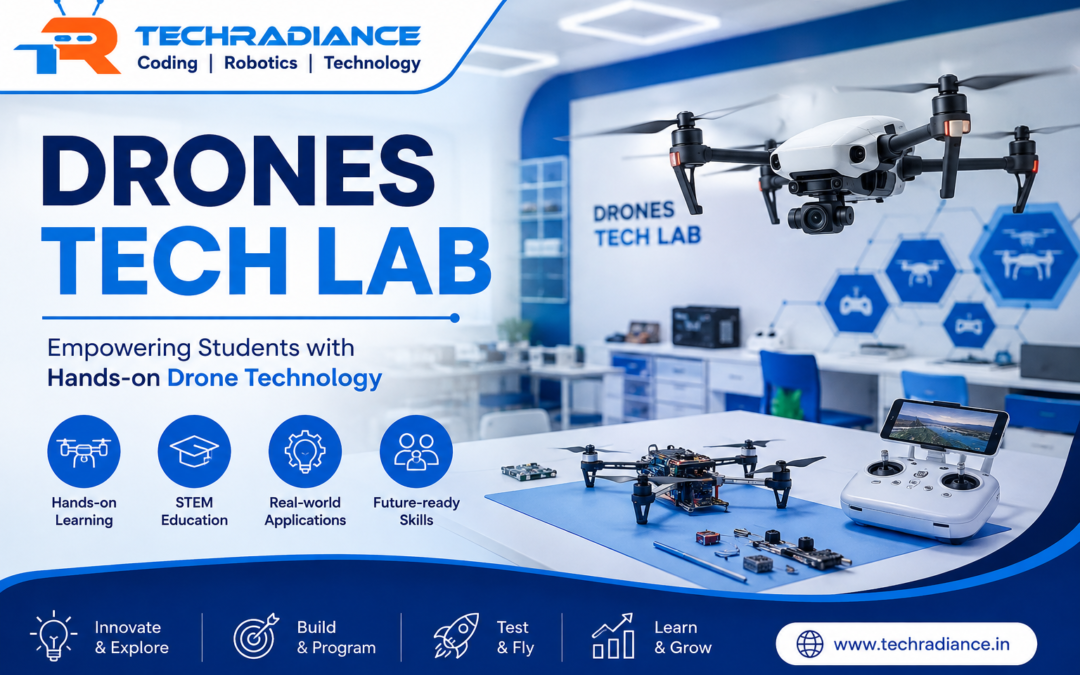
Technology in the present day is evolving rapidly. Schooling is also revolutionizing how students learn. Instead of merely studying books, students nowadays are learning through exercises. One of the most effective methods to make learning more exciting is to set up an Drones Tech Lab in schools.
Drones are tiny flying machine that is controlled by a remote or computer software. Students will learn about how drones operate and how they fly and how they are utilized in various industries. The Drone Lab offers students hands-on experiences using the latest technology, and helps students develop important capabilities for the future.
Techradiance , we support schools design contemporary technology laboratories that motivate students to study, discover and create. Drone labs are created in accordance with the requirements of schools and the most recent standards in education.
The Drones Tech Lab is a unique classroom where students are taught about drone technology through hands-on exercises. They are aware of the way drones are constructed as well as how they are programmed, tested and safe to operate.
Instead of watching videos or reading about theory students can construct drones, fly them and discover how sensors, motors batteries, and cameras are interconnected.
This kind of practical education can make math, science programming, engineering, and coding significantly more exciting
Why Should Schools Have a Drone Lab?
Schools should help students prepare for the future of their careers. Drone technology is employed in a variety of industries, and the use is increasing every year.
A Drone Lab helps students:
Be aware of modern technology from an young age
Enhance problem-solving abilities
Develop creativity and inspire innovation
Learn about electronics and coding
Create teamwork and improve collaboration
Build confidence through hands-on learning
Students love learning because they can see the real-world outcomes from their work.
How Does a Drone Lab Help Students?
Drone labs provide an interactive learning experience that makes learning fun and memorable.
Students are taught how to:
Create simple drones
Learn about drone parts
Fly drones in safety
Program flight paths
Find solutions to technical issues
Real-world projects
These activities help develop the students’ critical thinking skills and inspire them to be future creators.
Drone Tech Lab Curriculum for Schools
A well-designed curriculum must be simple enough for novices and then gradually introduce more advanced concepts.
Module 1: Introduction to Drones
Students are taught:
A drone is what?
Drones are of various types
The history of drones
Everyday use of drones
Module 2: Drone Components
Students understand:
Motors
Propellers
Batteries
Controller for flight
GPS
Sensors
Camera systems
Module 3: Drone Assembly
Students are taught:
Identifying drone components
Connecting components
Balance the drone
Basic maintenance
Module 4: Drone Flying Basics
Students are taught:
Safety rules
Controls of flight
Take-off
Landing
Hovering
Control of direction
Module 5: Drone Programming
Students explore:
Basic Coding
Flight automation
Sensor programming
Simple drone missions
Module 6: Real-Life Applications
Students learn about drones and how they are utilized in:
Agriculture
Photography
Disaster management
Mapping
Delivery services
Construction
Environmental monitoring
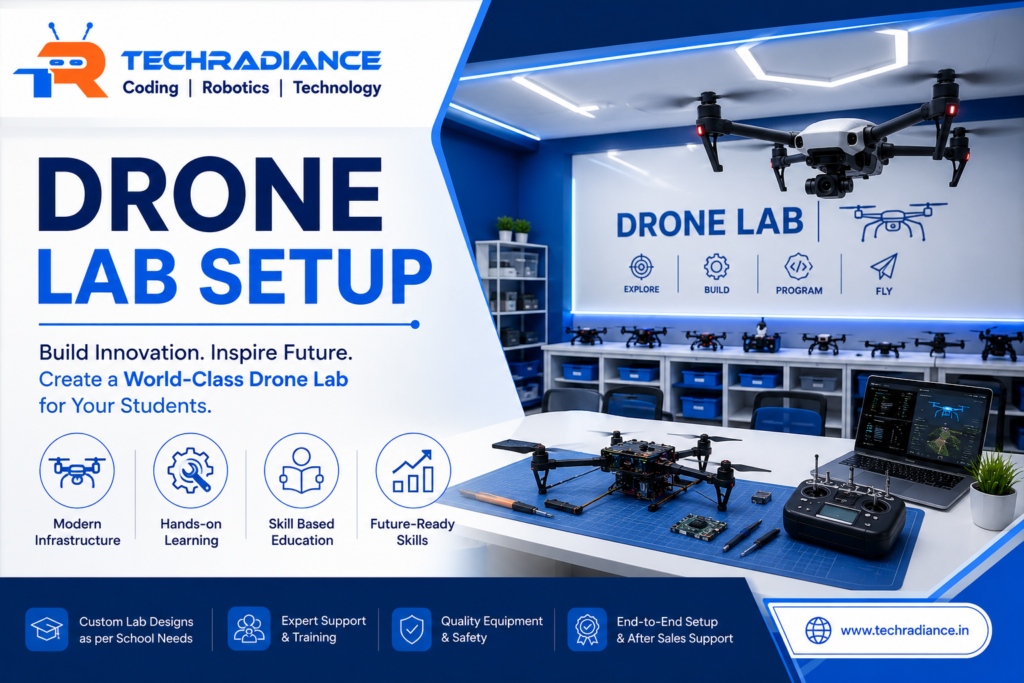
What Is Included in a Drone Lab Setup?
The complete Drone Lab Setup typically comprises:
Educational drones
Practice drones
Software for flight simulators
Charging station
Battery spares
Safety equipment
Repair toolkit
Manuals for training
Teacher Training
Kits for practical activities
Schools can select different sizes of labs based on the amount of students.
How Much Does a Drone Tech Lab Cost in 2026?
The cost of the cost of a Drones Tech Lab depends on many factors.
They include:
Students in the number
The type of drones
Software needs
Safety equipment
Training sessions
Lab furniture
Support for maintenance
Small schools generally need a basic set-up and larger schools might select advanced labs equipped with more drones, as well as additional training tools.
Techradiance provides customized drone lab solutions to accommodate different budgets for schools and learning objectives.
Benefits of a Drones Tech Lab
Modern Drones Tech Lab has many long-term advantages.
Better Learning
Students learn concepts through hands-on tasks instead of merely memorizing information.
Future Skills
They study programming, robotics, electronics and solving problems.
Higher Student Engagement
The hands-on activities make the classes more engaging and fun.
Improved Creativity
Students create, build, as well as test the design of their personal drones.
Career Readiness
The knowledge gained from drones prepares students for careers in engineering and technology.
Where Are Drone Services Used?
Presently, Drone services are gaining popularity across a variety of industries.
A few of the most popular applications are:
Agriculture
Surveying land
Photography
Film production
Construction
Monitoring traffic
Emergency rescue
Conservation of wildlife
Inspection of the infrastructure
Understanding these industries will help students to understand the practical applications in the real world.
Why Do People Search for “Drone Services Near Me”?
Many people go online to find drone companies near me in the event that they require aerial photography surveying, land surveys, inspections or mapping services.
When they learn about drone technology in high school, students are able to understand the ways these professional services function and what they need to know to be successful in this rapidly growing field.
Why Choose Techradiance for Drone Lab Setup?
Techradiance offers complete technology for education solutions for schools.
We can provide:
Drone labs that are customized to your specifications
Simple to follow program
Teacher formation
Practical activities for learning
Technical assistance
Modern educational equipment for schools
A student-friendly approach to learning
Our mission is to make learning about technology easy, enjoyable and future-proof.
What Schools Say About Techradiance
“The drone lab helped make our science classes more engaging. Students are eager to learn each day. ” – School Principal
“The STEM curriculum is easy practical and simple for students to comprehend. ” – STEM Teacher
“Our students are now enthused by robots and coding because they are able to apply the lessons they learned through the lab for drones. ” – Computer Teacher
“Techradiance managed the drone lab in a professional manner and also provided great teacher training. ” – School Administrator
“Parents are thrilled to watch their children learn the latest technology through hands-on activities. ” – Academic Coordinator
Final Thoughts:
An Drones Tech Lab is a great investment for schools who want to prepare their students for their future. It blends practical education along with coding, creativity engineering, science, and math in a way that is engaging. With the correct Drone Lab Set-Up students learn essential skills that can enable them to succeed in further education and in future career opportunities.
As drone technology continues to advance and schools that offer the opportunities to learn today will be able to give their students an edge in the future. Techradiance is dedicated to helping schools develop modern learning environments that are customized with drone labs, easy-to follow curriculum as well as ongoing support helping to make technology education easy, fun and future-ready.
Frequently Asked Questions
1. What is a Drones Tech Lab?
Drones Tech Lab is a Drones Tech Lab is a learning environment that lets students construct drones, program and fly drones while studying the science of coding, science and engineering through hands-on tasks.
2. Why is a drone lab important for schools?
A drone lab is a great way for students to acquire future-ready skills, boost their creativity, and gain knowledge of the latest technologies.
3. How does a drone lab help students?
Students develop the importance of teamwork and coding, as well as electronics problem-solving, as well as safe drone operation by engaging in practical activities.
4. What is included in a drone lab setup?
A typical setup comprises batteries, drones that are educational and charging stations, as well as security equipment and software and even training tools.
5. Can beginners learn drone technology?
Yes. A great curriculum begins with the basics which makes it easy for students and beginners to master the concepts step-by-step.