
10 Must-Have Technologies for a Future-Ready School Lab in 2026
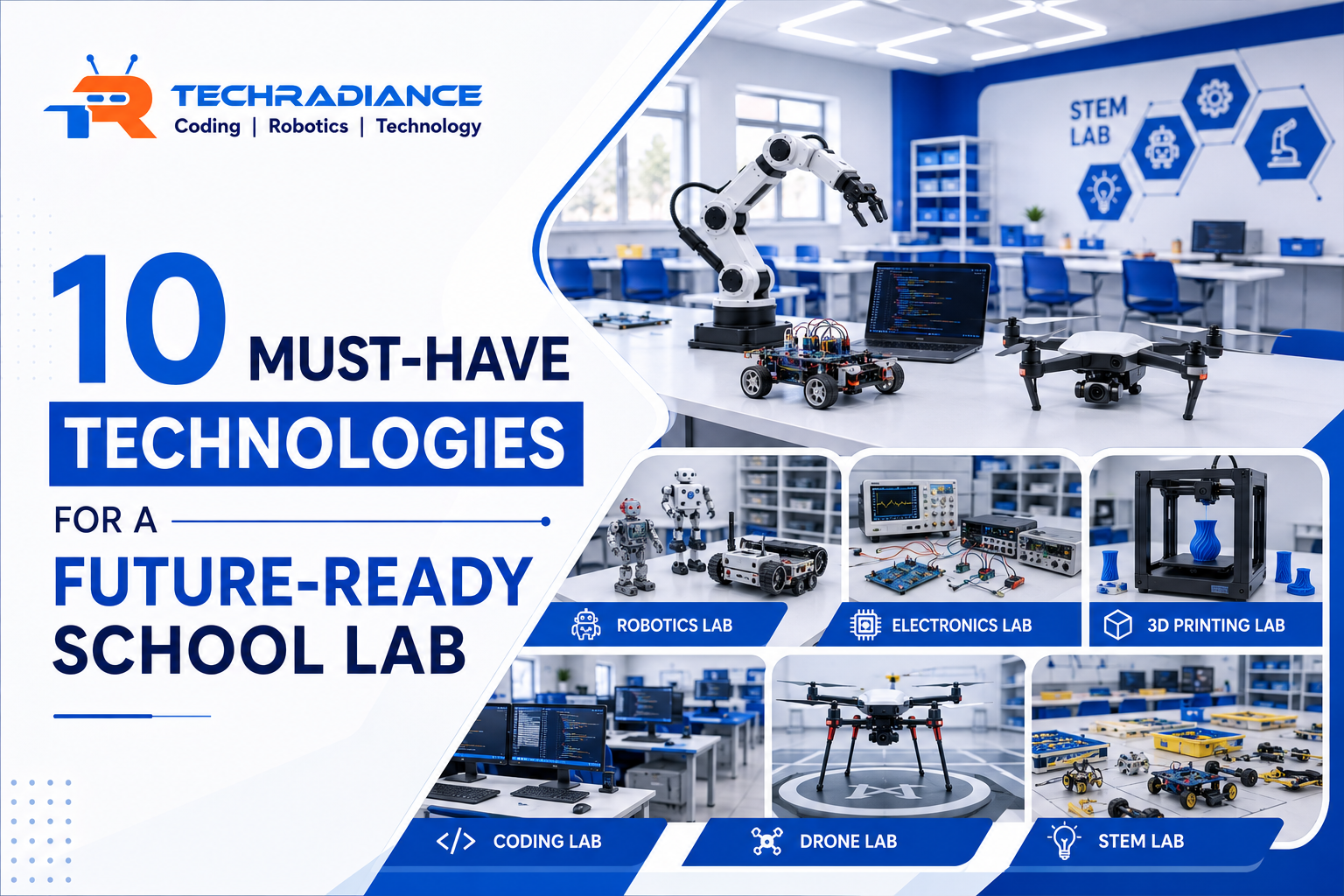
Schools are rapidly changing. Students today require more than blackboards and textbooks. They must also learn the workings of technology and how to use it to tackle real-world issues.
This is the reason why modern School Labs have become a vital component of learning. The best school labs provide students a space where they can play around, create things, fail, and then learn from their mistakes.
From robotics and artificial intelligence to 3D printing and intelligent technologies for learning, technological advancements have the potential to help make learning more useful and engaging.
But what technology do schools need to have in 2026? How can schools select the best technology?
In this article, we’ll look at the10 must-have technologies for a future-ready school lab and describe what they are, the reason they’re useful, and how students can benefit from these technologies.
What Are School Labs?
School labs are specially designed learning environments where students learn through practical exercises. Instead of just studying a subject, students get to experience the way it operates in real-world situations.
For instance, a student can study electricity in an instructional book. In a lab, that student could build an easy circuit and watch the light turn on.
Modern labs could comprise robotics kits, computer systems, sensors, 3D printers, drones, AI tools, electronic components, as well as other learning technologies.
The objective is to learn, experiment, create, and solve problems.
Why Do Schools Need Modern Technology Labs?
Technology is now an integral part of nearly every aspect of daily life. Students are using smartphones, computers, tablets, and digital tools all day. Schools can make use of these tools to enhance learning.
Modern labs can help students:
- Learn difficult concepts more quickly
- Develop problem-solving abilities
- Discover through hands-on activities
- Increase their creativity
- Teams work better when they are in a group.
- Create confidence
- Learn the way technology functions
- Get ready for a future career
Modern labs do not require the use of expensive equipment. The most important factor is selecting the technology that students can use and understand.
1. Robotics Kits for Hands-On Learning
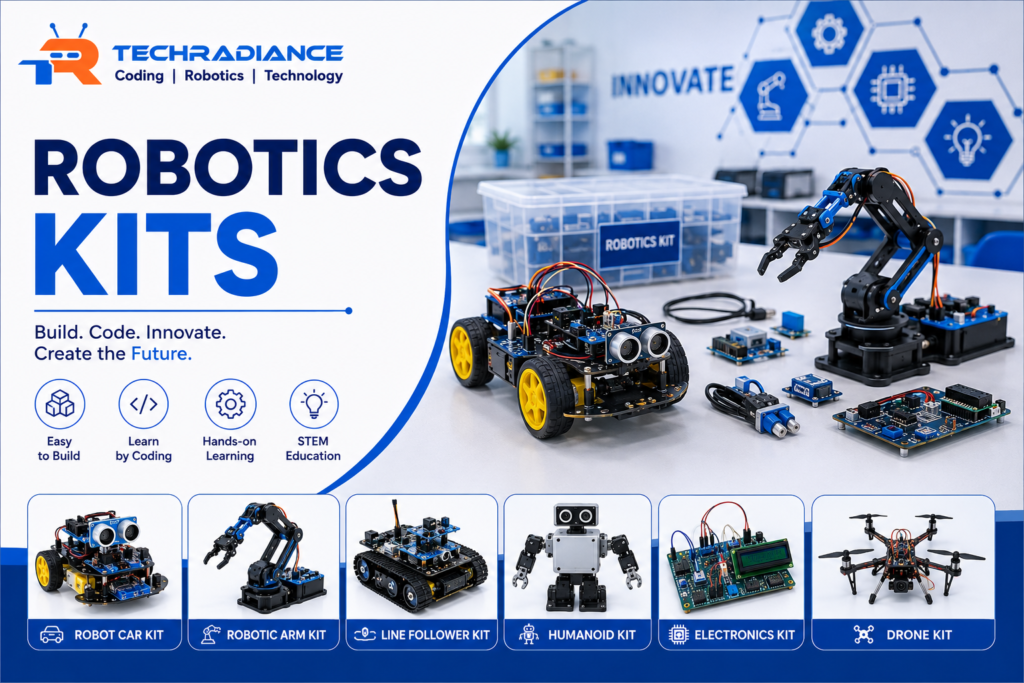
Robotics is among the most fascinating technologies that students can study in a lab at school.
Robotics in Education lets students construct and programme basic robots. They will learn about how sensors, motors, batteries, controllers, and software interact.
For example, students could make a line-following robotic device that follows the black lines across the floor. Students can also construct simple robots that avoid obstacles or vehicles.
Why is robotics useful for students?
Robotics helps students think step-by-step. If a robot doesn’t function, the students must discover the cause and then solve the issue.
This fosters creative thinking, logical thinking, and teamwork abilities.
A robotics laboratory can teach students about engineering and programming in a way that is fun.
2. Artificial Intelligence Tools
Artificial Intelligence, or AI, is becoming a crucial component of modern education.
AI in Education will help students understand how computers learn from information and make decisions.
Students are able to learn the basics like machine learning, speech recognition, computer vision, and AI-based apps by engaging in age-appropriate activities.
Students can, for instance, make a simple task that recognises objects by using cameras or study the ways in which an AI system can answer questions.
How does AI help students?
AI activities help students pose questions, like:
“How can the computer detect something?”
“How does a machine understand?”
“Can a computer make a decision?”
These questions can transform technology into an exciting learning experience.
Students should also be taught by schools to utilise AI in a responsible manner and be aware of the fact that AI tools should be used to aid learning, not replace it.
3. 3D Printers for Creative Projects
The 3D printer can be used by students to transform a digital concept into a tangible object.
Imagine a student creating tiny bridges, a gear model house, and robot parts using the computer. A 3D printer will create the design layer-by-layer.
This makes learning more concrete.
What kinds of projects can students create using the help of a 3D printer?
Students can design:
- Small engineering models
- Robot parts
- Science models
- Architectural designs
- Educational prototypes
- Simple mechanical objects
3D printing allows for the integration of design, maths, science, engineering, creativity, and science through one process.
4. IoT and Sensor Technology
The Internet of Things, commonly known as IoT, is a way to connect physical gadgets with the web or to other electronic systems.
Sensors can be used to gauge things like light, temperature, and movement, as well as moisture and distance.
Students can make use of these sensors to make simple projects.
For example, they could create an automated system for watering plants. A moisture sensor could determine whether the soil has dried. If the soil requires irrigation, then the sensor could start the small pump.
What’s the significance of IoT?
IoT aids students in understanding the way our everyday smart devices function.
It also allows them to be introduced to electronic devices, programming automation, and data collection.
These are essential capabilities for future jobs in technology.
5. Smart Classroom Technology
Smart classroomssmart classroom makes use of technology that is digital to help make learning and teaching more engaging.
Displays with interactive screens, projectors, electronic learning tools, apps, and multimedia content can assist teachers in straightforwardly explaining complex topics.
Instead of reading only about the solar system’s history, pupils could view an animated video and discover planets digitally.
What can a smart classroom do to help students learn?
It can be helpful to teachers:
- Animations and videos to show
- Display interactive lessons
- Make complex concepts clear visually
- Conduct digital activities
- Share learning materials quickly
If smart classroom technology is paired with hands-on lab experiences, students are able to first comprehend concepts digitally before they apply them in real-world situations.
6. Drones and Drone Technology
Drones aren’t just used for shooting. They are also being used as tools for education.
In a lab at school, students will be able to learn the basics of drone technology, which includes flight, sensor controls, motors, and programming.
A drone-based educational activity could teach students about areas like photography, engineering, geography mapping, automation, and more.
What could students learn from drones?
Students can comprehend:
- How do drones stay in the air
- Motors can help you fly.
- How sensors aid in movement
- How drone controllers interact with drones
- How drones can be utilised to survey and map
If properly monitored and accompanied by security rules, drones could be a fascinating element of modern STEM learning.
7. Coding and Programming Tools
Coding is another essential tech-related skill that students should master.
Students don’t have to start with complex programming languages. Beginning with younger learners is easier. Software for visual programming that uses blocks rather than long code lines.
As they get better at it, they are able to progress to a text-based approach.
Why should students study coding?
Coding is a way of teaching students to:
- Break down a huge problem into manageable steps
- Be logical
- Find mistakes
- Create digital projects
- Control robots and other devices
Coding can be even more beneficial when students can use the code to manage a robot or game, sensor or any other physical activity.
8. AR and VR Learning Technology
Augmented Reality (AR) along with Virtual Reality (VR) can enhance the learning experience.
With AR, students can experience digital data overlaid on reality. With VR, they are able to experience a computer-generated environment.
For instance, students can go on a virtual tour around space, look at their body’s anatomy, or go to historic sites without having to leave the classroom.
What are the advantages of AR or VR?
These technologies can make complicated or obscure subjects more understandable.
They can also help support Innovative Teaching Methods by providing students with the opportunity to study ideas instead of just studying them.
The most important thing is to utilise AR and VR only when they really improve understanding rather than merely because they are visually appealing.
9. STEM Lab Equipment
A successful lab requires the proper School lab equipment. Technology is beneficial only when students are equipped with the tools required to safely experiment.
Based on the school’s objectives, the equipment used could consist of:
- Robotics kits
- Sensors
- Electronic components
- Computers
- Microcontrollers
- Tools for measuring
- 3D printers
- Coding tools
- Kits for science experiments
- Safety equipment
What are the most important things schools should think about before purchasing equipment?
Schools should enquire:
- Does the equipment meet the needs of the age of the students?
- Are students able to use it safely?
- Does it help the curriculum?
- Do teachers know how to make use of it?
- Can students create multiple projects using it?
- Do you have technical or training assistance available?
A good STEM education does not mean possessing the latest and top equipment. It’s about providing students with the appropriate tools to research and develop.
10. Digital and Educational Technology
The final technology isn’t just one device. It’s the broad application of Educational Technology to connect learning and experimentation with digital resources, as well as evaluation.
Digital tools can assist teachers in delivering instructions, gathering data from projects, sharing materials, and monitoring the progress of students.
This is the point at which Technology in Education is able to be effective. Technology should be used in conjunction with teachers and not replace them.
For instance, a student can watch a video tutorial, then build an engineering project using robotics, gather information using sensors, and then display the results on computers.
This is a total learning experience.
How Does Technology Support STEM Education in Schools?
STEM education in schools emphasises science, technology, engineering, and maths.
Modern labs allow for the integration of all four of these areas together.
Take a look at a simple and clever irrigation plan.
Students can:
- Learn about science through knowing the needs of plants.
- Make use of maths to determine the use of water.
- Make use of technology via sensors.
- Engineers can be used to construct the system.
- Utilise coding to automate the process.
This is the reason why practical labs are so beneficial. Students do not learn each subject in isolation. Students are learning about how the different disciplines work together to solve real problems.
What Are the Benefits of Technology-Based School Labs?
Technology-based labs can bring several long-term advantages.
1. Learning Becomes More Interesting
Students will see their ideas transform into actual projects. This can make learning more engaging.
2. Students Learn by Doing
Instead of merely memorising information, students can try out and discover how things function.
3. Problem-Solving Skills Improve
If a task doesn’t work, students should determine the cause and then try it again.
4. Creativity Grows
Students can create their own projects and come up with many ways to solve the problems.
5. Teamwork Improves
Many projects in technology require students to collaborate. Students can write code while the other builds the model.
6. Students Become Ready for the Future
The skills of technology will help students comprehend the current career options that involve engineering AI robot design, software science, and other areas.
How Can Schools Build a Future-Ready Lab?
Schools do not need to set up every technology at the same time.
It is better to begin with the school’s mission and goals as well as student demands.
The first step is to determine what the students need to be taught. Select the best School Lab Equipment and techniques.
Schools should also think about teacher education as well as security of students, maintaining space, and future enhancements.
A great lab must be able to adapt. Students must be able to utilize the same equipment to complete different projects while they go from beginning to advanced tasks.
An expert technology partner can assist schools in planning and setting up their lab efficiently.
Why Choose Techradiance for School Technology Solutions?
Techradiance aids schools in creating practical, technologically based learning environments.
Its method can help schools who want to explore areas like robots, AI, STEM programming, and other new technologies.
The aim should not just be to install machines in an educational setting. A successful lab must assist students in understanding how to build, create, experiment, and develop.
If they are planned properly, schools can transform ordinary classrooms into an environment where students learn abilities for the future.
Final Thoughts:
It is the School Lab of 2026, which will be much more than a place packed with machines. It’s a place where students can ask questions, play around, create projects, tackle problems, and make their ideas real-world applications.
Robotics, AI, IoT, 3D printing, drones, coding, drones AR/VR Smart classroom tools and many other tools can help make learning more efficient and enjoyable.
But technology alone cannot guarantee higher education. The combination of excellent instructors, appropriate equipment, practical exercises, and creative teaching methods makes the difference.
If you are a school planning your next steps, the best method is to begin by asking a single question:
What Schools Say About Technology-Based Learning
The value of modern labs in schools can be observed when students begin using technology to develop, test, and work on real-world issues. Here are some examples of student testimonials that demonstrate the benefits schools get from technological learning:
“The robotics-related activities have helped to make our students more engaged in their studies. They love building projects and feel more confident in solving challenges .”
— G.D Goenka School Principal
“Our students can understand technology better when they learn through doing. The projects that they work on have made STEM learning more interesting for them.”
— STEM Coordinator
“Introducing AI and robotics activities has given our students the opportunities to study techniques that they could use in their careers.”
— Summer Field School Director
“The lab exercises encourage students to work together as a team. They make mistakes, but persevere until they discover an answer .”
— Vikas Bhart School, Science Teacher
“A properly planned technology lab can convert theoretical knowledge into practical experiences. Students are thrilled to take part in hands-on activities .”
— Academic Coordinator
Author: Himanshu ( Content Writer)
Frequently Asked Questions
How many labs are in a school?
The number of labs available depends on the size of the school facilities, curriculum, and other factors. The most common labs for schools comprise computers, science and maths, as well as robotics, STEM, and language laboratories. Schools may have multiple laboratories based on the students’ requirements.
What is the budget of a STEM lab?
The cost of a STEM lab is contingent on its size, the equipment, and the number of students. A simple STEM lab might need a lower investment, but a high-end lab equipped with robotics, AI, IoT, and 3D printing tools could be more expensive.
How to set up a school laboratory?
In order to set up the school lab, first establish the learning objectives, choose a suitable location and equipment that is appropriate for the age group, design safety measures, educate teachers, and develop an activity that students can do. A qualified lab setup partner will assist schools with designing the equipment, setting it up, and implementing it.
What is the future of robotics in education?
It is likely that the future for robotics in the classroom is exciting. Robotics could help students learn engineering, coding, and logical thinking, as well as creativity and teamwork, and problem-solving abilities, while making them ready for jobs in the field of technology.
Why are robotics and AI important in schools?
Robotics and AI assist students in understanding the latest technology by utilizing it in their learning. They teach problem-solving, creativity, and coding skills as well as logical thinking and other abilities that are valuable for future studies as well as jobs.
Which technology is best for school students?
There is no one best technology for each student. Robotics, coding, AI, IoT, 3D printing, and AR/VR can be beneficial if chosen in accordance with students’ age, the curriculum objectives, learning goals, as well as the level of their education.
How much does a school lab cost?
The cost of running a school laboratory is contingent on the type of lab, its size, the equipment technology, infrastructure, and the training needed. A basic lab is less expensive than a more advanced lab that includes robotics, AI, IoT, or 3D printing, which needs a bigger budget.