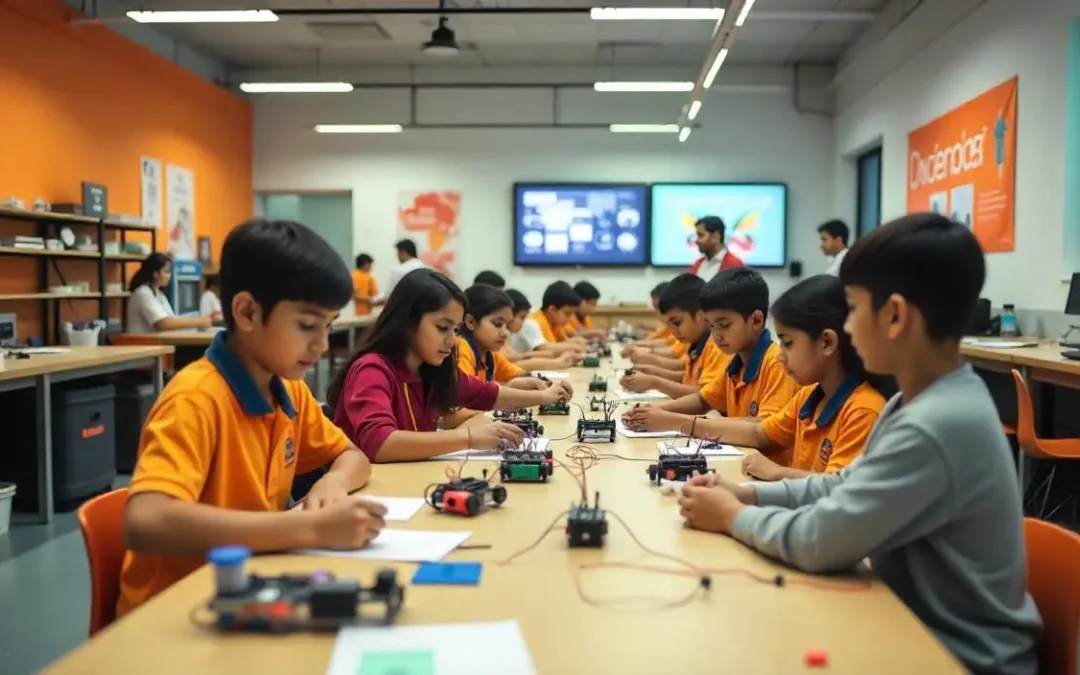
Robotics is the key to this rapid technological evolution. Robotics Lab setups in schools are being integrated worldwide to provide students with skills they will need in the future. These labs provide hands-on experiences to develop problem-solving skills, coding, and engineering.
This blog will explore the importance, their benefits, and how an efficient Robotics Lab setup enhances education.
Why Robotics Lab Setups in Schools Are Important
1. Bridging the Gap Between Theory and Practice
The traditional teaching methods are based on theoretic knowledge which is not always engaging for students. A Robotic lab setups allows students to apply their knowledge practically, making STEM subjects interactive. Robotics is a great way for students to learn, experiment, and understand scientific concepts
2. Encouraging STEM Learning from an Early Age
In today’s competitive job market, STEM (Science, Technology, Engineering, Mathematics) education is essential. Early robotics exposure helps students understand STEM concepts. A well-equipped Robotics Lab in Schoolsencourages innovation, and logical thinking and prepares students for careers in technology and science.
3. Enhancing Coding and Computational Skills
Learning to code has become a necessity for industries that rely on automation. Robotics Kit setups for Kids feature beginner-friendly interfaces that make it easier for students to pick up languages such as Python, C++, and Scratch. This exposure to computational thinking is essential for the digital age.
Benefits of Robotics Labs in Schools
1. Hands-on Learning Experience
Robotics education is more interactive than traditional classroom instruction. Students can design, build and program robots to improve their understanding of electronics, physics, and mechanics. A Robotic lab setups is a great way to engage students and help them understand technical concepts.
2. Development of Problem-Solving and Analytical Skills
Students who work on robotics challenges are faced with problems that require them to use critical thinking and troubleshooting. Students learn to test solutions, analyze problems, and refine designs. These analytical skills can be applied to many career paths, including software development and engineering.
3. Enhances Teamwork and Collaboration
The majority of robotics labs in schools are based on group projects that help students develop communication and teamwork skills. Students learn how to share ideas and collaborate to reach a common goal. They also learn how to delegate tasks. In professional environments, these interpersonal skills are highly valued.
4. Prepares Students for Future Careers
Robotics, artificial intelligence, and other technologies are revolutionizing industries like healthcare, manufacturing, and space exploration. Robotics kits for kids are a great way for schools to provide their students with the skills they need for high-demand jobs. Early exposure to STEM gives students an edge in STEM careers.
5. Boosts Creativity and Innovation
Students are encouraged to explore their ideas through robotics education, which can lead to new solutions. A robotic lab setups that is well-equipped allows students to test and develop their ideas, encouraging a technological mindset.
How to Robotics Lab Set Up in Schools
To ensure a successful learning environment, it is essential to plan carefully before setting up a robot lab. Here are some tips on how to successfully implement a Robotic program in schools:
1. Choosing the Right Robotics Kits for Kids
It is important to choose the right Robotics kit for kids. Schools should purchase kits that are age-appropriate and cater to various learning levels. Popular choices include:
LEGO Mindstorms– A visual programming environment that is ideal for beginners.
Arduino-based kits — Great for students who are interested in electronics and programming.
Raspberry Pi Kits are Suitable for advanced students working on complex projects.
VEX Robotics – Designed for competitive robot education.
2. Designing the Robotics Lab Setup
The following should be included in a well-organized lab setup:
Students’ safety is ensured by following safety guidelines and protective measures.
3. Training Teachers for Robotics Education
Teachers play an important role in the implementation of robotics education. Teachers who receive adequate training are better equipped to guide students in robotics projects. To improve the robotics expertise of teachers, schools should invest in workshops or certification programs.
4. Integrating Robotics into the School Curriculum
Robotics is a subject that should be integrated into existing STEM courses, rather than treated as an independent one. Robotics can be integrated into existing STEM courses such as physics, math, and computer sciences to enhance the learning experience through project-based activities.
The Future of Robotics Education in Schools:
1. Expanding AI and Machine Learning in Robotics
Future robotics labs in schools are likely to include AI-driven projects as artificial intelligence (AI), machine learning, and other technologies continue to develop. Students will get hands-on training with real-world AI apps, enhancing their technical skills.
2. Increasing Accessibility of Robotics Kits for Kids
Robotics Kits for Kids are becoming more affordable as the cost of robotics technology decreases. This affordability will enable more schools to implement robot education. Students can then benefit from hands-on STEM learning.
3. Growth of Robotics Competitions and Hackathons
Encourage students to take part in robotics contests such as First Robotics or RoboCup. This fosters healthy competition and problem-solving. These events provide students with an opportunity to demonstrate their skills, build teamwork, and gain real-world experiences.
Final Thoughts:
Robotics Lab setups inSchoolsno longer are a luxury, they are essential to preparing students for the future. Integrating robotics into the curriculum can help schools improve STEM education, foster critical thinking, and develop practical skills in today’s technologically driven world.
With a well-structured robot lab setup available, students can gain practical experience in robotics. Investing today in robotics education means that you are empowering the future generation of engineers, innovators, and technology leaders.
Robotics is a great way to help students become problem solvers.
Frequently Asked Questions ( FAQ’S)
1. What is a Robotics Lab in Schools?
A Robotics Lab for Schools provides a dedicated area where students can learn STEM concepts, robotics, and coding through robotics kits for kids.
2. Why are Robotics Lab setups Important for Schools?
These courses help students develop their problem-solving skills, critical thinking, and technical abilities, which will prepare them for careers in STEM fields.
3. How can Schools Benefit from a Robotics Lab Setup?
A robot lab setup improves the practical learning of students, encourages creativity and teamwork, and enhances their teamwork.
4. How Can Techradiance Help Schools Robotics Lab SetUps?
Techradiance offers expert guidance, robot kits, training programs, and assistance to schools in implementing robotics lab setups.
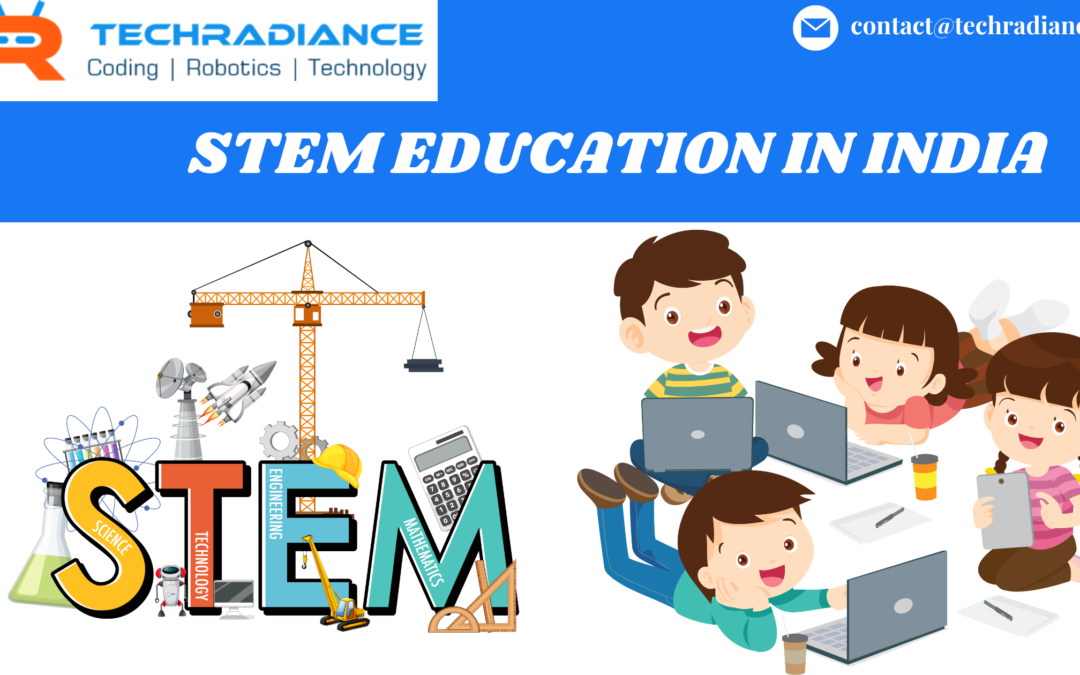
STEM Education in India means learning math, science, technology, and engineering interestingly and creatively. By participating in activities rather than just reading texts it helps students in understanding concepts. It becomes STEAM education when the arts are included. Students can learn how things work by building basic robots, apps, or tiny machinery.
Children who receive this kind of education are better able to think strategically, solve issues, and collaborate effectively. Additionally, it prepares them for careers in fields like space technology, artificial intelligence (AI), and coding.
Many Indian educational institutions and companies, like Techradiance, provide STEM labs and courses where children can gain knowledge by doing. STEM education is becoming more crucial for creating a bright and modern future in India, even though some schools have fewer teachers or fewer resources.
STEM Education means education that combines math, science, technology, and engineering. Students understand how these topics work in real life rather than studying them one at a time. For example, when kids build a tiny robot, they use technology to control it, math to measure it, and science to make it move. This increases the enjoyment and usefulness of learning.
Students in STEM programs ask questions, explore new ideas, and work through actual situations in addition to reading texts. These days, a lot of Indian schools use STEM or STEAM (which includes art) to help kids study more effectively and get ready for the future in an easy and fun way.
Why are STEM courses in India important?
STEM Courses in India are crucial because they teach students the skills they will need throughout their lives. STEM stands for Science, Technology, Engineering, and Math. The subjects taught in these courses help students understand how to make decisions, think critically, and work on real-world projects. If children begin STEM classes early, they gain confidence, a major benefit for their future. The courses allow students to have fun learning through creative concepts and hands-on exercises. This is the reason why many colleges in India are introducing STEM courses to make students smarter and better prepared for a variety of tasks.
Benefits of STEM Education in India
Learn by doing – Students take part in enjoyable projects in tech, science, arts, math, and art that make learning fun.
Learn to Think More – It assists children in tackling problems in clever and innovative ways.
Team skills – Students collaborate and share ideas, exactly like real life.
Future-Ready – STEAM education helps build the skills required for jobs of tomorrow.
Creative Learning – It blends science and art, which means that students are able to use both their imagination and logic.
Where You Can Learn STEM Courses in India?
STEM Courses in India are now taught in many Indian schools and learning institutions. However, Techradiance offers specialized labs and workshops where students can create machines, build robots, or solve problems using computers. Students can enjoy learning and prepare for their future careers in these settings.
Future of STEM Education in India
With the development of technologies like artificial intelligence (AI), robots, space travel, and smart devices, the world is rapidly changing. People with an understanding of science and technology will have greater opportunities to work in exciting fields in the future.
Students are being prepared for this new future through STEM Education in India. It assists young brains in developing their creativity, self-assurance, and preparation for the future. STEM will be included in every child’s education as more parents and schools recognize its benefits.
STEM education provides India’s gifted kids with the skills they need to succeed in the global arena. More Indian children will be creating apps, creating machines, and coming up with clever answers to global issues in the years to come.
Techradiance and STEM Learning
One of the top brands assisting Indian kids in their STEM education is Techradiance. It provides school children with specialized workshops and courses. Students can study subjects such as:
Robotics
Coding
Artificial Intelligence
Development of Apps
The Internet of Things
At Techradiance, education is enjoyable. Youngsters can create their first computer programs, construct actual robots, and enter contests to showcase their ideas. Children of all ages, including beginners, can participate in these programs. Students can participate and enjoy learning something new, even if they are just getting started.
Techradiance believes that every child has talent. They have the potential to lead science and technology in the future with the correct guidance and intelligent instruction.
Challenges in Implementing STEM Courses in India
Although STEM Courses in Indiaoffer many benefits, there are some challenges.
Lack of Resources: Many schools struggle to fund advanced technology and equipment.
Teacher Education: Not all educators are equipped to teach interdisciplinary subjects.
Curriculum Adaptation: Schools might need to restructure their traditional curricula to incorporate STEAM methods.
As we move into the year 2025, STEM Educationin India will remain essential to preparing our students for their future. It helps learners to be well-equipped for a world that is increasingly technology-driven by encouraging creativity, critical thought, and problem-solving skills. To make STEAM effective and accessible for all students, schools, educators and policymakers need to work together.
Success Stories from STEM Learners
1.Parents Testimonials “My son attended a STEM workshop run by Techradiance, and I was awestruck to observe him building a small robot by himself. STEM Education in India is helping kids like him learn in a fun way. He is now more confident and is enjoying everyday science. ” – Ritu Sharma, Parent
2. Student Testimonial “I always believed that science was dull. However, after I joined Techradiance’s classes, I began enjoying them. I created my first coding project and even built a small machine with my classmates. Science and Technology Education (STEM) in India can make learning enjoyable like playing an online game. ” – Arjun Mehta, Student (Class 6)
3.Student Testimonial “I have witnessed a significant shift in the students’ behavior since STEM Education in India started at our school. Through Techradiance, kids are more imaginative and are more curious, and they learn more quickly. It’s a fantastic method to get them ready for their future. ” – Neha Verma, Teacher
Final Thoughts:
STEM Education in India is an effective and fun method of teaching in which students not only learn through books, but also discover through the making, creating, and building of new things. Through a combination of engineering, science, technology, math, and art, children grow more imaginative, confident, and prepared for the future.
As the world moves rapidly with technological advancements like robotics, AI, and space sciences, students who are educated through STEM will be able to take advantage of more opportunities. Through programs and schools like Techradiance, which offer workshops and exciting projects, all children can discover their potential and prepare for an exciting.
In simple terms, STEM Education in India isn’t just about subject matter but also about learning in a manner that prepares children for their future, while also enjoying the present. Author: Himanshu
Frequently Asked Questions:
❓ What is STEM Education in India?
It’s a method for teaching Science, Engineering, Technology, and Math by combining them through activities like robotics, coding, and even experiments.
❓ When was STEM Education Introduced in India?
The STEM Education in India started around the year 2010 in the form of institutes and schools launching workshops and labs in order to enable learning to be more practical.
❓ What is the STEM Syllabus?
The STEM syllabus includes robotics programming, AI scientific experiments, math projects, Engineering models, as well as technology-related abilities.
❓ Who is eligible for the STEM Course?
Anyone is welcome to join. Children in the first grade can begin STEM with a basic introduction, whereas older students can enroll in advanced robotics courses or AI.
❓ What are the requirements for STEM?
Just the desire to learn, basic tools (such as a kit or laptop), and support from teachers are required to start STEM education.
❓ What’s the best age to start a STEM?
The ideal age to start is between 5 and 7 years, as children are naturally curious and can begin with basic tasks before progressing to more advanced subjects.
One of the best Career choice decisions you can make in 2025 is to learn to code. Coding abilities are necessary whether you want to work as a software developer, create websites, or create apps. It can be challenging to select the Best coding courses for Beginners that fit your learning preferences and objectives, though, because there are so many options.
In this guide, we will outline what to look for in a course and assist you in locating the best coding schools for beginners.
Why Learn Coding in 2025?
Coding is no longer just for software developers because technology is quickly developing. Coding ability is also needed in fields including marketing, healthcare, and finance. You can benefit from learning to code by:
Get a tech career that pays well.
Start your own company or work as a freelancer.
Increase your ability to solve problems and think logically.
Create your games, apps, or websites.
The best approach to get started if you’re new to programming is to sign up for online coding classes for beginners.
What to Look for in the Best Coding Courses for Beginners?
Not every Coding course for beginners looks for these characteristics when selecting the best course:
a) Content for Beginners
The training should begin at the beginning and work its way up to more complicated ideas. Seek out classes that address:
Fundamental ideas in programming.
Practical coding tasks.
Step-by-step efforts.
b) Interactive Learning
Writing real code is the most efficient way to learn how to code. Select the Best coding classes for Beginners that are accessible to beginners, such as sites that provide coding tasks and difficulties.
c) Knowledgeable Instructors
Check whether professionals from the industry are offering the course. A skilled teacher simplifies difficult subjects.
d) Employment Assistance & Certification
Seek for classes that offer certifications or help with placement if you are learning to gain a career.
e) Affordably priced
Many beginner-friendly online coding courses provide discounts or free trials. When selecting a course, take your budget into account.
Choosing the Best Coding Courses for Beginners with Techradiance
The Best coding courses for beginners have been assembled by Techradiance to make it easy for you to get started with programming. It provides beginner-friendly courses with hands-on learning, regardless of your interest in software engineering, web development, or data science. You may learn to code at your own pace and lay the groundwork for a successful calculating career with flexible scheduling and expert-led courses.
Choosing the Right Programming Language
Consider which programming language to learn first while choosing the Best coding courses for beginners. Here are a few wise decisions:
Python: Popular in web development, automation, and artificial intelligence, with a simple syntax.
Web development: Web development requires JavaScript.
Java: Used in the creation of Android applications.
C++: Well-liked for system programming and game development.
If you’re not sure, start with Python or JavaScript. These are helpful and easy for beginners to utilize.
Free vs Paid Coding Courses for Beginners – Which One Should You Choose?
Both free and paid choices are available for many online coding courses for beginners level. Here’s a brief analogy:
Feature
Free Courses
Paid Courses
Cost
Free
Visit here
Instructor Support
Limited
Full Support
Certification
No
Yes
Course Depth
Basic-Intermediate
Advanced
How to Make the Most of Your Coding Classes for Beginners?
Participating in a course is only the beginning. Use these pointers to become a true coding expert:
a) Consistent Training
Set out at least half an hour every day to code. You get better more quickly the more you practice.
b) Create Actual Projects
Create tiny tasks to put what you’ve learned into practice. Try constructing:
A private webpage.
An app for a basic calculator.
An API-based weather app.
c) Participate in Coding Groups
Participating in a coding community keeps you inspired. Sites like Reddit, Stack Overflow, and GitHub are excellent for networking and education.
d) Accept Coding Difficulties
Websites that provide coding challenges that enhance problem-solving problems include LeetCode, CodeChef, and HackerRank.
e) Stay Regular
Coding takes time to learn. Continue practicing and never give up, even if you don’t initially comprehend everything!
Techradiance is the most cost-effective course (affordable with discounts).
Top Certification Program
Final Thoughts:
The Best coding courses for beginners in 2025 don’t have to be hard to find. Choose a programming language, enroll in a beginner-friendly course, and practice regularly to get started. Regardless of whether you decide to take paid or free classes, the most crucial thing is to continue coding consistently.
Is it time for you to begin learning to code? Take the first step toward becoming an experienced coder by Studying the abovementioned platforms!
Frequently Asked Questions( FAQ’S)
1. What are the Best Coding Courses for Beginners in 2025?
Best Coding Courses for Beginners in Python, Java, Web Development, and many Subjects are available on Techradiance.
2. Who can enroll in Coding Courses for Beginners?
Is anyone interested in learning to code? No prior experience is required.
3. What programming languages will I learn?
Python, Java, C++, HTML, JavaScript, and other languages are available for learning.
4. Are these Coding courses for Beginners online available?
Yes, Techradiance provides beginner coding classes both in-person and online.
5. How long do the Best Coding Courses for Beginners take?
Course durations can range from a few weeks to many months depending on the program.
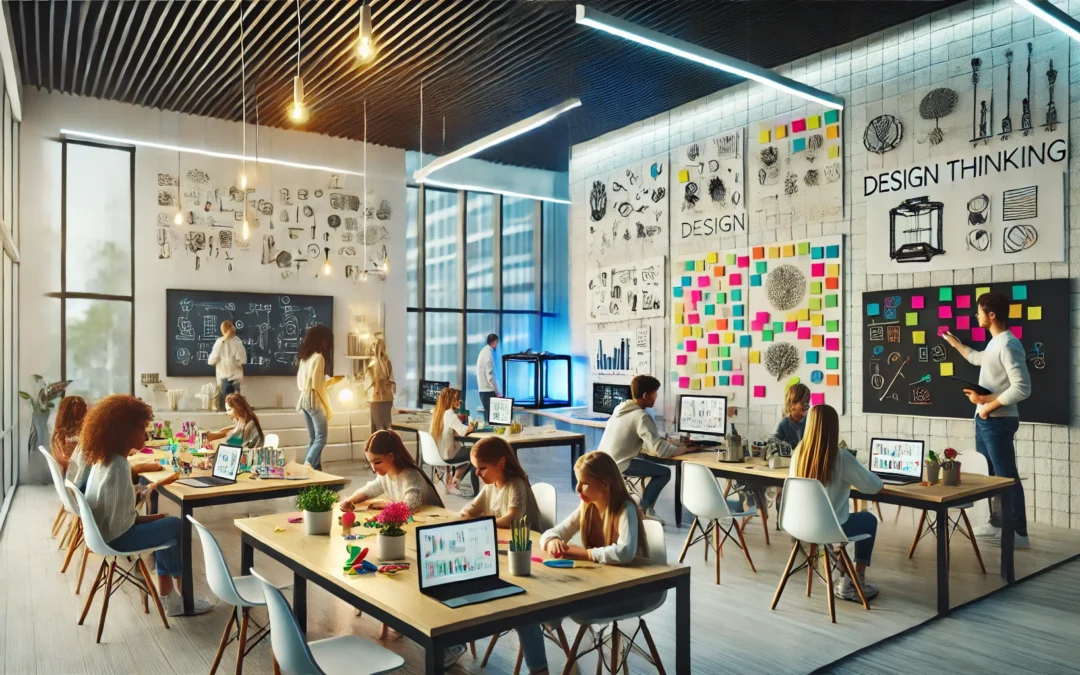
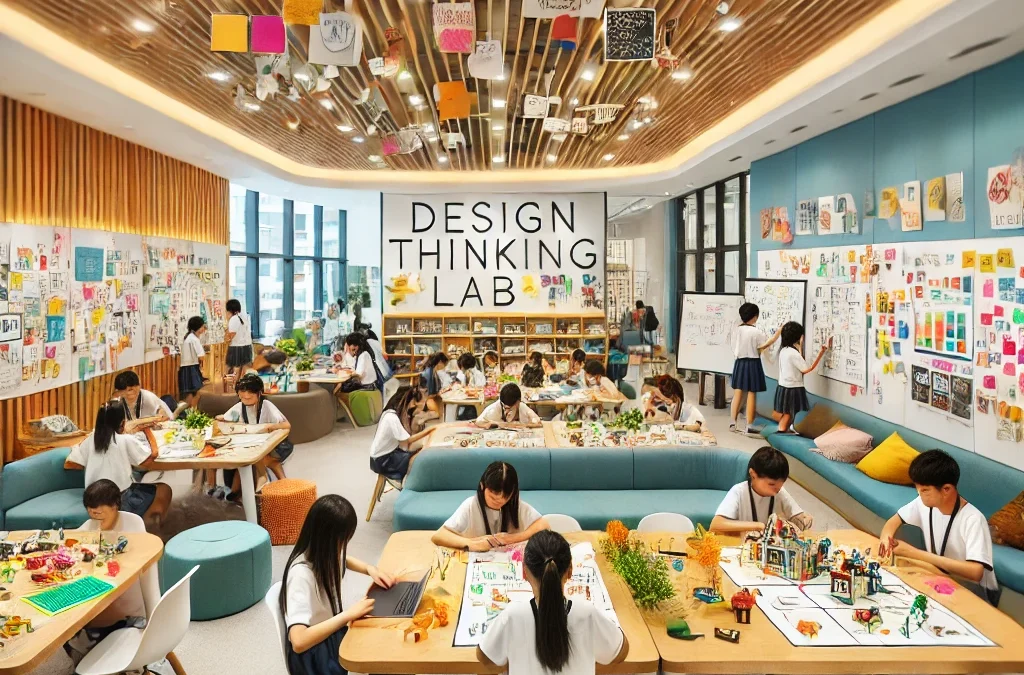
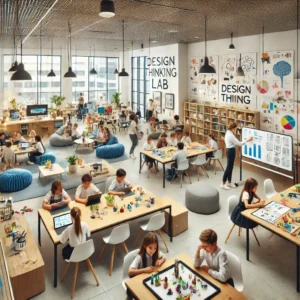
These days, students need more than just textbook knowledge to thrive. Creativity, problem-solving, and innovation are crucial skills that prepare them for the future. A Design Thinking Lab is an incredible way to foster these abilities in students, giving them a hands-on space to ideate, prototype, and bring their ideas to life. However, setting up such a lab requires careful planning—not just in terms of infrastructure but also financially.
If you’re considering building a Design Thinking Lab in your school, this guide by Techradiance, will break down the approximate costs involved, ensuring you get the best value for your investment.
1. Understanding the Core Costs of a Design Thinking Lab
Before we dive into numbers, it’s essential to understand what goes into a Design Thinking Lab. Broadly, the expenses fall into these categories:
Infrastructure & Space Setup
Furniture & Workstations
Tools & Equipment
Technology & Software
Training & Development
Miscellaneous Costs
Each of these elements plays a crucial role in building a functional, engaging, and efficient lab. Let’s explore them one by one.
2. Infrastructure & Space Setup (₹5 – ₹15 Lakhs)
A Design Thinking Lab requires a dedicated space where students can brainstorm, experiment, and collaborate. If your school already has an empty classroom, your setup costs will be lower. However, if you need to construct or renovate, here’s what you’ll need to budget for:
Renovation & Painting: ₹1 – ₹3 lakhs
Lighting & Electrical Work: ₹50,000 – ₹2 lakhs
Flooring & Carpentry: ₹2 – ₹5 lakhs
Ventilation & Air Conditioning: ₹1 – ₹3 lakhs
Tip: Opt for modular design and multi-purpose spaces to maximize efficiency.
Thinking Lab
3. Furniture & Workstations (₹3 – ₹8 Lakhs)
A well-designed Design Thinking Lab should have flexible, adaptable furniture that supports collaborative work, brainstorming, and prototyping. Some key furniture expenses include:
Work Tables & Benches: ₹2 – ₹4 lakhs
Whiteboards & Pinboards: ₹50,000 – ₹1 lakh
Storage Units: ₹50,000 – ₹1.5 lakhs
Ergonomic Chairs & Stools: ₹1 – ₹3 lakhs
Tip: Consider furniture that can be easily rearranged to support different modes of learning—individual work, group discussions, and hands-on projects.
4. Tools & Equipment (₹5 – ₹12 Lakhs)
The heart of a Design Thinking Lab is its hands-on materials and prototyping tools. Depending on your budget, you can start with basic supplies and gradually scale up to advanced equipment.
Tip: Consider education discounts on software and opt for open-source alternatives where possible.
6. Training & Development (₹2 – ₹5 Lakhs)
A Design Thinking Lab is only as effective as the teachers and facilitators running it. Investing in teacher training ensures that students get the best experience.
Key Training Costs:
Workshops & Certifications for Teachers: ₹1 – ₹3 lakhs
Guest Lecturers & Industry Experts: ₹50,000 – ₹2 lakhs
Tip: Partner with design institutions like Techradiance to get cost-effective training programs.
Finally, don’t forget the ongoing expenses that keep the lab running smoothly:
Consumables & Replacements: ₹50,000 – ₹1.5 lakhs per year
Maintenance & Repairs: ₹50,000 – ₹1 lakh per year
Internet & Software Renewals: ₹50,000 – ₹1 lakh per year
Tip: Set aside an annual budget for upgrades and repairs.
Overall Tip: If budget is a constraint, start with a basic lab (~₹15-₹20 Lakhs) and scale up gradually.
Thinking Lab
Final Thoughts: Making the Most of Your Investment
A Design Thinking Lab is a long-term investment in your students’ future. While the upfront costs might seem significant, the impact on creativity, innovation, and problem-solving skills is invaluable. Atal Tinkering Labs provide an excellent platform to foster these skills, equipping students with hands-on experience in innovation and design thinking.
How to Optimize Costs?
Look for grants & sponsorships from local businesses or NGOs.
Start small and expand gradually based on student engagement.
Partner with ed-tech companies for subsidized tools and resources.
Encourage DIY projects and student-led initiatives to save costs.
By carefully planning your Design Thinking Labs, you can create a transformative learning space that empowers students to think critically, solve problems, and innovate for the future.
So, are you ready to build the next generation of thinkers and innovators? Let’s get started! Contact our team at Techradiance!
Design Thinking Labs: Today, traditional education is no longer enough to prepare students for the challenges of tomorrow, schools must embrace innovative approaches to learning. One such approach is design thinking—a creative problem-solving method that encourages curiosity, collaboration, and innovation. Investing in Design Thinking Labs is not just a trend; it is a necessity for schools that want to empower students with essential 21st-century skills.
What is Design Thinking?
Before we dive into why schools should invest in Design Thinking Labs, let’s break down what design thinking actually means. It is a human-centered approach to solving problems by understanding users’ needs, brainstorming solutions, testing ideas, and refining them based on feedback.
The five key stages of design thinking are:
Empathize – Understand the needs and challenges of the people you are designing for.
Define – Clearly identify the problem that needs to be solved.
Ideate – Brainstorm multiple creative solutions.
Prototype – Create simple models or sketches to test ideas.
Test – Gather feedback and refine solutions.
This process is widely used by top companies like Apple, Google, and Tesla to create innovative products. So, why not introduce it in schools to prepare students for the future?
1. Encouraging Creativity & Innovation
Most traditional classrooms focus on rote learning and standardized tests, leaving little room for creativity. Design Thinking Labs provide an open, interactive space where students can think outside the box and develop their creative potential.
Instead of memorizing facts, students learn by doing—experimenting, failing, and improving.
They can build prototypes, test ideas, and collaborate with peers on real-world challenges.
This hands-on approach helps students develop confidence in their creative abilities.
By fostering creativity, Design Thinking Labs encourage students to become inventors rather than passive learners.
Design Thinking Labs
2. Building Problem-Solving Skills
Life is full of challenges, and the ability to solve problems effectively is one of the most important skills a person can have. Design thinking teaches students to approach problems with a solution-oriented mindset.
Instead of seeing failure as a setback, students learn to view it as a stepping stone to improvement.
They develop resilience and adaptability—essential traits for success in any field.
By working on real-world projects, students learn to analyze issues critically and come up with innovative solutions.
This mindset shift from “problems” to “opportunities” can transform the way students approach learning and life.
3. Preparing Students for Future Careers
The future job market is changing at an unprecedented pace. Many traditional careers are being replaced by automation and artificial intelligence, while new roles are emerging that require creativity, critical thinking, and collaboration.Artificial intelligence and robotics courses play a crucial role in preparing individuals for these new opportunities
Top companies are looking for employees who can think creatively and solve complex problems.
Design Thinking Labs equip students with skills that will help them thrive in careers that do not even exist yet.
Whether they become entrepreneurs, engineers, designers, or educators, students will have the mindset and skills needed to excel.
Investing in Design Thinking Labs today is an investment in future-ready students.
4. Promoting Collaboration & Teamwork
In reality, success is rarely achieved alone. Whether in the workplace or in personal life, collaboration is key!
Design Thinking Labs encourage students to work in teams, share ideas, and respect different perspectives.
They learn how to communicate effectively, resolve conflicts, and build on each other’s strengths.
By working on projects together, students develop essential leadership and teamwork skills that will benefit them in any career path.
This collaborative approach prepares students for the real-world work environment, where teamwork is essential.
5. Bridging the Gap Between Theory & Practical Learning
One of the biggest flaws in traditional education is the lack of connection between theory and real-world application. Students often wonder, “Why am I learning this? Where will I use it?”
Design Thinking Labs help bridge this gap by:
Enabling students to use classroom knowledge for actual world issues.
Giving them hands-on experience in STEM (Science, Technology, Engineering, and Math) subjects.
Encouraging them to experiment, test, and refine their ideas in a safe, supportive environment.
When students see the practical impact of their learning, they become more engaged, motivated, and excited about education.
6. Boosting Confidence & Leadership Skills
Many students hesitate to share their ideas because they fear being wrong. Design Thinking Labs create a culture where mistakes are embraced as part of the learning process.
Students gain the confidence to express their thoughts and take risks.
They develop leadership qualities by guiding their peers through brainstorming and problem-solving sessions.
As they see their ideas come to life, they feel a sense of achievement, boosting their self-esteem.
When students believe in their abilities, they are more likely to take initiative and become future leaders.
7. Making Learning Fun & Engaging
Let’s face it—many students find traditional learning methods boring. Endless lectures, repetitive worksheets, and memorization do not inspire curiosity or excitement.
Design Thinking Labs bring fun and excitement into learning by:
Encouraging students to work on hands-on projects.
Allowing them to use technology, art, and storytelling to solve problems.
Making learning an interactive and immersive experience.
When students enjoy what they learn, they become more engaged, curious, and motivated to explore new ideas.
8. Encouraging Social Responsibility & Empathy
At its core, design thinking is about understanding people’s needs and solving problems that matter. This helps students develop a strong sense of social responsibility and empathy.
They learn to listen to others, understand different perspectives, and design solutions that make a difference.
Whether working on sustainability projects, community challenges, or accessibility solutions, students become aware of how their skills can positively impact society.
This mindset helps shape them into responsible, compassionate individuals who want to make the world a better place.
Conclusion: The Future of Education Lies in Design Thinking
The world is evolving, and so should education. Schools that invest in Atal Tinkering Labs and Design Thinking Labs are not just adding another classroom; they are creating a new way of learning—one that prepares students to be thinkers, innovators, and problem-solvers.
By fostering creativity, collaboration, and critical thinking, Design Thinking Labs help students develop skills that are essential for the future. They bridge the gap between theory and practice, make learning more engaging and fun, and empower students to solve real-world problems.
Now is the time for schools to take action. Investing in Design Thinking Labs today is an investment in the future of education and the success of every student.
If we want our children to thrive in a world of constant change, innovation, and new possibilities, we must give them the tools and mindset to lead that future. And it starts with design thinking. Design Thinking in Schools plays a crucial role in equipping students with these skills
Contact our team atTechradiance to set up a Design Thinking Lab in your school in Delhi and beyond!
Our nation is on the brink of a major transformation in education and innovation. In a bold move to foster creativity and scientific temperament among students, the central government has announced plans to establish 50,000 new Atal Tinkering Labs across the country over the next five years. This initiative is set to revolutionize the way young minds approach learning, shifting from rote memorization to hands-on experimentation and problem-solving
With a strong emphasis on STEM (Science, Technology, Engineering, and Mathematics) education, Atal Tinkering Labs will equip students with the necessary skills to thrive in a rapidly evolving technological landscape. This initiative aligns with India’s broader vision of becoming a global innovation hub by nurturing the next generation of scientists, engineers, and entrepreneurs.
What Are Tinkering Labs?
Tinkering labs are creative workspaces designed to encourage students to experiment, invent, and build projects using cutting-edge technologies such as robotics, artificial intelligence (AI), 3D printing, and the Internet of Things (IoT). These labs provide an open environment where young learners can test their ideas, solve real-world problems, and develop a maker’s mindset.
They are typically equipped with:
Electronics and circuit boards
Mechanical tools and 3D printers
Coding and robotics kits
IoT and AI learning modules
Virtual reality (VR) and augmented reality (AR) tools
By exposing students to such technologies at an early stage, Atal Tinkering Labs play a vital role in bridging the gap between theoretical knowledge and practical application
The Government’s Vision: Why 50,000 Labs?
The Indian government, through organizations like Atal Innovation Mission (AIM) under NITI Aayog, has been actively promoting innovation-driven learning. With over 10,000 Atal Tinkering Labs (ATLs) already established, the plan to add 50,000 more aims to extend this impact to every corner of the country.
Key Objectives of the Initiative:
Encouraging Innovation: Empower students to develop problem-solving skills through hands-on projects.
Bridging the Digital Divide: Provide access to advanced technology in schools across urban and rural areas.
Boosting Entrepreneurship: Foster an entrepreneurial mindset by enabling students to transform ideas into working prototypes.
Enhancing STEM Learning: Make STEM education more interactive and engaging, leading to a better understanding of concepts.
Preparing for Future Careers: Equip students with 21st-century skills required for emerging industries like AI, robotics, and automation.
This large-scale expansion of Atal Tinkering Labs will create a more inclusive ecosystem, ensuring that even students in remote areas have access to the same learning opportunities as those in metropolitan cities
atal tinkering labs
Impact on Students and Schools
The introduction of 50,000 Atal Tinkering Labs will redefine the learning experience for millions of students across India. Instead of relying solely on textbooks, students will explore, invent, and collaborate, making learning more engaging and effective
How Students Will Benefit:
Hands-on Learning: Practical exposure to AI, coding, robotics, and IoT will deepen understanding.
Confidence Building: Creating projects from scratch will enhance critical thinking and creativity.
Teamwork & Collaboration: Working on real-world challenges will improve communication and leadership skills.
Career Readiness: Exposure to futuristic technologies will prepare students for high-demand careers.
Global Competitiveness: Indian students will be better positioned to compete in the global innovation landscape.
For schools, integrating Atal Tinkering Labs means upgrading their educational approach. Institutions adopting this experiential learning model will gain a competitive edge, attracting students and parents looking for modern education methodologies
Bridging the Urban-Rural Divide
One of the biggest advantages of this initiative is its potential to democratize access to technology. Many schools in rural India lack modern infrastructure and learning resources. By setting up Atal Tinkering Labs in these areas, the government ensures that students from underprivileged backgrounds also get equal opportunities to innovate and excel
This initiative will unleash untapped potential by:
Providing high-tech resources to rural schools
Encouraging students to think beyond traditional careers
Connecting rural innovators to mentors and industry leaders
Promoting local innovations that solve grassroots problems
Challenges & How to Overcome Them
While the initiative is ambitious and promising, its success will depend on effective implementation. Some challenges that may arise include:
Infrastructure & Maintenance: Setting up and maintaining 50,000 labs requires substantial investment and resources.
Solution: A public-private partnership model can help share financial and operational responsibilities.
Teacher Training: Many educators lack the technical expertise to guide students in advanced technology projects.
Solution: Conducting regular teacher training programs to ensure they are equipped with the right skills.
Awareness & Adoption: Schools and parents might hesitate to embrace new learning methods.
By addressing these challenges proactively, the government can ensure the long-term success of this initiative.
A Step Towards an Innovative India
The plan to set up 50,000 Atal Tinkering Labs in the next five years is a game-changer for India’s education system. It signifies a shift from passive learning to active exploration, paving the way for a future generation of innovators, problem-solvers, and entrepreneurs. Composite lab and skill laboratory setups will further complement this initiative by providing diverse learning environments that enhance practical skills and interdisciplinary knowledge
This initiative will not only prepare students for high-tech careers but also contribute to India’s vision of becoming a global technology leader. By fostering a culture of innovation from an early age, these labs will empower young minds to shape the future of science and technology. Design & Technology Lab setup for CBSE Schools will further enhance this vision by providing modern infrastructure and resources to support experiential learning and creativity
India is ready for its next big innovation revolution—and it starts in the classrooms of today.