A Humanoid Robotin India looks and acts like a person. It can walk, talk, and help people. These robots are becoming increasingly popular in India. They are used in many schools, offices, and hospitals for various tasks. We are working with Techradiance to provide smart humanoid robotics to schools and students in India. This blog will tell us how robots are created, how they are used, and how they can help in the future.
A Humanoid Robot that looks like a person can act and look just like one. It has a body, arms, and legs. Some robots have faces that smile, blink, or speak like humans. These robots can walk, talk, and help with human work.
India, among other countries, is doing some amazing work on the humanoid robot front.
The First Humanoid Robot in India
You may be asking yourself, “What is the name of the First Humanoid Robot in India?”
India’s first humanoid robotic device is “Manav.”. It was created by A-SET Training & Research Institute in Delhi. Manav is a two-foot-tall robot that can dance, walk, perform pushups, and speak using artificial intelligence.
This robot was made entirely in India, and it showed the world India’s readiness for the future.
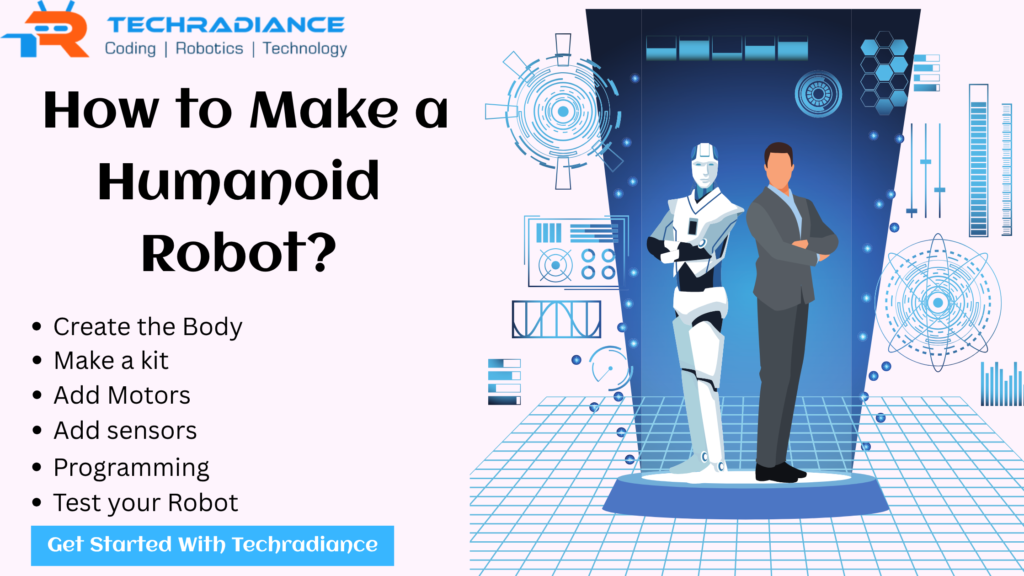
How to Make a Humanoid Robot?
It’s possible to make a humanoid robotic being. Here’s an easy way to understand how the process works:
Create the Body: Begin with a sketch that looks like a human body. You will need arms, legs, and a face.
Make a kit: There are many companies that offer Humanoid Robot kits, which include motors, sensors, and wires.
Add Motors Motors allow the robot to move its hands, legs, and head.
Add sensors: Sensors allow the robot to feel and see things such as heat, touch, and sound.
Programming To program a robot, you need to write some code.
Test your Robot: Check that the robot can walk, talk, or wave once it has been built.
Students can learn how to build small robots by participating in robotics workshops or school projects that use beginner-level kits.
Humanoid Robot Kits for Beginners
Humanoid Robot kits offer the best starting point for students and beginners. These kits include:
Plastic or metal body parts
Small motors, also known as servomotors
Sensors and wires
Battery and power supply
Microcontrollers such as Raspberry Pi or Arduino
Humanoid Robot Kits in India:
Robokits India Humanoid Kit
DIY Robotic Arm Kits
Lynxmotion Biped BRAT Kit
The kits are easy to use for even school children with the help of teachers or parents.
Growth of Humanoid Robot in India
In the past few years, India has made rapid progress in the area of robotics. Students and companies are all working to create smart robots.
Shalu — A Hindi-speaking AI robot created by an elementary school teacher from waste materials
These robots can answer questions about general knowledge, teach students in multiple languages, and talk in different dialects
What is a Humanoid AI Robot?
A Humanoid AI Robot that looks and acts like a human. It also uses Artificial Intelligence to learn.
AI assists the robot in:
What people say is important
Answer questions
Face Recognition
The Internet is a great place to learn new things
In India, robots such as Shalu and AI-powered humanoid robotics are examples. They can answer questions in many Indian languages, including Hindi, Marathi, and Bhojpuri, and they can speak.
Uses of Humanoid Robots in Daily Life
Humanoid Robots aren’t just for entertainment. They can be useful in many ways. Here are some examples:
1. Education
Use robots in the classroom to:
Teach math, science, and English
Enjoy fun quizzes together with your students
Learn coding and robots with your students
2. Healthcare
Robots in hospitals can:
Speak to your patients
Remind patients to take their medicines
Help doctors during surgeries
3. Home Help
Robots can be used at home to:
Turn the lights on and off the lights
Play music
Answer simple questions
Children love stories.
4. Customer Service
Humanoid robots are often found in malls and hotels.
Greet Customers
Give directions
Answer questions politely
🇮🇳 Future of Humanoid Robot in India
The future of humanoid robotics in India looks very promising. Many colleges, schools and companies now include Robotics as part of their curriculum.
Special projects such as:
Atal Tinkering Labs (ATL)
Digital India Mission
Startup India programs
India could build humanoid robotics in the next 10 Years that can:
Teach in schools
Work in hospitals
Help in factories
Supporting elderly people in their own homes
It is the perfect time for students to learn about robotics and use technology to build their future.
India in the Robotics World
India is gradually becoming a part of the Robotics World Championship. India’s students are winning robot contests in other countries.
Students can benefit from companies like TechRadiance by:
Teaching Robotics in Simple Language
Hands-on Kits
Organizing robotics championships
This support allows Indian children to learn how to build robots from a young age.
Fun Facts About Humanoid Robots
These fun facts will delight children.
The word is derived from the Czech word “robota,” meaning forced labor.
Sophia, a humanoid AI from Hong Kong, can speak and express emotions.
NASA uses humanoid robots in space!
The robot in India, ” SHALU,” was created using scrap materials such as plastic, cardboard, and old wires.
Many humanoid robots can perform better than humans at!
Why Should Students Learn About Humanoid Robots?
Why you should learn about robots, humanoids now:
Enjoy the fun and excitement
You can make your robot
You will improve your problem-solving skills and creativity
Robotics will be a popular career in the future
Robotics Competitions are held in India and around the world.
Learning robotics in India is now affordable and easy with platforms such as Techradiance.
Testimonial: What Students Say About Learning Robotics with Techradiance
“I built my Humanoid Robot with the help of a Techradiance Workshop at my school. I never imagined that learning robotics would be so easy and enjoyable. When I grow up, I’d like to be a robot scientist! ” — Riya Sharma, Class 6, Delhi
“Techradiance taught me how to build a humanoid robotic kit, and I even got my robot to walk!” It was incredible to see my robot move like a real human. ” — Aarav Mehta, Class 9, Mumbai
“Our school hosted a competition in robotics with Techradiance and it changed my whole life. I now understand what AI is and how robots help people. It was one of the highlights of our school year. ” — Kavya Jain, Class 7, Jaipur
Final Thoughts:
The journey for Humanoid Robot in India has only just begun. We have seen India’s growth in the fields of robots and artificial Intelligence.
These robots will change the way we learn, live, and work. You can discover the humanoid robotic world now with excitement and curiosity if you’re a student reading this.
India’s future will be brighter with companies like Techradiance leading the way in robotics.
Frequently Asked Questions ( FAQ’S)
What is a humanoid robot?
A Humanoid Robot is a robot that looks and behaves like a person. It can talk, walk, and move its arms.
Who made the first humanoid robot in India?
A-SET Training & Research Institute has developed India’s first robot humanoid, Manav.
Can children make humanoid robots?
Yes! Children can build humanoid robots using simple kits with the right guidance and robot kits.
Where can I buy a humanoid robot kit in India?
Online, you can purchase robot kits from sites like Robokits India and attend workshops at companies like Techradiance.
What is the future of humanoid robots in India?
The future looks bright. Robots will soon be found in schools, hospitals, and offices.
Technology is advancing daily in the fast-paced world of today. Children are already making robots in addition to watching cartoons and playing games on iPads! For this reason, robotics contests, such as the Robotics Championship, are gaining a lot of traction in Indian schools and universities. However, what makes these contests significant? Let’s take a straightforward approach.
A Robotics championship is a unique occasion where students gather and show off the robots they have constructed. These robots have the ability to walk, pick objects up, speak, and even solve issues. Teams compete with one another for medals, certificates, and prizes.
Winning isn’t everything. Students learn how to solve problems, collaborate with others, and think like actual scientists and engineers through these challenges.
How Students Become a Robotic Champion
Every student who participates in a tournament aspires to win a robotics championship. This indicates that their robot performs better than any other. Students study electronics, mechanics, coding, and other subjects in order to become champions. They meticulously construct and extensively test their own robot.
Whether they succeed or fail, every youngster who tries grows in intelligence, self-assurance, and curiosity. That’s the true prize!
Benefits of Robotics Competitions for Students
Let’s examine the incredible advantages that children get when they participate in a Robotics Competition:
1. Encourages Imagination and Creativity
Students build a robot from the ground up using their creativity. Does it have to walk? Speak? Grab a block? The possibilities are infinite. This encourages kids to think creatively and unconventionally.
2. Enhances the Ability to Solve Problems
Occasionally, the robot malfunctions. It may fall or remain still. Students make repeated attempts to remedy it. They learn to persevere from this. Additionally, it teaches kids how to approach challenges methodically.
3. Collaboration and Interaction
Teams of students compete in the majority of robot championship events. They learn how to cooperate, listen to others, and exchange ideas as a result. These abilities are also crucial in real life!
4. Acquiring Knowledge by Doing
Students learn by doing things with their hands rather than just reading from books. This is known as “learning by doing” as it makes studying more enjoyable and helps students retain information better.
5. 🏆 Instills Pride and Confidence
Students feel proud when they display their robot on a large stage. They receive support and applause whether they win or lose. This gives them more self-assurance.
India and the Robotics World Championship
Students from all across the world compete in the Robotics World Championship, and India is now one of them. Numerous Indian teams have excelled and brought honor to our nation.
These global contests demonstrate to students the limitlessness of science and technology. They have the potential to launch their own tech company or work for large corporations in the future.
Schools and Robotics Clubs
Children can now learn how to build robots in robotics clubs at many Indian schools. These groups assist students in getting ready for national and international Robotics Championships.
Members of these clubs:
Learn to operate motors, wires, and sensors.
Work with instructors and mentors
Get opportunities to compete via traveling.
Make buddies who share their passion for robotics!
Why Teachers and Parents Should Encourage Robotics
Robotics is more than just a topic. It’s an enjoyable way to learn a variety of disciplines together, including math, physics, art, and even English! For this reason, educators and parents ought to encourage kids who wish to participate in Rbotics Competitions.
Parents can:
Assist children in purchasing little robot kits
Watch videos of robots with them.
Encourage them as they compete.
Teachers are able to:
Create school robot clubs.
Bring pupils to regional robotics competitions.
Use robot activities to enhance the enjoyment of learning.
Real Stories of Robotic Champions from India
Let’s examine some actual tale:
Twelve-year-old Riya from Delhi created a floor-cleaning robot. In a robot championship at IIT Delhi, she took home a silver prize.
Tools Students Use to Build Robots
Students that want to compete in a robotics competition use:
Boards for Arduino
Sensors (such as touch or light sensors)
Wheels and motors
Batteries
Coding (with basic applications like Python or Scratch)
Don’t worry; although it could seem difficult, practice and direction make it simple.
Different Types of Robotics Championships in India
The following are a few well-known robotic competitions in India:
RoboCup Junior India: for pupils between the ages of 10 and 19
Teams compete in the World Robot Olympiad (WRO) from several states.
Leading engineering universities host the National Robotics Championship (NRC).
The International Robotics Championship, or Technoxian, draws students from around the globe.
School, state, national, and international levels are the various levels at which these competitions are held
What Students Learn Through Robotics
The following are a few well-known robotic competitions in India:
RoboCup Junior India: for pupils between the ages of 10 and 19
Teams compete in the World Robot Olympiad (WRO) from several states.
Leading engineering universities host the National Robotics Championship (NRC).
The International Robotics Championship, or Technoxian, draws students from around the globe.
School, state, national, and international levels are the various levels at which these competitions are held.
The Future of Robotics in India
India is emerging as a global leader in technology. AI (Artificial Intelligence) and robotics will be necessary for many new vocations in the future. Younger students will be prepared for the jobs of the future.
Robotics also adds enjoyment to learning! It gives kids happiness, teamwork, and lofty goals. For this reason, robotics should be taught in all Indian schools.
Final Thoughts: Let’s Build the Future, One Robot at a Time
In India, Robotics championships are more than merely occasions; they represent the foundation of the future. They assist children in developing their intelligence, creativity, and readiness for the world of the future.
Ask your school to form a robotics club if you’re a student. Support children on this incredible journey if you are a parent or educator. Because your child might be the next robotic champion!
Let’s all say, “I am capable of building robots.” I am capable of winning
Frequently Asked Questions( FAQ’S)
1. What is a robotics championship?
In a Robotics Championship, students construct and demonstrate functional robots. They learn science in an enjoyable way while competing for prizes.
2. Can school students take part in robotics competitions?
Indeed! Many robotics competitions are for schoolchildren between the ages of 8 and 18. Teachers or parents can assist them in joining as a team and participating.
3. Is it expensive to join a robot championship?
Robot kits are available online, and some tournaments charge a little fee. Sometimes, sponsors and schools assist students with the expenses.
4. How can I become a robotic champion?
Learn basic robotics first, then join a club, construct your own robot, and compete locally. Anyone may become a champion with practice and cooperation!
Students need more than just books and exams to keep up with the fast-changing world. Students need to be able to solve problems and come up with new ideas. The Design Thinking Process can help. It is now being used by many IB schools to make learning fun and more real.
Learn how Techradiance helps IB schools implement the Design Thinking Process in their classrooms.
The Design Thinking process is an innovative way to solve issues. It encourages people to come up with new, useful ideas. This process isn’t just for adults. Even children can use and learn it.
It is a method that involves a series of steps to help you understand problems, come up with solutions, and then test and improve them.
Why Do IB Schools Use the Design Thinking Process?
The IB school wants its students to:
You can also check out our Creative Ideas
Curious
Problem solvers are good problem-solvers
Prepared for the future
In order to do so, they employ the Design Thinking Process when teaching. This method allows students to learn through doing. Students talk, build, test, and improve. It makes learning fun and more useful.
Students feel proud about their work when they solve real problems in a smart way.
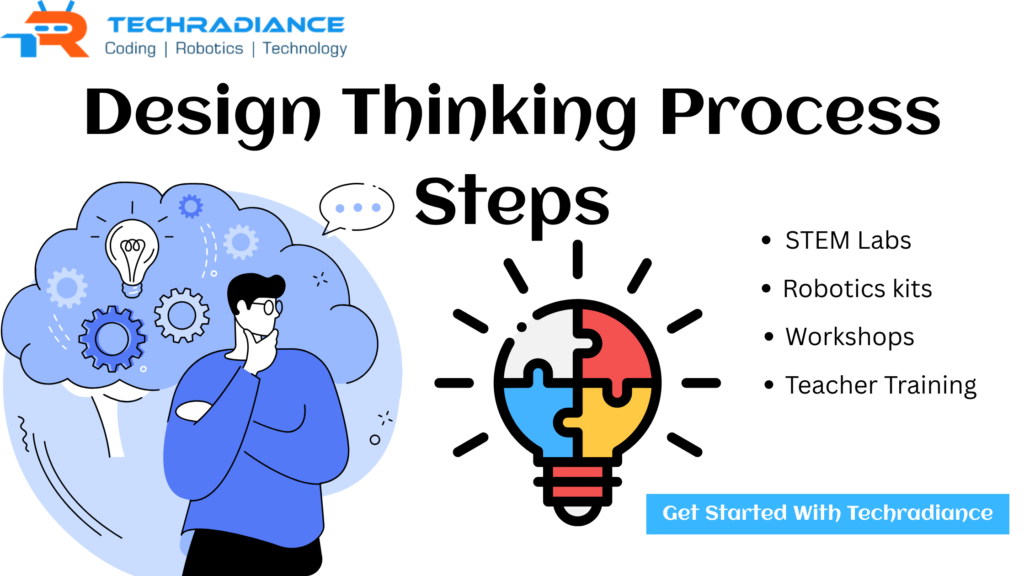
Design Thinking Process Steps Explained
We’ll look at the Design Thinking Process Steps. Here are five steps that will help you think like a designer.
Step
Name
Easy Meaning
1
Empathize
Understanding how people feel about themselves and the problems they face
2
Define
What is the problem?
3
Idea
Try to come up with many different solutions for the same problem
4
Prototype
Create a miniature or model of the best idea you have
5
Tests
Test the model to see what works and then improve it
Each step is crucial. The Design-Thinking Methods can be used in any order, but depending on the circumstances, they may need to change.
Real-Life Design Thinking Process Example in an IB School
We’ll look at a simple Design Thinking Process Example that will help you understand how this works in schools.
The playground at the school gets too hot in summer:
Empathize: Students can ask their teachers and peers about the effects of heat on them.
Define. They discover the problem: Children can’t go outside to play on hot days.
Ideate: They come up with many ideas, such as putting up tents, planting trees, or creating shaded areas.
Prototype– They create a small cardboard model of a shaded playing zone.
Test: They present it to other people, get feedback, and then improve the design.
The Design Thinking Process is used to help students solve real-world problems.
How Techradiance Helps Schools Use Design Thinking
Techradiance helps schools bring their ideas to life. They teach this process to students in IB schools through:
STEM Labs
Robotics kits
Workshops
Teacher Training
Their support allows schools to transform classrooms into laboratories where children can think, build, and test.
Techradiance holds design challenges, where students compete using the design thinking process steps to solve interesting problems.
Design Thinking Methods in the IB Curriculum
They use design thinking methods in every aspect of learning. In every aspect of their learning, they use design thinking methods. This is how it works:
1. Learning Through Stories
Teachers start with a story. The story might be “A family lives in a village that lacks clean drinking water.” Then, students would work together using the five Design Thinking Process Steps to come up with solutions.
2. Project-Based Learning
Students can create water filters, intelligent bags, or small robots. They can learn math, science, and art all at once with these projects.
3. Think Together
Asking questions such as:
Why is this a problem?
Who is affected by this problem?
What can we do?
These questions will lead you to innovative thinking and creativity.
4. Testing and Improving
Students test their models or projects in class after creating them. The students ask for their teacher’s and friends’ opinions. They then improve it based on the feedback. This step is crucial inthe Design Thinking process.
Subjects That Use Design Thinking in IB Schools
Design Thinking Method is not limited to computers and science. This process can be applied to many subjects.
Science: Solving real-world problems, such as waste management.
English: Write stories that are based upon problems and solutions.
Math– Budgeting for student projects
Art: Designing posters and displays.
Social Studies – Building ideas to help the community
Design Thinking Builds Life Skills
Students who use the Design Thinking Process will learn life skills such as:
Teamwork is about working together and valuing different ideas
Creativity is about thinking in new ways
Leadership: Guiding group projects
Communication: Sharing your ideas clearly
Confidence: feeling proud of your work
They can use these skills at school, at home, and for future employment.
Design Thinking Activities for Students
IB schools create simple activities that teach design thinking. Here are a few fun examples:
1. How to Build a Better Backpack
Students consider the problems they have with their schoolbags: too heavy, not enough space, or difficult to carry. They used Design thinking methods to create a new version.
2. Classroom Cleaning Robot
Students can build a robot that will clean the classroom floor using Techradiance’s Robotics kit.
3. Upgrade the lunch menu
Students discuss lunch with their friends and teachers. They then design a healthier, more delicious menu using the Design Thinking process.
The activities are designed to make learning fun and encourage real-world thinking.
Benefits of the Design Thinking Process in IB Schools
Some of the most important benefits are:
This new interactive method of learning makes learning fun and exciting
Students can solve real-world problems
Enhances creativity and critical thinking
Prepare students for the future
Respect and teamwork are encouraged
The IB Schools are convinced that smart children are not just those with high scores but also those who can imagine and create new things to improve the world.
Final Thoughts
The Design Thinking Process helps students become smarter, more confident, and better prepared for life in the real world. Learning is more than just books in IB schools. Think with your mind, feel with your heart, and create with your hands.
Students can solve real-world problems using the Design Thinking Process Steps with support from companies such as Techradiance.
These students will not only get good jobs in the future–they’ll create them, build businesses, and make the planet a better place.
Next time your child asks, “Can I create something useful ?”-just smile and say “Use Design Thinking!
Robotics is a creative and fun way to learn. By 2026, many classrooms will feature robots. These kits allow students to build robots and learn coding. They also help them better understand science. This blog will discuss the Best Robotics kits for schools and how they can help with learning. We’ll also discuss which kits are suitable for beginners. Explore the exciting world of educational robotics with Techradiance.
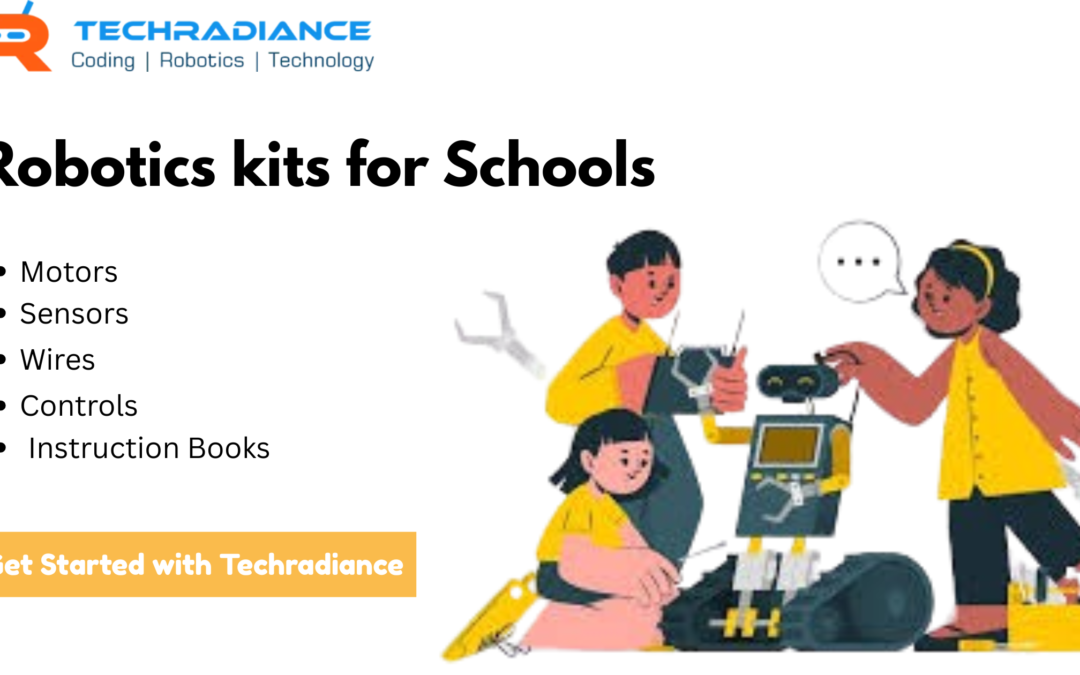
Robotics Kits for Schools are special boxes that contain the parts needed to build robots. These kits can include:
Motors
Sensors
Wires
Controls
Instruction Books
These parts allow students to code robots that can make sounds, move, follow a line, or avoid obstacles. These kits allow children to understand how real machines work.
Why Are Robotics Kits Important in Schools?
Robotics kits can be used as learning tools. When students use them at school, they will:
Fun way to learn science and math
Solve problems creatively by thinking outside the box
Team up with your classmates
Understanding how technology works
Robotics kits used in the classroom prepare students for their future.
Top Robotics Kits for Schools in 2026
Here are some of the best robot kits schools will be using in 2025. These kits are safe, easy to use, and excellent for learning.
1. Techradiance Robotics Kit – Beginner to Pro
Techradiance is a name you can trust in the field of education technology. They offer a special Robotics Kit for Schools. This kit is ideal for students in Class 3 and above.
Features:
Instructions step-by-step
Easy-to-connect parts
Beginner’s coding tutorials
Mentorship from Techradiance
This kit is designed to grow with the students’ skills, whether they are beginners or experts.
2. LEGO® Education SPIKE™ Prime Set
LEGO is a favorite of children all over the globe. SPIKE Prime will be one of the top robot kits for kids by 2025. The kit includes motors, sensors, and colorful blocks.
Features:
Drag-and-drop code
LEGO fun building blocks
Ideal for groups
Compatible with laptops and tablets
Learning is fun when it feels like playing!
3. Arduino Starter Kit for Education
An Education robotics kit designed for students in middle and high schools. Students can learn to program real circuits with Arduino and control motors, lights, and other devices.
Features:
Code and electronics are good for you
Real-world Projects
Great for STEM labs
Teachers need to guide younger children
This kit is ideal for schools that want to learn more about robotics and technology.
4. Makeblock mBot Neo
The mBot Neo robot kit is a great starter kit. It’s one of the simplest Robotics kits for education.
Features:
Work with block coding for easy kids
Sensors that follow or avoid lines
Apps can be used to control the device
The best for project-based education
This kit is popular with schools that want to engage students in hands-on learning.
5. Booster Kit from Techradiance for Competitions
Techradiance offers Advanced robotics kits for schools that prepare students for competitions. These kits come with extra motors and sensors as well as coding platforms for making strong, fast robots.
Features:
Best for school robotics clubs
Get ready for the national and international competitions
Included in the support and training
Students and teachers can access online learning
This kit will help young learners to become future robotics champs!
What’s Inside a Beginner Robotics Kit?
A beginner robotics kit can be a good place to begin if you’re new to robotics. These kits are simple to use and safe. The majority of starter kits include the following:
Robot base or body
Wheels and motors
Battery pack
Sensors (such as eyes or sound sensors)
Simple Coding Software
The guide will show students how to build the robot and control it.
How Schools Can Use Robotics Kits in Classrooms
Robotics kits can be used in many ways to make learning fun.
Robotics periods: Students can have robotics as a weekly class, just like they do with science and math.
STEM labs: Schools may create special laboratories with robotics kits to practice and explore.
Holiday camps: Schools can host robotics camps during vacations with Techradiance.
Competitions: Schools can prepare teams to compete in robotics competitions on a national and international level.
Benefits of Using Robotics Kits for Schools
Add robotics to your school curriculum, and you will reap many benefits.
Benefit
What It Means
Better Learning
Fun way to learn math, science, and coding
Skill Building
Enhances creativity, logic, and teamwork
Tech-Ready Students
Prepares you for a career in AI, robotics, and IT
More Engagement
Kids enjoy hands-on activities more than reading
Future-Ready Education
Modern technology in schools
Why is Techradiance the Best for Robotics Learning?
Techradiance offers Robotics kits for schools as well as expert training. Here are some reasons why schools choose Techradiance.
Kits for Beginners and Advanced Learners
Support for students and teachers online and offline
Workshops and training programmes
Participation in robotics competitions at the national level
Coding platforms that are easy to use
Techradiance can help you, whether your school has just started a robotics laboratory or has one already.
Tips to Choose the Best Robotics Kits for School
Before purchasing robotics kits, schools should consider the following tips:
Age Suitability: Check that the kit is appropriate for the age group.
Choose kits that include teacher guides and training.
Start simple: Begin by using beginner kits, and then move on to more advanced ones.
Choose kits that will grow with your students.
Request Demo: Contact companies such as Techradiance to request a free demo.
Types of Robotics Kits
Different robotics kits are available for different learning requirements:
Basic kits are great for beginners in lower grades
Intermediate Kits- For students in middle school who are familiar with coding
Advanced Kits for Senior Students and Robotics Clubs
AI and IoT Kits- For high-tech education (usually in upper classes)
Techradiance has a wide range of school kits available.
Schools Already Using Robotics Kits in India
In India, many schools are using robotics kits to enhance learning. The schools are experiencing an increase in student engagement and improved learning.
Schools from cities such as Delhi, Mumbai, Bangalore, and Chennai collaborate with companies like Techradiance to create robotics laboratories and conduct workshops.
Final Thoughts: Robotics is the Future of Learning
Robotics Kits for Schools offer more than fun – they are the future of learning. These kits help students to become better thinkers and learners.
It’s the right time to get your school started with robotics. Choose kits from Techradiance and watch your students code, build, and shine!
Frequently Asked Questions:
Q1. What is a robotics kit for schools?
A Robotics kit for Schools is a collection of tools designed to help students learn and build robots in the classroom.
Q2. Are robotics kits safe for kids?
Most kits are designed for children and have safe, user-friendly components.
Q3. Can kids learn coding with robotics kits?
Yes! Yes! Most kits come with simple coding tools, and it is good for beginners
Q4. What is the best beginner robotics kit?
This beginner robotics kit by Techradiance will be a good choice for schools that are just starting to learn robotics
Q5. How can schools start using robotics kits?
Techradiance offers kits, training for teachers, and support to schools.
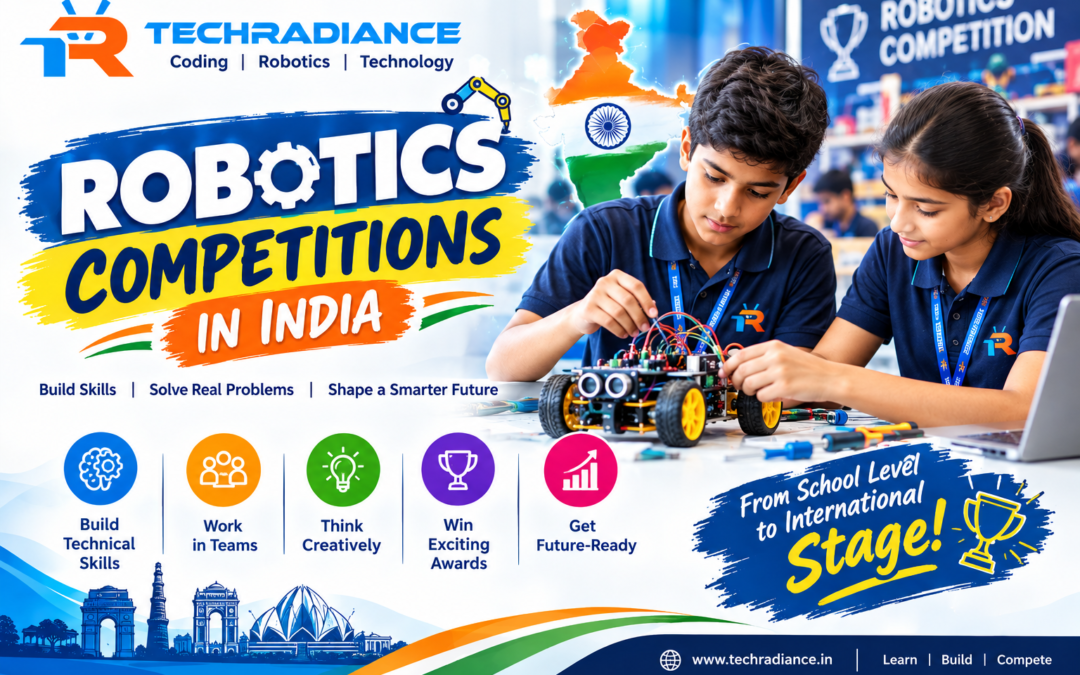
Are you looking for Robotics Competitions in India? This guide contains upcoming school and college robotics competitions, their dates, eligibility, locations, categories, registration details, and official links for 2027.
We will describe the competition, who is eligible to compete, and how students may get ready for this thrilling robotics event in this blog.
Students build robots to perform various tasks in a Robotics Competition. These tasks include:
Following a path
Picking up objects
Fighting with other robots
Solving puzzles or mazes
Missions can be completed using sensors
These events are fun for kids and teach them teamwork, technology, and creative coding.
Upcoming Robotics Competitions in India 2026–27
India will host thrilling competitions in 2027. The Techradiance Jr. World Cup 2027 is one of them, where children can build robots, solve problems, and compete against other teams.
There will be three primary phases of the competition:
School Zonal Round → IIT Nationals → International Final (Dubai/Malaysia)
The school round will be held at the school. Teams that win advance to IIT’s National Round. Top International Teams can get the chance to participate in the International Final in Dubai/Malaysia in April 2027.
Students can take part in several robotics challenges based on their age and competition category. It’s a fun method to learn robotics, coding, problem-solving, and cooperation.
List of Robotics Competitions in India
Many robotics competitions are held in India for schools and universities. Students can construct robots, learn to code, solve puzzles, and compete against other teams in these competitions.
Some well-known Robotics Competitions in India are:
1. Techradiance Jr. World Cup 2027 – A School-level Robotics Competition with School Zonal Rounds → Nationals at IIT → International Finale in Dubai/Malaysia.
2. World Robot Olympiad (WRO) – Students construct and program robots to tackle various problems in the World Robot Olympiad (WRO), a global robotics competition.
3.FIRST LEGO League — A robotics competition where students utilize LEGO robots to accomplish challenges and cooperate as a team.
4.e-Yantra Robotics Competition – IIT Bombay sponsors this robotics and innovation competition for college students.
5.ABU Robocon – A big robotics competition for university students from many countries.
6.IRC (Indian Robotics Competition) — Robotics competitions and challenges developed for students to learn practical robotics abilities.
Each competition has its own set of regulations, age groupings, dates, and registration procedures. Before registering, students should visit the official competition website.
Who Can Join These Competitions?
Any student can join! There are contests available for all students, whether they are in classes 4, 5, or 12. Many schools and educational centers encourage students to participate in Robotics Competitions in India.
You don’t need to be a genius. You only need to be curious and eager to learn.
Robotics Competition Near Me – How to Find One?
If you can search for a Robotics competition near me by asking:
Your teacher
Search online
Browse websites like Techradiance
You can also ask nearby science or robotics groups
There are many competitions in large cities such as Delhi, Mumbai, Bengaluru, Hyderabad, Chennai, and others.
Techradiance: Organizing Robotics Competitions in India at IIT
Techradiance has a long-standing reputation in the robotics education world. Every year, Techradiance hosts theRobotics Championship in Indiaat IIT. It is attended by thousands of students from various schools and colleges.
This is more than just a competition. It’s an entire learning experience. The students first learn to build robots in workshops. The students then compete against other students across the country.
Highlights of Techradiance Robotics Championship:
The event will be held at the IIT Campus
Enjoyable learning workshops
National-level participation
Play real-time games and challenges
Medals, certificates, and awards
Learn from industry experts
This is one of the best Robotics competitions in India to help students learn and win!
Robotics Competition 2027 – What to Expect?
The Robotics Competition2027 will be bigger and even more exciting. There will be many new challenges, games, and themes. Techradiance will welcome more robots and schools to the event.
Start learning now if you plan to join. Learn basic coding and build small robots in a workshop.
How can students participate in robotics competitions in India?
Students can take part in robotics competitions by visiting the Techradiance Championship page and filling out the registration form. Our team can provide the next steps, preparation details, and preparation details.
After that, students can get their robot ready, study the regulations of the tournament, and compete in the School Zonal Round → Nationals at the IIT → International Finale (Dubai, Malaysia).
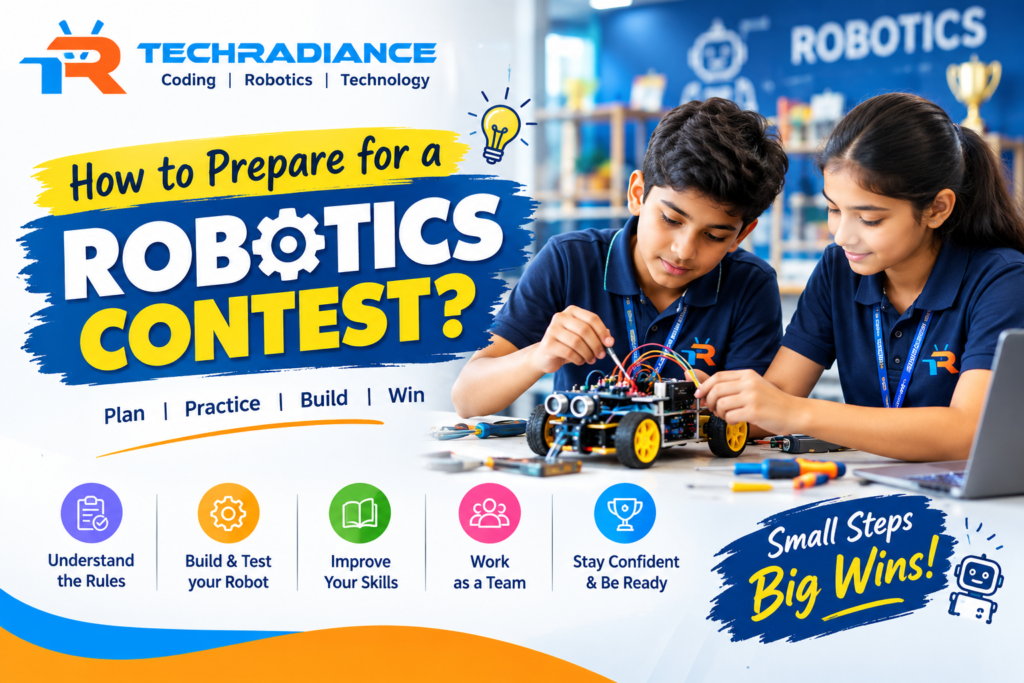
How to Prepare for a Robotics Contest?
Follow these steps to enter a Robotics Competition:
1. Start Learning Early
Learn about basic robotics. Learn about sensors and motors.
2. Practice Building Robots
Build small models using a robot kit. Exercise involves moving, turning, and solving problems.
3. Join a team
Most contests involve teams. You can work with classmates or friends. Everyone can play a part, such as designing, coding, or testing.
4. Participate in Workshops
Techradiance provides workshops for schools, where students can learn how to use the software step-by-step. These workshops are great for beginners.
5. Have fun and Stay Confident
Making mistakes is okay. It’s okay to make mistakes. Do not worry about losing. Learning is more important than winning.
Tools Used in Competition Robotics
These are the tools and parts that students use in their competition robots.
Arduino boards (brains of robots)
Sensors (like light, distance, sound)
Wheels and motors
Batteries
Codes or remote controls
Basic tools such as screwdrivers, wires, and other basic tools
These tools are easy to use and safe with teacher guidance
Benefits of Joining Robotics Competitions in India
Fun way to learn science and code
Problem-solving and improved thinking
Teamwork is important
Confidence booster
Prizes and certificates are available
Techradiance: Meet real engineers at IIT
Find inspiration for a career in technology or robotics
Techradiance Robotics Competition Success Stories
1. Ekamjot Kaur
⭐⭐⭐⭐⭐
“It was a great experience, and I really enjoyed it. Thank you, Techradiance! 🎉🏅 It was very helpful.”
— Ekamjot Kaur |
2. Argh Jain
⭐⭐⭐⭐⭐
“Overall, it was so good. I recommend everyone to join!”
— Argh Jain |
3. Uma Maheshwari ⭐⭐⭐⭐⭐ “it was vey nice i really enjoyed”
4. Dharm Baraiya ⭐⭐⭐⭐⭐ “It was a wonderful experience during that journey. The trainer was also good. She taught me well.” — Dharm R. BARAIYA
🎓 Student Registration Open for Robotics Competition at IIT Delhi – April 2027
Techradiance has openedstudent registration for the forthcoming robotics contest in India that will take place on the campus of IIT Delhi in April 2027. The competition is open to school students looking to learn about robotics in a fun and easy way. Students will be able to construct and control robots, participate in challenges, and develop new technologies. It is not necessary to have any advanced knowledge; therefore, even novices can participate without difficulty. The event teaches students cooperation, creative thinking and problem-solving skills while playing robotics.
Robotics Competitions in India are growing each year. More and more students from schools and colleges are participating and learning. Not only robots, but also cool and exciting ways to learn science!
Do not wait if you are interested. Get ready to compete by joining a robotics course, building your first robot, and preparing for competition. Don’t forget that Techradiance hosts the Robotics Championship in India every year at IIT. This could be your opportunity to shine!
Join Techradiance Today!
Book your place at the next Robotics competitionon the Techradiance Website. Who knows? Who knows?
Frequently Asked Questions
Students build robots to complete tasks such as solving mazes, fighting on a ring, or following lines. This is both fun and educational.
Students in 4th grade and above are eligible to participate. Some contests also include college students.
Every year, Techradiance organizes the popular Robotics Competition in India. Students from across the country compete.
For upcoming events, you can search online or ask your school.
This global robotics competition is where students build big robots to solve missions and earn points together as a group.
Introduction: The Future is Here with 3D Printing Lab
New technologies are becoming a part of our everyday lives. 3D printing is one of the most exciting new technologies. In many schools, a 3D Printing Lab is used to teach students new skills and prepare them for the future.
This blog will discuss what a 3D Printing Lab is, how it can benefit schools, and how Techradiance helps students develop skills for 2026.
Schools in India will be able to use 3D Printing Labs.
Let’s start by understanding the 3D Printing Definition of.
Imagine drawing a car on your computer. A 3D printer can transform your drawing into a toy car that you can play with and touch!
The 3D printer builds objects using plastic or other materials, rather than paper and ink. This magical and fun process takes place inside a 3D Lab.
What is a 3D Printing Lab?
A 3D Printing Lab can be found in an educational center or school. The room is equipped with 3D printers and computer software to allow students the freedom to design things.
This lab:
Students can create their designs on a computer
3D printers can be used to print actual models
They can see how real things are made
The 3D Lab helps students to learn through creativity and play. Not only is it fun, but you’ll also learn real skills.
Why is a 3D Lab Important in Schools?
Here are some reasons why a 3D lab will be a good idea for schools by 2025.
1. Hands-on Learning
Students can create real things instead of just reading books. It helps them to understand math, science, and art.
2. Boosts Creativity
Kids love to create and imagine. A 3D Printing Lab provides them with the tools they need to make their ideas a reality. They can print anything, from animals to cars.
3. Learn Future Skills
3D printing has applications in many industries, including medicine, space travel, automobiles, and fashion. Early exposure to 3D printing helps prepare students for future careers.
4. Improved Problem-Solving
Students learn to solve small problems when they design and print something. This helps develop critical thinking.
How Techradiance Builds the Best 3D Printing Lab for Schools
Techradiance has been a leader in the construction of 3D Printing Laboratories for schools in India. They aim to teach technology in an easy and fun way for students of Class 5 and higher.
What makes Techradiance so special?
Easy-to-use 3D printers
Learning support for children
Friendly trainers
Workshops, fun projects and
Custom Labs for Each School
Even young students can easily learn to design, print, and understand 3D Models with Techradiance.
What Do Students Learn in a 3D Printing Laboratory?
Students learn much more than printing objects in a 3D Printing Laboratory. Here are some of the fun and exciting things that they do:
3D Design software: How to create 3D models using a computer
Slicing software: Convert models to printer instructions
3D printer Use: Loading, printing, and handling the machine safely
Model finishing: clean and finish the final printed model
Real-World Uses: Discover how doctors, engineers, and designers use 3D printers
This is more than just a course–it’s an experience.
3D Printing Projects for Kids: Learn While Having Fun
The fun projects that students can create in a 3D Printing Lab are one of the most enjoyable parts.
Here are some examples:
Design a dinosaur model
Build your dream home in 3D
How to make a space rocket
Customize a toy car
Print models for the brain or heart
The projects are fun and educational for students, allowing them to learn math, science, and art.
Benefits of Having a 3D Printing Laboratory in School
We will look at the benefits that a 3D Printing Laboratory can bring to both students and school.
For Students
For Schools
Real-world learning activities
More student admissions attract
Enhances creativity and confidence
More student admissions attracts
Becoming a future-ready school
STEM Education Improved
Get exposure to global technology
Brand image and innovation culture
How to Set Up a 3D Printing Lab in Your School?
Techradiance makes it easy to set up a 3D Printing Lab.
Steps:
Contact Techradiance to discuss your school’s needs
Create a lab plan that is customized to your space and grade level.
Install 3D printers
Beginner-friendly training workshops
Let your students explore and have fun!
This 5-step process is easy and will bring great value to your school.
What Makes Techradiance the Best Choice?
Many companies offer 3D solutions. But here are the reasons why schools choose Techradiance.
Focus on education at the school level
Simple and curriculum-aligned content
Affordable packages for schools of all types
Children can be trained by experts
In India, there are already many successful labs.
Techradiance’s 3D printing laboratory helps students to do just that.
The Future of Learning: 3D Printing in 2026 and Beyond
Learning in 2025 will not be limited to reading and writing. It’s building, experimenting, and creating. A 3D Printing Lab can help schools bring the future to life.
Children are no longer just students. They are young creatives. From building city maps to making science models, 3D printers are the keys to creative learning
Final Thoughts: Make Your School Future-Ready with Techradiance
3D Printing Lab is not only a tech room, but also a creativity laboratory, learning zone, and future skills center. It encourages children to imagine, think, and build.
Techradiance brings this innovative learning solution to Indian schools. Set up a 3D Lab if you want to inspire your students and make learning fun.
🚀 Contact Techradiance Today
Techradiance can help you build your 3D Printing Laboratory. Empower your students. Prepare your students for the future.
Frequently Asked Questions (FAQ’S):
1. What is the meaning of 3D printing for kids?
A 3D printer is a machine that uses a computer to create a physical object (such as a model or toy).
2. Can small children use the 3D Printing Lab?
Yes! Even Class 5 students who are guided can safely use 3D printers.
3. Is 3D printing safe for schools?
It is safe to use if you follow the rules. Techradiance teaches teachers and students how to use it safely.
4. What do students learn from a 3D lab?
Students learn about design, technology, and creativity. They also solve real-life problems.