
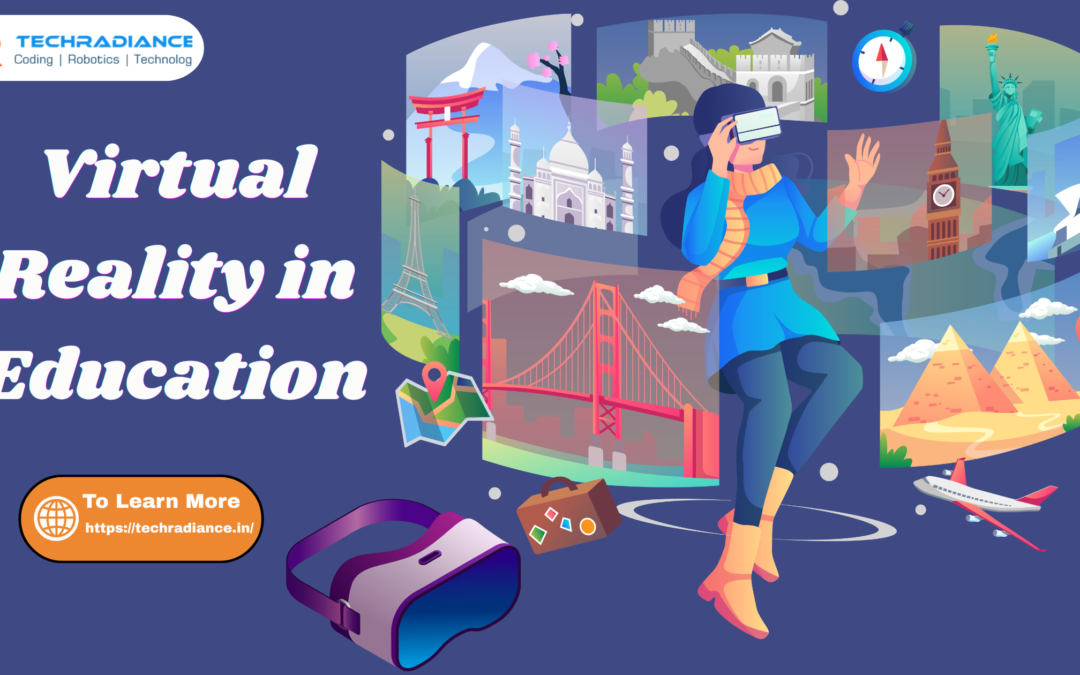
Technology is revolutionising the way students learn in school. In 2026, a lot of schools will be using intelligent learning tools that help make learning more enjoyable and engaging. One of the biggest shifts is the introduction of Virtual Reality in Education. Students no longer learn solely from blackboards and books. Today, they can explore planets, go to historical locations, and conduct scientific experiments with virtual worlds.
Techradiance can help schools bring innovative learning tools to classrooms using the latest VR technology and smart technology for education.
In this blog, we’ll learn about virtual reality and how it is used in schools, the reasons why schools use it, and the numerous advantages it can bring to teachers and students.
Author: Himanshu, a Content writer
What is Virtual Reality in Education?
Virtual reality is a computer-generated 3D space where students can explore as well as interact with objects by using VR headphones and smartphones.
When we speak of Virtual Reality in Education, it refers to using VR technology to enhance the learning process in colleges, schools, and training facilities.
For example:
- Students can go to ancient Egypt without having to leave the classroom.
- Biology students can look at the human body 3D.
- Geography students can study mountains, volcanoes, and rivers virtually.
- Students in science can conduct experiments without risk in a virtual lab.
This makes learning more enjoyable and easy to comprehend.
Why are Schools Using Virtual Reality in 2026?
In 2026, schools want students to be able to learn with a better and more concrete method. Traditional learning methods can be useful; however, the majority of students learn better by being able to observe and feel things.
This is the reason why schools are utilising VR technology.
Here are a few important reasons to consider:
1. Better Student Engagement
Students love interactive learning more than reading long books. VR classes make learning engaging and enjoyable.
2. Easy Understanding of Difficult Topics
Certain topics, such as space, human anatomy, and science experiments, are difficult to visualise. Virtual reality can help students understand how these ideas are clear.
3. Safe Learning Environment
Students can take part in risky tasks safely in a virtual world. For instance, experiments in chemistry can be conducted with no real risk.
4. Improves Memory
Children are more aware of things when they experience and see them rather than only reading about them.
How Does Virtual Reality Work in Classrooms?
Schools employ VR headsets and smart screens, computers, as well as special educational software to provide immersive learning experiences.
Here’s the way it functions:
- The teacher decides to choose the VR lesson.
- Students are required to wear VR headsets.
- The 3D virtual world is projected before them.
- Students are free to play around and discover the lessons interactively.
For example, during a lesson on history students are able to explore ancient structures and gain a deeper understanding of history.
This approach to learning boosts the students’ interest.
Advantages of Virtual Reality in Education
There are numerous Advantages of Virtual Reality in education. Teachers and schools are embracing VR as it enhances learning in many ways.
1. Makes Learning Fun
Children are fascinated by learning through images and engaging activities. VR can be a great way to stimulate classrooms.
2. Improves Focus
Students pay greater concentration when they are in VR classes because they are connected to the learning.
3. Encourages Practical Learning
Instead of just reading the theory, students can actually practice concepts through virtual reality.
4. Helps Slow Learners
Students may require visual explanations for concepts. VR helps them learn more easily. students who need visual explanations.
5. Boosts Creativity
Virtual reality lets students explore their creative thinking and work on problems in a collaborative manner.
6. Better Collaboration
Students are able to collaborate on virtual projects and games.
7. Supports Modern Education
Schools that use VR technology offer advanced and future-proof education.
These are the major benefits of virtual reality for education, which are helping schools improve their learning in 2026.
What Subjects Can Use Virtual Reality?
Virtual reality is a tool that can be utilised in virtually every area.
Science
Students can discover the universe, atoms, and planets as well as humans in 3D.
Mathematics
Complex shapes and formulas are more comprehensible visually.
History
Students are able to explore ancient civilisations as well as historical monuments.
Geography
Children can go on adventures in deserts, oceans, forests, and even volcanoes.
English Learning
Students can enhance their speaking and communication skills through active learning.
Medical Training
Medical students and doctors use VR for practice in surgery as well as patient education.
What is Augmented Reality?
A lot of people are confused about VR and AR. Let’s look at the distinction between augmented reality and virtual reality.
Virtual Reality (VR)
VR creates a completely virtual world. Students wear headsets and are immersed in the virtual world.
Example:
A student explores the solar system within an online classroom.
Augmented Reality (AR)
AR allows digital objects to be added to the real world with tablets, phones, or smart glasses.
Example:
A 3D dinosaur appears on a table in a classroom using an app for mobile devices.
Augmented Reality vs Virtual Reality
Here’s a brief comparison of augmented reality and virtual reality.
| Feature | Augmented Reality | Virtual Reality |
| Environment | Digital world in real time with objects | Virtually immersive world |
| Devices | Tablets or mobile phones | VR headsets |
| Experience | Partly fully | Full immersion |
| Usage | Interactive learning | Virtual experiences that are deep |
| Cost | Usually, the lower | Could be higher |
Both of these technologies are beneficial in the classroom and help schools improve the learning experience of students.
How Virtual Reality in Education Helps Teachers
Virtual reality isn’t just beneficial for students. Teachers also benefit from it.
Easy Explanation of Topics
Teachers can explain difficult concepts more clearly using visuals.
Better Classroom Participation
Students become more active during lessons.
Saves Time
Complex demonstrations can be demonstrated quickly using VR simulations.
Improves Teaching Methods
Teachers can design innovative and modern classroom experiences.
What is Virtual Reality Training?
Virtual Reality Training uses VR technology to help students learn practical aspects of life safely and effectively.
Nowadays, a variety of industries utilise virtual reality in their training. This includes:
- Medical training
- Pilot training
- Training for military personnel
- Engineering education
- Training in safety for the workplace
For example, medical students can practise surgeries in virtual simulations before performing the same procedures in real life.
This helps reduce mistakes and increases confidence.
Benefits of Virtual Reality Training for Students
Safe Practice
Students can learn new skills with no risk of harm.
Real-Life Experience
VR offers a realistic learning experience.
Better Skill Development
Students gain speedier results with the use of interactive exercises.
Confidence Building
The repetition of practice in virtual reality increases confidence.
Challenges of Virtual Reality in Education
While VR offers many advantages, there are a few issues too.
High Cost
VR equipment is expensive for some schools.
Internet and Technical Issues
Some schools might not have reliable internet or technical assistance.
Teacher Training
Teachers require proper training in order to utilise VR tools efficiently.
But technology is becoming accessible each year, and more and more schools are embracing VR solutions.
Why Virtual Reality is the Future of Education
The world of education is rapidly changing. Students today demand intelligent, interactive and practical learning techniques.
Virtual reality can help schools design future-ready classrooms that allow students to:
- Learn faster
- Get better at understanding
- Stay engaged
- Learn practical abilities
In the next few years, many schools across India and around the world will implement VR learning technologies.
How Techradiance is Helping Schools
Techradiance is a modern educational tool for schools, such as smart classrooms, VR labs, robotics labs, and innovative learning strategies.
The company supports schools:
- Develop advanced VR labs
- Enhance digital learning
- Design smart classrooms
- Enhance student engagement
- Help with practical learning methods
Innovative educational solutions from the company help students prepare for their future.
Final Thoughts:
Virtual Reality in Education is transforming classrooms in 2026 by making learning more engaging, fun, and relevant. Students no longer have to stick to conventional methods of learning. They are now able to discover the world around them, carry out experiments, and grasp intricate topics with engaging experiences.
The benefits of virtual reality in the classroom are aiding students in developing their confidence, creativity, and problem-solving abilities. While at the same time, technologies like virtual reality vs augmented reality are opening up new opportunities for better learning.
With companies such as Techradiance that are promoting modern solutions for education, schools are moving towards a more exciting and innovative future.
What Schools and Students Say About Our VR Learning Solutions
“Students love learning using VR.”
“After the introduction of Virtual Reality learning in our classes, students became more engaged and enthusiastic in their lessons. Even complex science concepts are now simple to grasp. Thanks to Techradiance for bringing intelligent education to our schools.”
— Principal, Delhi Public School
“Learning Has Become Fun and Interactive”
“Our students are enjoying playing in virtual worlds during class. The VR lab has increased students’ engagement and enthusiasm. Teachers are also finding it easier to communicate complex issues.”
— School Coordinator, Gurugram
“Best Technology for Modern Classrooms”
“We were looking for future-ready classrooms to teach our students. The VR solutions offered by Techradiance have helped us reach this target. The process of installing was easy, and the tech support team was extremely helpful.”
— Director, Smart Kids Academy
“Very Helpful for Practical Learning”
“Virtual real-world training provides students with the opportunity to experience real-world learning without risk. Students can grasp concepts more quickly when they learn using visuals.”
— Science Teacher, Haryana
“Students Remember Lessons Better”
“Children are more engaged and focused when they are in VR sessions. They retain lessons for longer because they can see and feel what they are learning.”
— Academic Head, CBSE School
Frequently Asked Questions ( FAQ’S)
1. What is the use of Virtual Reality in Education?
Virtual Reality in Education is utilized to make learning more fun, interactive and enjoyable. It aids students in understanding difficult concepts by using 3D images and virtual experiences.
2. Which VR is best for education?
The most effective VR for education is one that’s user-friendly as well as safe for students and that supports learning through interactive activities. Schools are increasingly using educational VR headsets that come with intelligent software for classrooms to provide better learning experiences.
3. What are Virtual Reality examples?
Common virtual reality examples include virtual science labs, 3D solar system tours, medical simulations, virtual museum tours, and exploring historical places.
4.What are the three types of VR?
1. Non-Immersive VR 2. Semi-Immersive VR 3. Fully Immersive VR