
Easy Automatic Street Light Project for Beginners
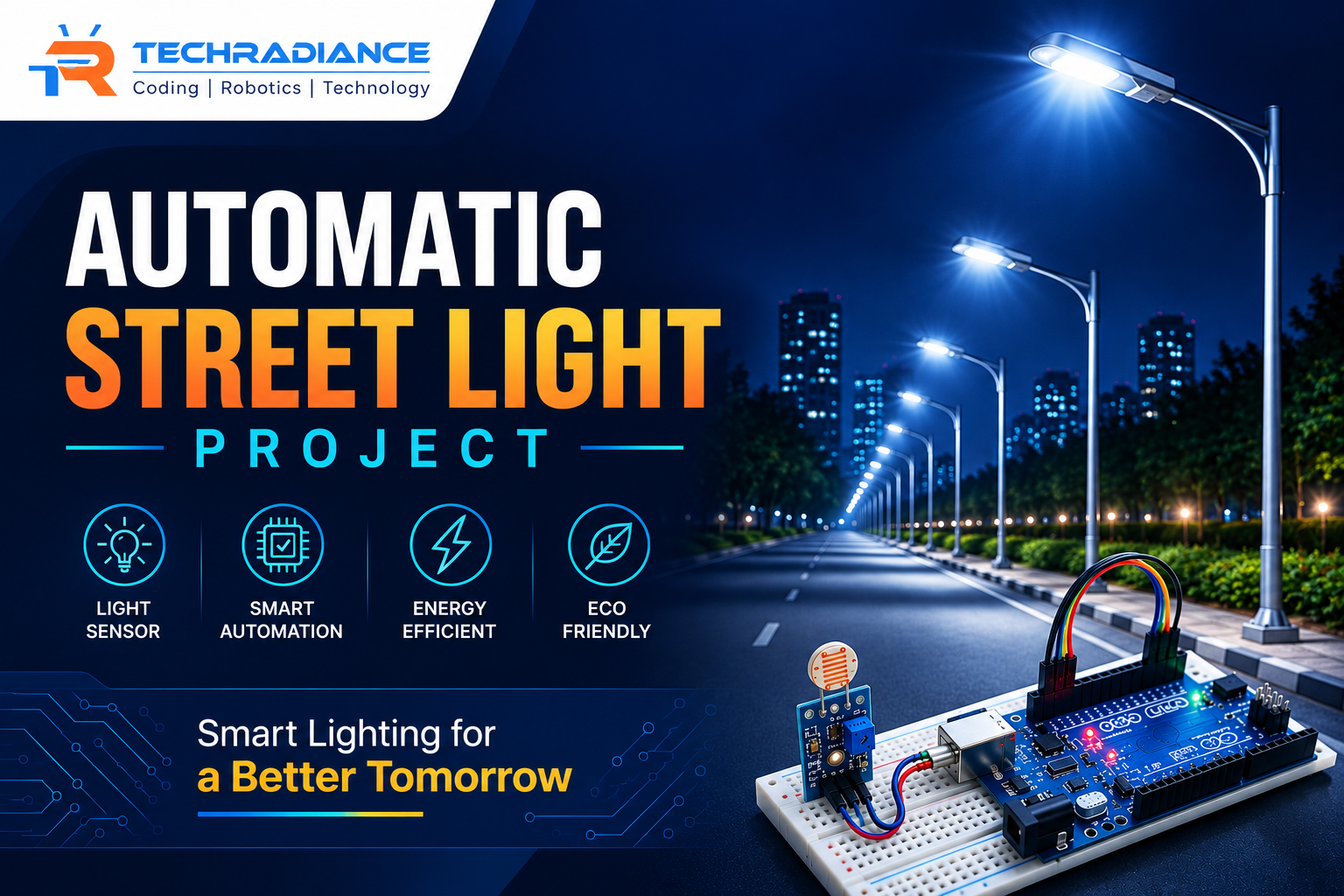
Ever wondered why street lights are turned off by themselves once it gets dark? And then stop automatically when the sun is up? There is no need to spend each night flipping switches to turn on many streetlights! This is due to an easy and clever idea known as ‘the Automatic Street Light Project’.
In this blog, we’ll describe everything in simple terms. Even if you’re a student, a hobbyist, or someone who likes building things, you’ll be able to comprehend the project in a snap. In the end, you’ll be able to understand exactly what it’s about and how it operates, what it can do, and how to create your own Automated Street Light Model at your home. Let’s get started!
Author: Himanshu ( Content Writer)
What is an Automatic Street Light Project?
An Automatic Street Light Project is a basic electronic circuit that turns on street lights at night when it is dark (like at night) and switches them off immediately when it is light (like at dawn).
Instead of turning the lights off and on each day, a tiny sensor can do the job. This sensor can detect dark and light and regulates the street light according to the amount of light or darkness outside.
It’s among the most well-known beginner-friendly projects that are taught in colleges and schools because it’s easy, practical, and imparts real-world science in a fun and engaging way.
Why Do We Need an Automated Street Lighting System?
Let’s consider it simply. In many cities, street lights are turned on manually by a human. This can cause several problems:
- Sometimes lights are switched on too early and waste energy.
- Sometimes, lights turn off, and roads are in darkness, which can be dangerous.
- A person needs to be reminded to perform this task every day.
The Automated Street Lighting System can solve all of these issues. It responds to lighting on its own, which means there’s no chance of making a mistake or forgetting. This helps save electricity and the environment and makes roads safe during nighttime.
How Does an Automatic Street Light System Work?
This is where the fun begins! We’ll break this down in easy steps.
- Sensing light: A tiny component known as an LDR (Light Dependent Resistor) is employed. This is the main focus of the work.
- Testing brightness: In the daylight, light falls onto the LDR. This signals the circuit to say, “It’s light outside, so keep the light off.”
- The detection of darkness: When the sun sinks, there’s less light in the LDR. The circuit can say, “It’s getting dark; make the light ON.”
- Switching the light on: The circuit uses either a transistor or a tiny switch (called a relay) to turn the LED or bulb either on or off according to the signal from the LDR.
That’s it! There are no buttons, there are no timers, and there are no manual tasks. All you need is light and darkness to control everything automatically.
What is an Automatic Street Light Using LDR?
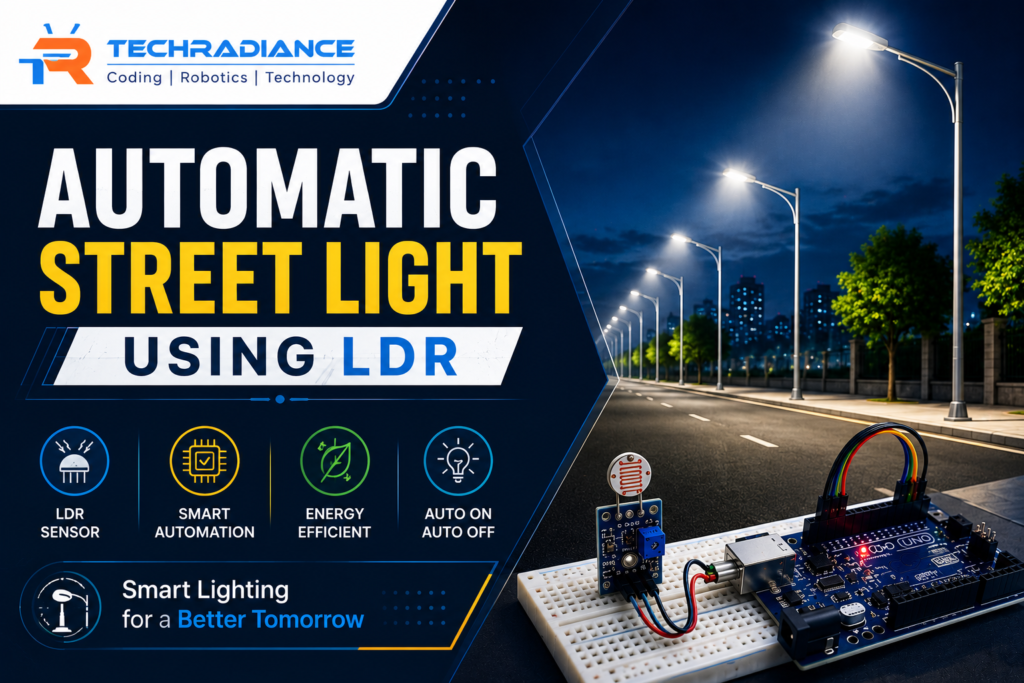
You may be asking, ‘What exactly is an LDR? ‘Automatic Street Light Using LDR is simply a way of saying that the entire project relies on one tiny component to monitor light levels.
An LDR appears like a small circular disc that has a wavy pattern. Its distinctive feature is its resistance changes as light passes through it:
- In bright light, its resistance decreases, and it flows smoothly while the light remains off.
- In darkness, the resistance rises, which means the flow of current changes and the circuit is then prompted to switch on the light.
This is the reason why the LDR will be considered the top vital component of any automated streetlight model.
What Materials Do You Need to Build This Project?
This project is for beginners and doesn’t require many components! This is what you’ll need
- LDR (Light-Dependent Resistor)
- The transistor (like BC547)
- A resistor
- An LED or a tiny bulb (to serve as a street light)
- A 9V-powered battery, or a power source
- A breadboard and the connecting wires
It is possible to locate the parts in any electronics shop or purchase them on the internet. The price is generally extremely low, which makes it ideal for students and enthusiasts.
How to Build Your Own Automatic Street Light Model (Step-by-Step)
Here’s a basic guideline to follow
- Install the breadboard: Place all your components to make wiring simple.
- Connect the LDR and resistor: Join the LDR with the resistor. Join them together to create what is known as a voltage divider. This allows you to detect the changes in the light.
- The transistor is connected: The transistor acts as a switch, which switches the LED on or off depending on the signals generated by the LDR.
- Connect to the LED (street light): Connect it to the output of the transistor.
- Connect the circuit: Connect your battery, and it’s done!
- Check it out: Cover the LDR by using your hands (to cause darkness) and then watch the LED come on. Remove the cover and the LED will shut off.
Congratulations! You’ve built your own automated street lighting system!
Benefits of an Automatic Street Light Project
Let’s discuss why this project is extremely useful in the real world. These are the most important advantages of automatic street light systems:
- Reduces power consumption: Lights only turn on when they are needed, reducing energy consumption.
- Reduces costs: Lower electricity bills for communities and cities.
- No manual work required: No person has to turn the lights on or off throughout the day.
- More safety on the road: Lights turn on at the exact moment it begins to get dark, making sure that roads and pathways are secure.
- eco-friendly A lower energy consumption results in a lower impact on the environment.
- Durable: Since lights aren’t used a lot, LEDs and bulbs tend to last longer.
- Excellent learning tool: It helps students understand the concepts of sensors and electronics, as well as automation, in a fun, hands-on manner.
This is precisely why cities across the globe are moving towards intelligent automated lighting systems rather than traditional ones.
Real-Life Applications of Automatic Street Light Systems
This project isn’t just for school-based demonstrations; it also has practical applications, like:
- Street lighting in cities as well as villages
- Park and garden lighting
- Parking lot lighting
- Highway lighting systems
- Smart home outdoor lights
As cities get “smarter”, automated lighting is now an aspect of our everyday infrastructure.
Tips for Beginners
If you’re trying this idea for the first time, make sure you keep these suggestions in mind:
- Check your wiring thoroughly before switching on the power to ensure that there is no damage.
- Test your LDR independently first to verify that it’s operating correctly.
- Start with an LED before switching to larger bulbs, because LEDs are more secure and more manageable.
- Do not be worried if it does not perform on the first go. This is normal for newbies! Simply recheck your connections.
What Our Learners Say (Testimonials)
Here’s what the students and enthusiasts who worked on this project with the guidance of Techradiance have to say about it:
“I constructed my first automated street light model using Techradiance’s help, which actually performed the first attempt! The explanation was so easy that my little sister could understand it.” — Ananya R., Class 10 Student
“As a beginner in electronics, I was apprehensive that the project might be difficult. However, Techradiance broke it down step-by-step, and now I can understand how an automatic street lighting system operates.” — Rahul M., Engineering Student
“This was our science school exhibit. Thanks to Techradiance’s straightforward instructions, our street light made with LDR is a big success! The teachers were very impressed.” — Sneha K., Parent of a Class 8 Student
Final Thoughts
This Automatic Street Light Project is among the top beginner projects that allow you to get familiar with the real-world applications of electronics in a fun and easy manner. It shows the basics of how sensors, transistors, and other circuits can be used in conjunction to tackle everyday issues – for example, conserving electricity and ensuring that streets are safe in the dark.
You may be a student working on a project in science or just someone interested in electronics; making your own Automated Street Light Model is an excellent method to transform your learning into an exciting and hands-on experience.
If you liked this guide and would like to learn more beginner-friendly project suggestions, explanations, or kits, Techradiance is here to help you master electronics in a simple method, one step at each step!
Frequently Asked Questions
1. What is the automatic street light project?
An automatic street lighting system is a tiny circuit that switches street lights on at night and turns them off in the daytime, with no assistance from humans. It relies on a light detector (LDR) to sense the darkness and the light.
2. How to make a Smart Street Light?
To create an intelligent street light, join an LDR sensor and a transistor, as well as a relay and an LED bulb, to the circuit board. When the LDR detects darkness, it tells the transistor to turn the relay on, which then turns on the LED on its own.
3. What are the materials of an automatic street light?
The fundamental materials are the LDR (Light Dependent Resistor), a transistor (like BC547), a resistor, a relay, and LEDs or bulbs, as well as a battery or power supply and a breadboard or PCB that connects all of it.
4. Which sensor is used in an automatic street light?
An LDR (Light Dependent Resistor) is the principal sensor that is used in an automatic street light. It senses darkness and sunlight and helps the circuit determine when to turn the light on or off.
5. How does a street light turn on automatically?
As it gets darker, the resistance of the LDR increases, and the signal is sent to the transistor. The transistor is then activated by it, which then activates the relay. It turns on the street light and all without touching the switch.
6. What is the price of a sensor street light?
A basic street light sensor that incorporates an LDR typically costs between Rs150 and Rs500, depending on the quality of the sensor, the bulb’s type, and other elements used.