
How to Set Up a Robotics Lab in a CBSE School
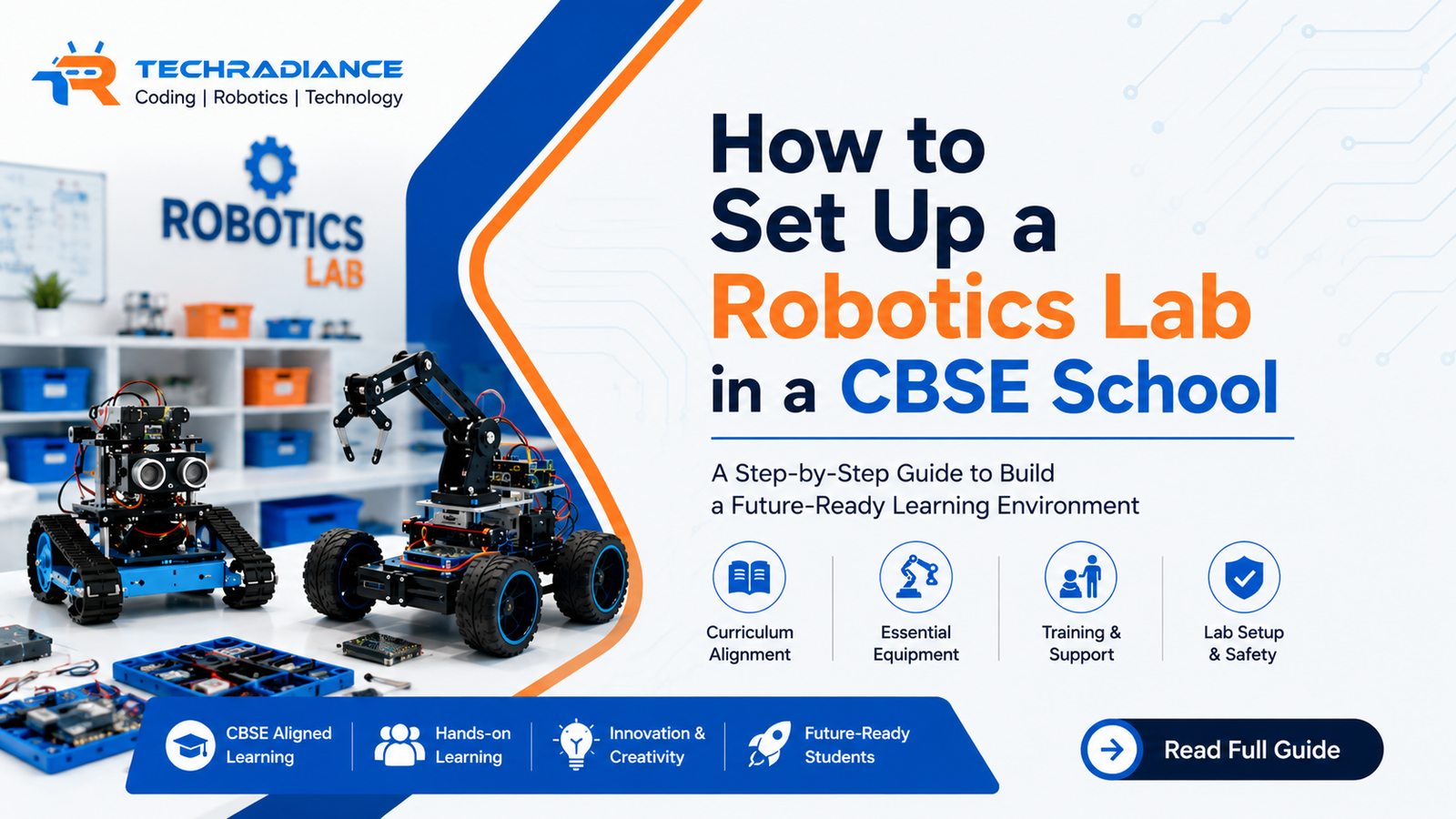
The best method to set up a Robotics Lab in a CBSE School is to begin with clear learning objectives and then select the appropriate robotics kit, design an appropriate space, educate teachers, and follow all the CBSE skill education guidelines and NEP 2020 standards. A well-designed robotics lab can help students to learn about coding robots, robotics (AI), electronic devices, and problem-solving using hands-on activities.
The world of education is changing rapidly. Schools are moving away from textbooks and encourage students to learn through doing. The CBSE Robotics Lab provides students with the opportunity to create robots, write basic programs, test their ideas, and increase their creative thinking. Instead of just reading about technology and science, students are able to experience them in their own lives. This type of learning is what makes classes more exciting and aids students in understanding concepts better.
When you’re considering establishing a brand-new Robotics Lab for schools or upgrading your existing STEM facilities, meticulous planning is crucial. In this guide, you’ll learn everything from budgeting and selecting the right robotics equipment to developing an educational curriculum and training teachers. Techradiance is a leader in robotics education. Techradiance has helped numerous schools to create futuristic robotics labs that inspire creativity and prepare their students for future career opportunities.
Author: Himanshu ( Content writer
What Is a Robotics Lab in a CBSE School?
Robotics Labs are a unique learning space in which students build, design, and program robots, studying science, technology, engineering, and mathematics (STEM). Instead of merely learning theories, students are able to apply their understanding by working on real-world projects and solving problems that arise in everyday life.
The modern CBSE Robotics Lab incorporates robotics tools including coding software, sensors, motors, electronic components, and computers to create an engaging learning environment. Students are free to experiment and make mistakes and gain self-confidence while working on thrilling projects.
In contrast to a typical computer lab, a robotics lab is one that encourages cooperation, creativity, thinking, and ingenuity. Students don’t just write code but also experience how their programs operate on real machines. This makes learning fun and useful.
What Students Learn in a Robotics Lab
Students develop many important skills, including:
- Basic programming and coding
- The design of robotics and their assembly
- Sensors and electronics
- Artificial Intelligence (AI) basics
- Automation concepts
- Logical thinking
- Critical thinking
- Collaboration between teams
- Communication skills
- Innovative problem-solving
These skills aid students in performing better academically and prepare students for their future career opportunities in technology.
Why Robotics Learning Is Different
Robotics blends various subjects into one task. For instance, when making a robot, the students will use the following:
- Science for understanding the relationship between electricity and sensors.
- Mathematical calculations to calculate measurements and movement.
- Engineering is used to construct robust robot structures.
- Coding is used to control robots’ actions.
This blended learning method helps students to understand how the knowledge they learn in class can be applied in real-world situations.
Why Every CBSE School Should Have a Robotics Lab
Technology is becoming an integral part of nearly every field. From agriculture and health care to space and manufacturing, robots and automation are revolutionising the way that people work. Schools that teach robotics from the beginning will help students gain confidence in using technology.
A Robotics Lab for Schools provides a stimulating atmosphere where learning is interactive instead of passive. Students take part, play, ask questions, and find answers on their own.
Benefits for Students
A robotics lab helps students:
- Enhance the ability to think logically
- Create a sense of creativity
- Develop teamwork
- Develop coding skills
- Know the engineering concepts
- Develop confidence as problem solvers
- Get ready for a future career
- Learn through hands-on, interactive activities
Students also learn a crucial principle: failing is an integral part of learning. If a robot fails in the beginning, then they pinpoint the problem, improve and attempt to do it again. This helps build resiliency and perseverance
Benefits for Schools
Schools also have several benefits:
- Improvement in learning outcomes
- Better student engagement
- Modern learning environment for students
- Stronger STEM education
- The confidence of parents has grown
- A better appeal to admission
- Affiliation with national educational goals
Many parents are now looking for schools that provide technology-based education. The presence of a robotics lab shows schools are preparing children for the 21st century, rather than just focusing on traditional methods of teaching.
Building Future-Ready Students
The jobs of the future will require skills like programming, AI, automation, data analysis, and innovative problem-solving. Beginning robotics early gives students a solid foundation and helps them adapt to new technologies with confidence.
How Robotics Labs Support NEP 2020 and CBSE Skill Education
The Indian education system is shifting toward practical and skills-based learning. The CBSE Skill Education framework, as well as the National Education Policy (NEP) 2020, call for schools to aid students in developing practical skills rather than simply relying on their memory.
A robotics laboratory is a perfect fit with these goals since it allows students to gain knowledge through experimentation, exploration, and collaboration.
Learning by Doing
One of the main objectives for NEP 2020 is to promote the concept of experiential learning. Instead of just studying about science or technology, students build projects, evaluate, and then improve their projects.
For example, students might:
- Create a smart traffic light
- Design an automatic door.
- Create an automatic line-following robot that follows lines
- Design a smart irrigation system
- Create a robot that can avoid obstacles
This makes learning fun and easy to remember.
Supporting Project-Based Learning
Project-Based Learning is a powerful teaching technique that allows students to solve real-world problems using hands-on activities.
The robotics industry naturally supports this idea since every task involves:
- Planning
- Designing
- Building
- Coding
- Testing
- Improving
- Presenting the final version of the project
- This helps students comprehend concepts in depth while increasing teamwork and communication
Preparing Students for the Future
Through education in robotics, students are exposed to technology, such as:
- Artificial Intelligence
- Machine Learning basics
- Internet of Things (IoT)
- Automation
- Systems embedded in the system
- Smart devices
These technologies are becoming increasingly significant across different industries, making robotics education an investment for schools.
Step-by-Step Guide to Setting Up a Robotics Lab
The process of setting up an effective school Robotics Lab Setup requires a meticulous plan. A well-organised laboratory will ensure that the students are happy while teachers are able to conduct their activities efficiently.
Follow these easy steps to set up a successful robotics lab.
Step 1: Define Your Learning Goals
Before buying equipment, determine what the students need to learn.
Ask questions like:
- Which classes will utilize the lab?
- Are robotics included in the normal course or an extracurricular one?
- What are the skills that students should develop throughout the year?
- Which students utilize the lab on a daily basis?
A clear goal helps schools make better choices about the equipment as well as curriculum and budget.
Step 2: Understand Student Requirements
Different age groups require different teaching materials.
For instance:
- Classes 3 and 5 can start with coding using blocks and robotics kits for beginners.
- Classes 6-8 can study motors, sensors, as well as basic programming.
- Classes 9-12 may engage in AI, IoT, automation, Python programming, and advanced robotics projects.
Making use of tools that are appropriate for their age helps students stay engaged and assures the development of their skills over time.
Step 3: Plan Your Budget
A robotics laboratory should be a good fit with your school’s goals as well as its budget. Instead of purchasing all the equipment at once, schools can begin with basic equipment and slowly increase the amount of equipment as students’ participation increases.
Concentrate on durability, quality, and the support of your school rather than just buying the most expensive equipment.
Step 4: Select the Right Technology Partner
A trustworthy robot education provider can help make the whole setup process much simpler.
A reputable provider such as Techradiance does not just provide robotics kits, but also helps schools in the planning of curriculum and teacher training, installation support along with project guidance and continuous technical assistance. This will ensure that schools effectively implement robotics education, without putting themselves in a position to face unnecessary difficulties.
Step 5: Train Teachers Before Launch
Even the most advanced robotics labs require skilled instructors. Organise training sessions prior to the start of classes to help teachers become familiar with the tools and lesson plans, as well as the coding platforms and class activities.
If teachers are confident, students are able to learn more efficiently and also enjoy the experience.
Step 6: Encourage Innovation
When the lab is set, encourage students to take part in exhibitions, competitions, innovation fairs, and collaborative projects. These opportunities increase confidence as well as teamwork and creativity while also demonstrating the school’s dedication to a modern approach to education.
Key Takeaways
The process of setting up a robot lab is not just about buying computers and robots. It’s about creating an environment in which students can learn through enthusiasm, imagination, and experiences. Through a systematic method and aligning the curriculum with CBSE Skills Education, schools can create an educational space that is future-proof, fosters innovation, and ensures the long-term success of students.
Planning Your Robotics Lab Budget
The creation of a robotics lab is an investment for the future of your students. A budget that is well-planned can help schools to purchase the appropriate equipment without investing more than they need to. Instead of purchasing all the equipment at once, schools should start with the essentials and then enhance the lab as students start using it.
A successful school Robotics Lab Setup should be focused on safety, quality and learning outcomes more than focusing on the most affordable items. Investing in durable robotics equipment and reliable equipment can cut down on the cost of maintenance and gives an improved learning experience.
Factors That Affect Your Budget
Each school’s budget differs. The cost of tuition is based on a variety of important aspects which include:
- Students using the laboratory
- The classes that will be participating (Grades 3-12)
- Required number of robotics kits
- Laptops or computers
- Furniture and classroom set-up
- Teacher program for teacher training
- Maintenance and technical support for the year.
- Resources for learning and curriculum
Preparing these expenses ahead of time helps schools to avoid costly expenses later on.
Budget Planning Tips
Make sure you follow these easy steps when making your robot lab plan:
- Begin with the essential equipment, and increase the capacity gradually.
- Select robotics equipment that supports different levels of learning.
- Set aside a budget for teacher education.
- Save money to pay for maintenance and repair parts.
- Choose products that come with a warranty and technical assistance.
A reputable education partner such as Techradiance can assist schools in designing an appropriate robotics lab that meets the educational goals of their students and budget without sacrificing quality.
Choosing the Right Space and Classroom Layout
A learning space plays an essential role in education for robotics. Students require space in which to construct robots, evaluate projects, and collaborate at ease.
A well-designed classroom promotes collaboration and creativity and allows for practical learning.
Characteristics of a Good Robotics Lab
A robotics class should include as follows:
- Bright and well-ventilated
- Easy to watch and safe
- Large enough to accommodate group activities
- With the correct electrical connections
- Organized by storage cabinets
- The comfortable design is ideal for long-term learning sessions.
Maintaining a clean and well-organised space also allows students to locate equipment quickly and prevents damage to expensive parts.
Recommended Classroom Layout
A robotics lab typically includes various learning areas.
Learning Zone
Students participate in discussions, demonstrations, and coding classes.
Practical Workstations
Groups of robots are assembled to connect sensors and create programs.
Testing Area
Students test robots on a training track, obstacle courses, or in competition fields.
Storage Area
Cabinets and shelves are separated and used to keep robotics equipment, tools, batteries, as well as spare parts organized and safe.
Classroom Design Tips
To increase the quality of education, schools should:
- Set up tables to facilitate learning.
- Make sure you have sufficient charging points.
- Use movable furniture for flexibility.
- Show robotics models and students’ projects.
- Make sure that emergency exits are free of obstructions.
- Make sure you have the proper lighting for your work.
A relaxing classroom inspires students to spend more time exploring and learning.
Essential Robotics Lab Equipment for Schools
Selecting the appropriate equipment is among the most crucial steps to take in the process of designing the Robotics Lab for Schools. Schools should buy tools that are appropriate for the students’ ages as well as their curriculum and the learning objectives.
Instead of buying expensive equipment right away, start with the basics of learning tools before gradually introducing more sophisticated technology as students become more confident.
Basic Equipment Every Robotics Lab Should Have
A fully equipped robotics laboratory typically comprises the following:
Robotics Kits
They are the primary tools for learning that enable students to build, design, and program robotics.
Computers or Laptops
Students utilise computers to code and program, as well as for simulations and testing.
Microcontroller Boards
Popular development boards assist students in learning about electronics and programming as they build real-world projects.
Sensors
Students can play with various types of sensors, like:
- Ultrasonic sensors
- Sensors for IR
- Light sensors
- Sensors for temperature
- Motion sensors
- These assist robots in interacting with their environment.
Motors
Different motors help students learn how robots operate and carry out tasks.
Common choices can include:
- DC motors
- Motors with Servos
- Stepper motors
Batteries and Power Supplies
The reliability of power sources guarantees uninterrupted sessions of practical use.
Electronic Components
Students must also have access to:
- Breadboards
- LEDs
- Resistors
- Jumper wires
- Switches
- Buzzers
- Connecting cables
These tools help students learn the basics of electronics prior to creating advanced robotics-related projects.
Hand Tools
Simple tools help with installation and repair.
Examples include:
- Screwdrivers
- Wire cutters
- Pliers
- Cable organizers
Optional Advanced Equipment
As students get more familiar and gain experience, schools may offer:
- Artificial Intelligence-based learning modules
- Internet of Things (IoT) devices
- Vision cameras
- Smart sensors
- 3D printers
- Laser cutters
- Drone development kits
The introduction of modern equipment makes learning engaging and futuristic.
What Schools Say About Techradiance
⭐⭐⭐⭐⭐
“A Complete Robotics Lab Solution for Our School”
“We joined forces with Techradiance to establish a CBSE Robotics Lab, and the whole process was easy and well-organized. From establishing the lab, to training for teachers and students workshops, their team was there to support us through every step. Our students are more enthusiastic about robotics, coding and STEM than they ever have been.”
— Rajesh Sharma, Principal, Delhi
⭐⭐⭐⭐⭐
“Students Love Learning Through Hands-On Projects”
“The Robotics Lab for Schools offered by Techradiance has revolutionized how our students learn. They love building robots, tackling real-world challenges and collaborating in imaginative projects. The program is simple to follow and perfect to different grades.”
— Neha Verma, STEM Coordinator, Jaipur
⭐⭐⭐⭐⭐
“Professional Staff with Outstanding Teaching Training”
“We needed a reliable partner for the school robotics lab setup and Techradiance has exceeded our expectations. The robotics equipment they offer is top quality, and the instructor training sessions gave our instructors the confidence to teach hands-on robotics classes on their own.”
— Anil Kumar, School Director, Lucknow
⭐⭐⭐⭐⭐
“The Best Investment for Future-Ready Education”
“Adding the robotics lab is among the best decisions we made for our school. Students are learning to code, AI, and problem-solving abilities through fun activities. Techradiance is a credit to Techradiance for providing comprehensive assistance, technical assistance, and a great robotics education experience.”
— Priya Mehta, Academic Head, Pune
Final Thoughts
The process of setting up a robotics lab is not just about adding the latest technology to schools. It’s about creating an educational environment that allows students to explore concepts, tackle real-world issues, and acquire abilities that will benefit their future. A carefully planned CBSE Robotics Lab fosters curiosity, imagination, as well as teamwork and confidence by providing students with hands-on learning opportunities.
An effective Robotics Lab for Schools is a matter of planning. Schools must select the best space, invest in appropriate robotics kits, educate teachers, and create an educational program that is suited to the students’ levels of learning. If they follow a well-planned school Robotics Lab Setup process, schools can set up an environment where students are excited to learn about programming, science, artificial intelligence, and robotics in a real-world manner.
Education continues to change initiatives such as CBSE Skills Education as well as the National Education Policy (NEP) 2020, as well as project-based learning, encourage schools to concentrate on practical knowledge in addition to academic excellence. Robotics education is a way to achieve these objectives by encouraging students to think critically, collaborate, and create creative solutions to everyday problems.
No matter if your school is launching its first robotics lab or expanding an existing STEM facility, selecting the right partner for your technology will make the process more enjoyable. Techradiance is a partner in Techradiance we assist schools to develop future-proof robotics labs by providing quality equipment, well-planned education support, teacher training, as well as ongoing technical support. Our mission is to make education in robotics easy, enjoyable, and accessible to all students.
In making investments in robotics education now, schools aren’t just increasing the quality of their education but also equipping students with the knowledge they’ll need to compete in the future’s technologically driven society.
Frequently Asked Questions (FAQs)
1. What is a CBSE Robotics Lab?
The CBSE Robotics Lab is a learning center where students design, program, and build robots while studying programming, electronics, intelligence (AI), and STEM concepts. It encourages hands-on learning and assists students in developing problem-solving, creative, and teamwork skills.
2. Why should a CBSE school set up a robotics lab?
A robotics laboratory helps students develop their skills through hands-on activities rather than just studying textbooks. It enhances logical thinking, creative thinking, coding skills, and ingenuity while aiding CBSE Skills Education as well as the objectives that are part of the National Education Policy (NEP) 2020.
3. How do I set up a Robotics Lab in a CBSE school?
In order to set up an effective school Robotics Lab Setup, schools must establish learning objectives as well as plan their budget. Pick a suitable space and purchase appropriate robotics equipment for their age, create a planned curriculum, educate teachers, and provide frequent activities for students to learn.
4. What equipment is required for a Robotics Lab for Schools?
The Robotics Lab for Schools typically includes robotics kits, laptops or computers with microcontroller boards, sensors, batteries, motors, electronic components, coding software, storage cabinets, and tools. Advanced labs could also contain AI, IoT, and 3D printing devices.
5. How does a robotics lab support NEP 2020?
NEP 2020 promotes experiential and skills-based learning. A robotics lab enables students to gain knowledge by conceiving projects, building, testing and improving their projects to make learning more relevant, enjoyable and relevant to the future.